







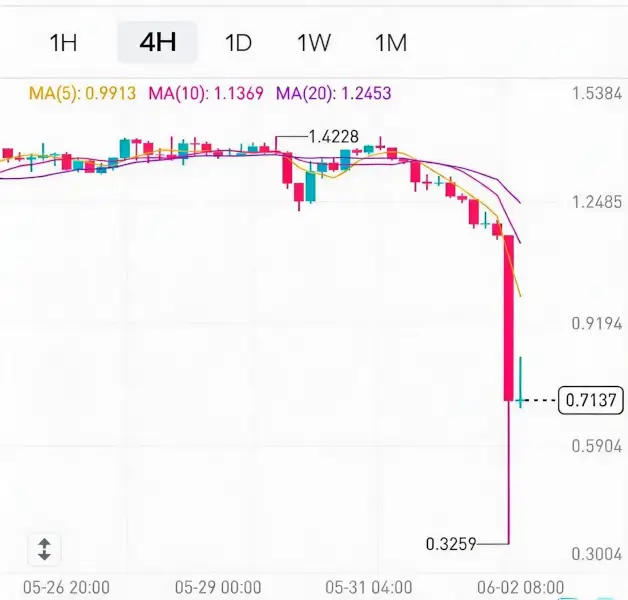
Around 4:00 AM on June 2nd, the native token EDGE of edgeX experienced a violent and abnormal fluctuation. The price plummeted over 77% from around $1.14 in a short period, hitting a low of $0.32 before rebounding to approximately $0.64, with a market cap of about $250 million.
edgeX responded immediately, explicitly ruling out a hacker attack or platform security vulnerability, and instead pointing the finger at “market manipulation deliberately carried out by a specific external entity.”
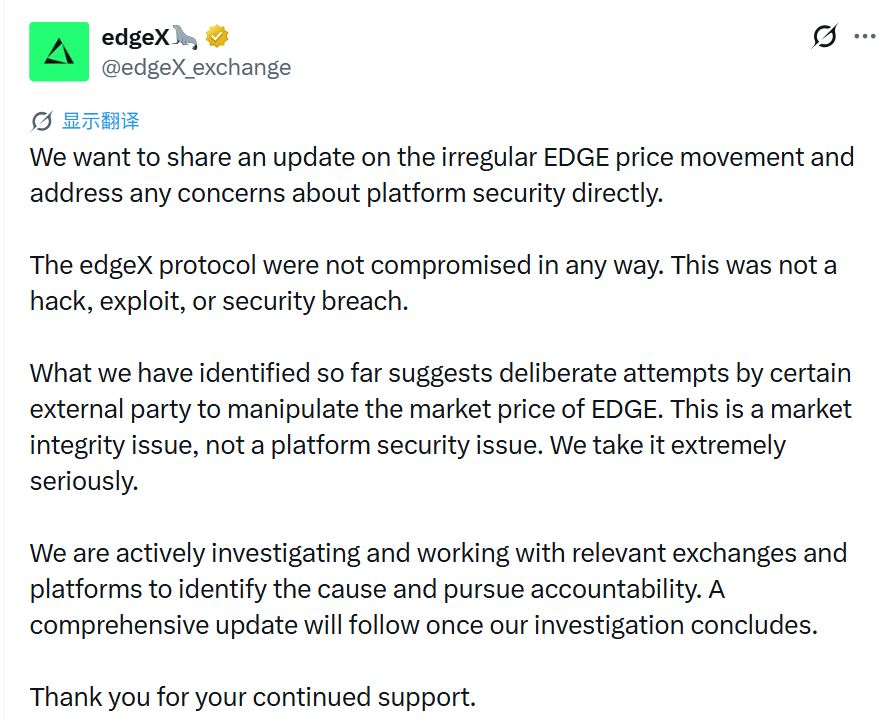
edgeX stated that its protocol was not breached and there was no hacker attack or security vulnerability. The abnormal price movement is suspected to be market manipulation deliberately implemented by a specific external entity, constituting a market issue rather than a platform security problem. The team is currently actively investigating and cooperating with relevant exchanges and platforms to trace the responsible parties. A complete investigation report will be released after the investigation concludes.
edgeX emphasized that core contracts like SpotVault are operating normally with no suspicious activity detected, further focusing the issue on external market behavior rather than the protocol itself.
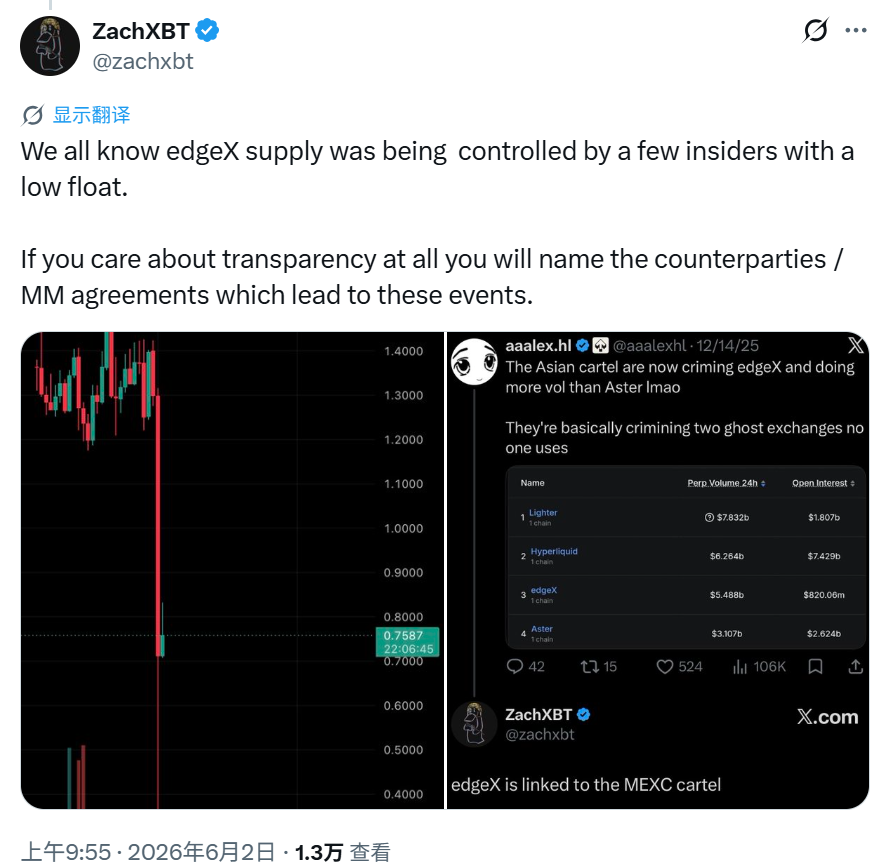
On-chain detective ZachXBT commented on the incident, noting that EDGE’s supply has long been controlled by a small group of insiders with low circulating supply, and called on the project team to disclose market makers and counterparty information to enhance transparency.
As the incident unfolded, many users directly linked this volatility to the project’s past operations, expressing disappointment in the team’s integrity. One community member stated bluntly: “No one is even discussing EDGE’s crash anymore. This project team lacks credibility and keeps going back on their word. There’s really little desire to buy the dip.”
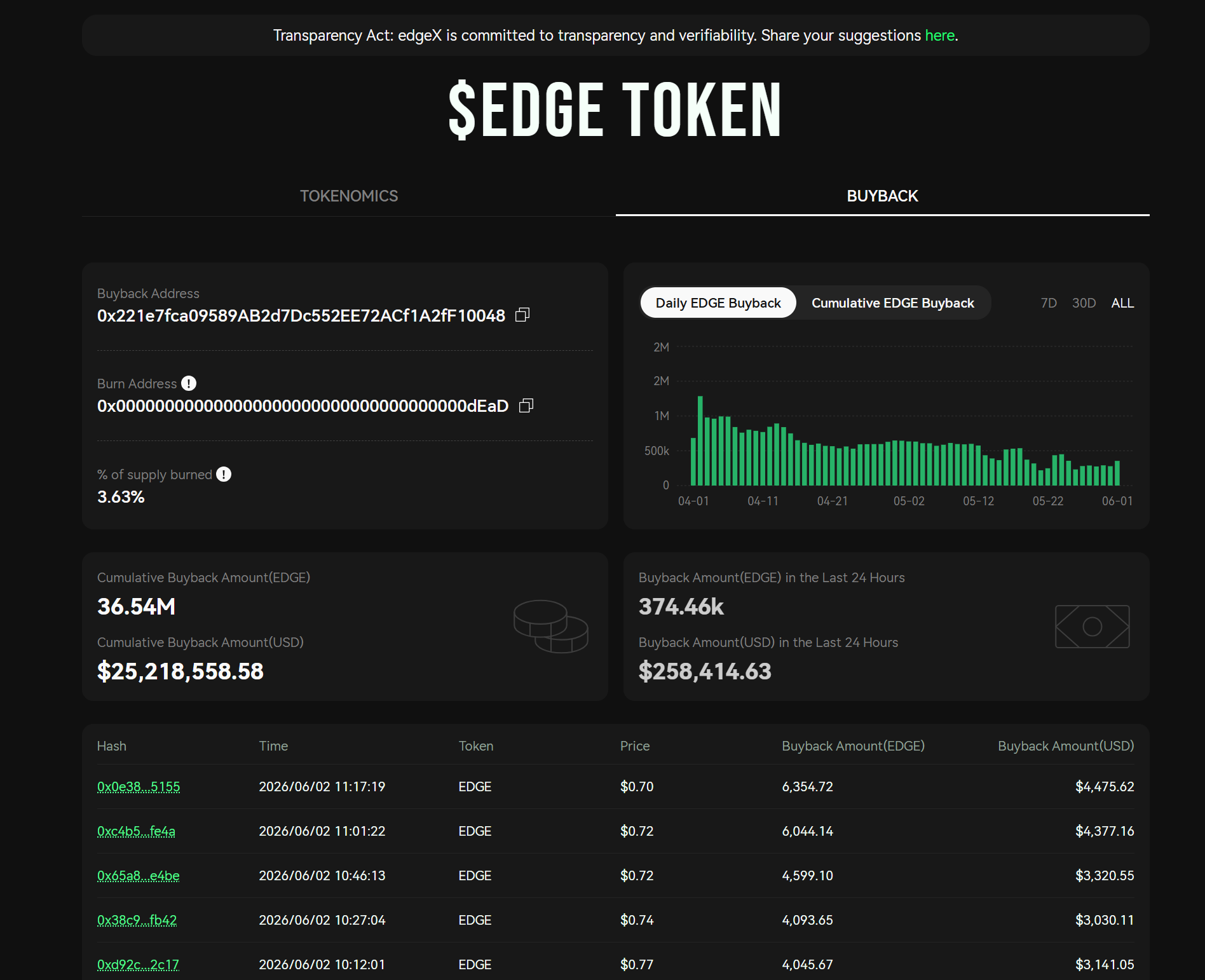
Since edgeX’s TGE, the token price surged from $0.7 to $1.5, and later fluctuated around $1.4. Additionally, the official team launched a dedicated token website to self-prove transparency. At the end of May this year, the protocol upgraded to V2 and adjusted its tokenomics so that all profits are used to repurchase EDGE. According to its official website data, approximately 36.54 million tokens have been repurchased so far, with a total value of about $25 million.
Furthermore, relevant information shows that the protocol received investment from Circle Ventures and Amber Group, though the specific amounts were not disclosed.
Past エアドロップ Controversy Set the Stage for the Subsequent Crash
This incident can hardly be separated from the context of edgeX’s previous airdrop controversy. In April 2026, the author detailed the entire process of community dissatisfaction triggered by the TGE in an article titled “The Inside Story of the edgeX Airdrop Debacle: A Carefully Crafted Harvest?“. The project promised the community a 25% token share, but the actual allocation to regular traders was only about 4%, while approximately 14% (valued at roughly $94.6 million at the time) flowed to partner wallets. Arkham token flow charts show that at least 80 associated addresses were created in 2025 with consistent behavioral patterns: first small test transactions followed by large deposits, then concentrated withdrawals after TGE, involving approximately $90 million in token transfers, with some funds flowing to exchanges.
The core controversy lies in the opaque point-to-token conversion mechanism. Users reported massive disparities in conversion ratios for identical trading volumes. Furthermore, the deviation between estimated point values (pre-TGE market expectations of $30-$40 per point or higher FDV) and the actual airdrop received exceeded 80%. Early contributors and NFT holders also experienced cases of “the lowest allocation across the network.” Community members flooded the official Twitter account with complaints, causing the team to disable comments at one point.
Afterward, edgeX announced it would lock up the controversial 14% token allocation for one year and initiate a buyback, but refused the community’s demand to burn the tokens on Ethereum.
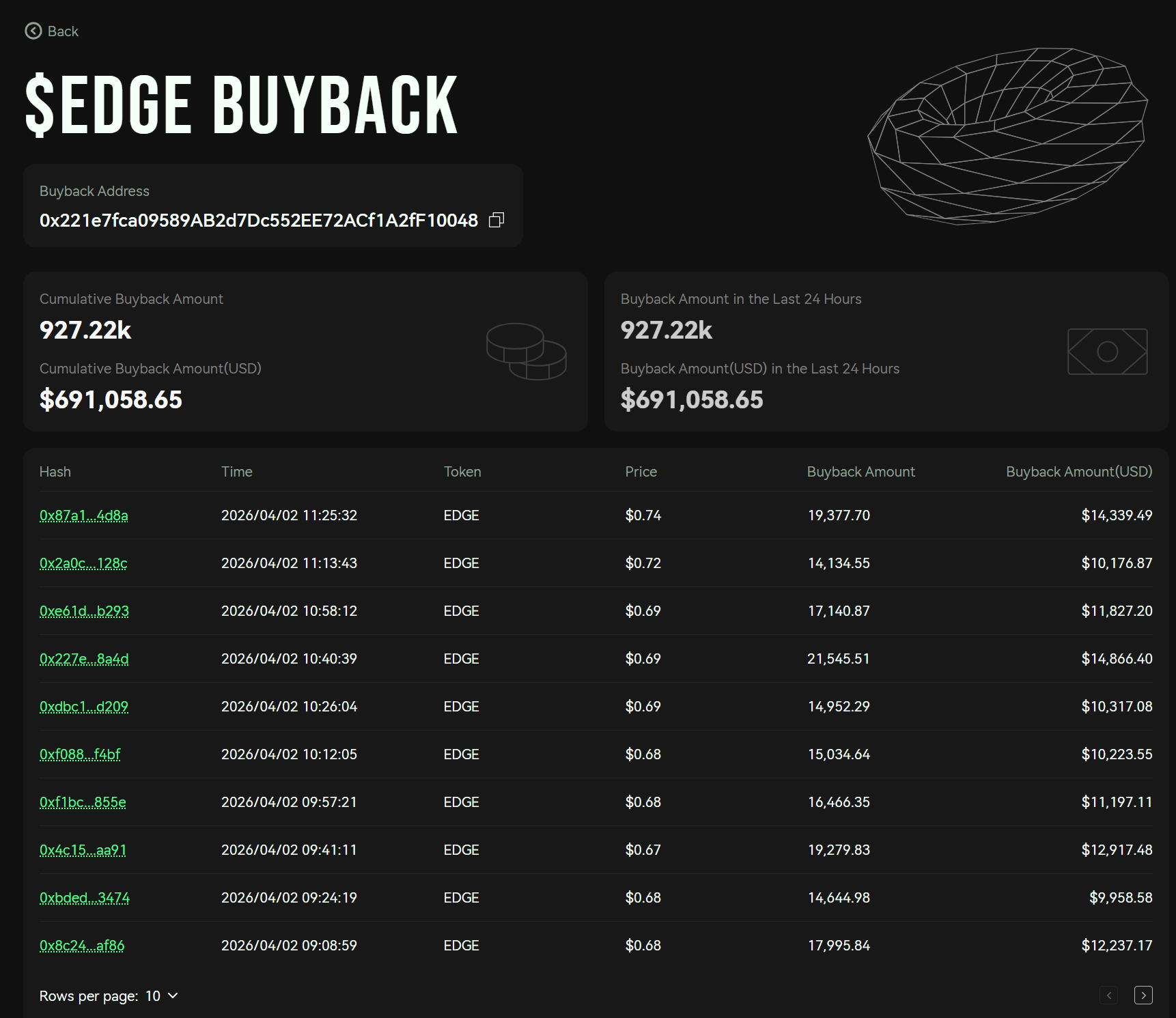
These unresolved issues directly paved the way for the current volatility: the concentration of tokens among a few addresses or affiliated parties makes it easier for external entities to influence prices through large-scale operations. Low circulating supply is not accidental but a natural consequence of early distribution and lock-up arrangements. When abnormal sell pressure hits the market, the lack of sufficient depth to buffer it makes a chain reaction highly likely.
Structural Risks and the Test of Transparency
edgeX once carved out a niche in the space with its trading speed, low slippage, and perpetual contract innovations. The project experienced staged appreciation post-TGE, with trading volume and fee revenue frequently ranking among the top in DeFi. According to the latest data from DefiLlama, the protocol generated $10.7 million in total fees over the past 30 days, with the perpetual DEX recording a trading volume of $42.765 billion over the last 30 days.
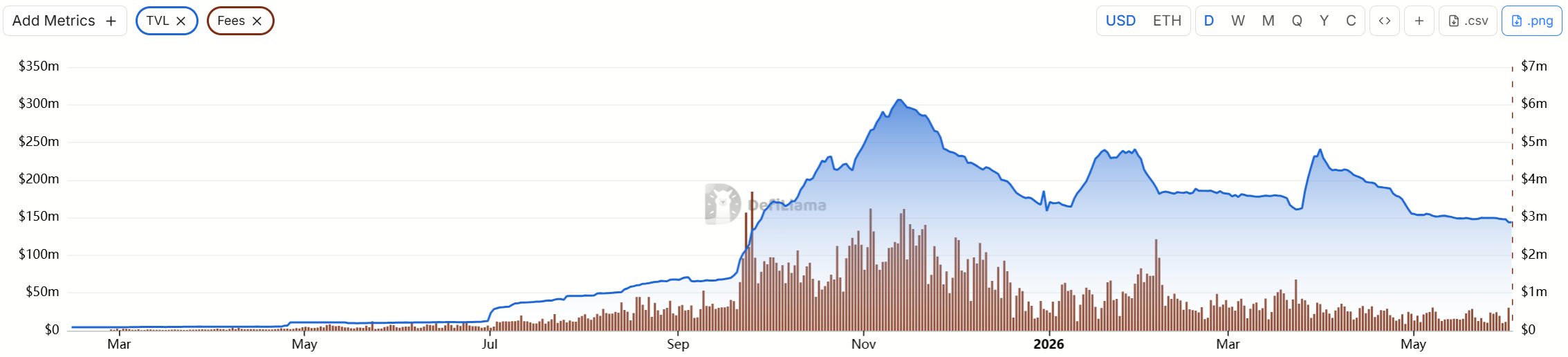
But from the airdrop distribution controversy to this latest price anomaly, this ‘low circulation + high control + opaque market making’ model has become a go-to ‘serial harvest scheme’ for new projects in the past couple of years. They preach community-first rhetoric while their wallets honestly dump tokens to affiliated parties; it’s just a single-player game disguised as DeFi.
Allegations of external manipulation are difficult to prove instantly, but the traceable abnormal on-chain transfers are enough to raise community alarms.
Ironically, even as it faces the turmoil of a price crash, a prediction market for EDGE’s token price has already quietly gone live on Polymarket.
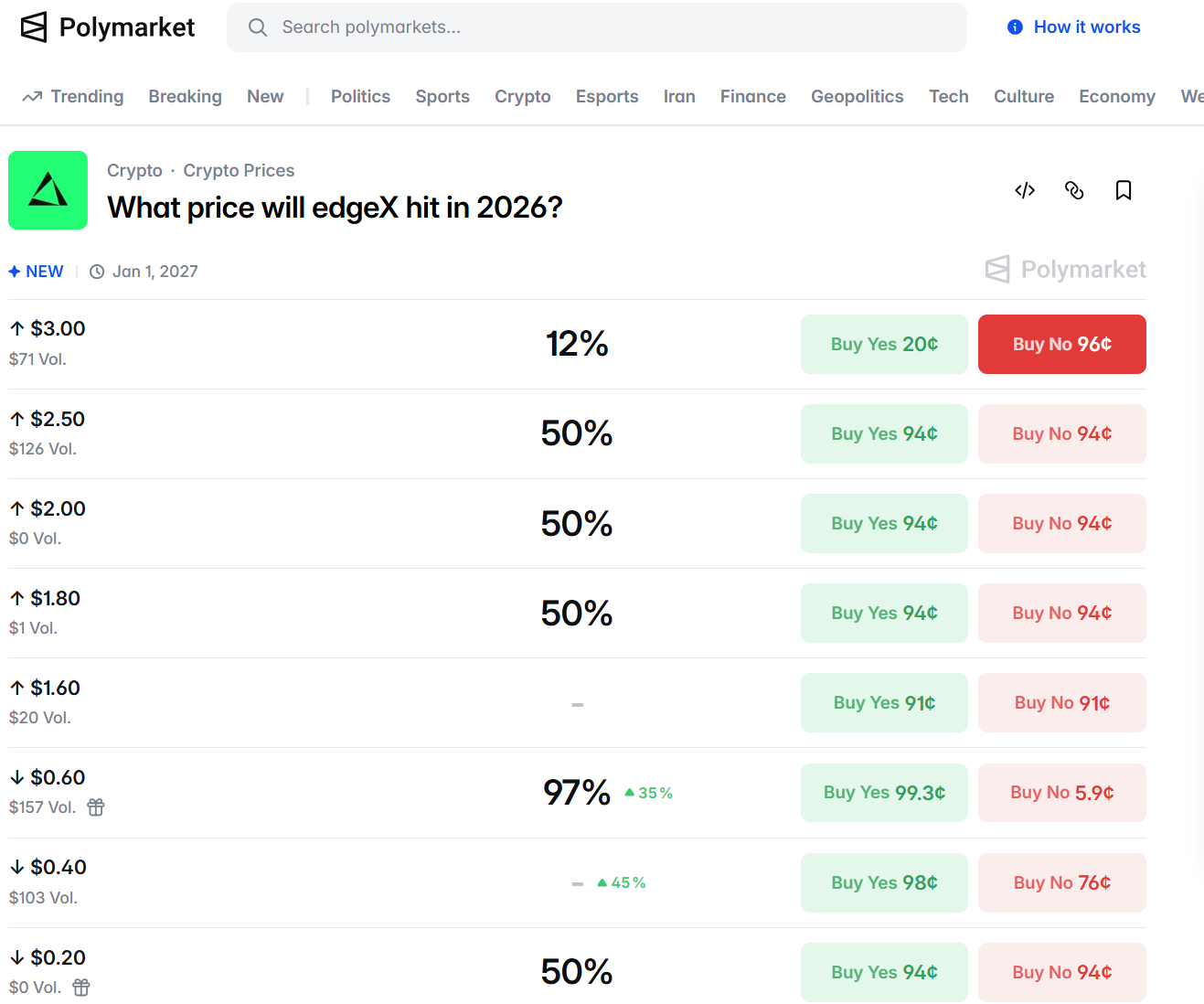
The project team is busy trying to prove their innocence, while trapped retail investors are angrily seeking justice. Meanwhile, on Polymarket, some users have already started betting on how much the token will rise or fall by the end of the year.
この記事はインターネットから得たものです。 EDGE crashes 77%: External manipulation or an inside job?
Related: AI Infrastructure Surged Throughout Q1; Who Can Sustain “High Valuations” in Q2?
Previously, MSX published an overview outlook titled “Soaring Oil Prices, Stubborn Rates, and the ‘Seven Sisters’ Stalling: Which Themes Should Drive Excess Returns in Q2 US Stocks?“, which systematically outlined the overall market themes for Q2. Delving deeper into this framework reveals that the Q1 AI rally in US stocks is far more complex than simply “whether the leading computing power stocks will rise.” From the perspective of MSX Research, it’s not just a few companies around GPUs that are rising, but the entire data center ecosystem: expanding facilities, increasing bandwidth, supplementing power supply, deploying liquid cooling, and pushing production capacity forward. Therefore, entering Q2, the main theme remains unchanged, but the market rhythm will shift. Networking, optics, storage, power, and equipment manufacturing are still on the main theme, but…
相关文章

































 日本語
日本語  English
  繁體中文
繁體中文  简体中文
简体中文  Tiếng Việt
  العربية
  한국어
한국어  Bahasa Indonesia
  हिन्दी
  اردو
اردو  Русский