







GameStop CEO sells socks to buy eBay: A $56 billion performance art piece
In the early hours of May 7th, GameStop CEO Ryan Cohen posted a screenshot on X.
eBay had sent him a notification that his account had been permanently suspended, citing “we believe this activity is putting the eBay community at risk.”
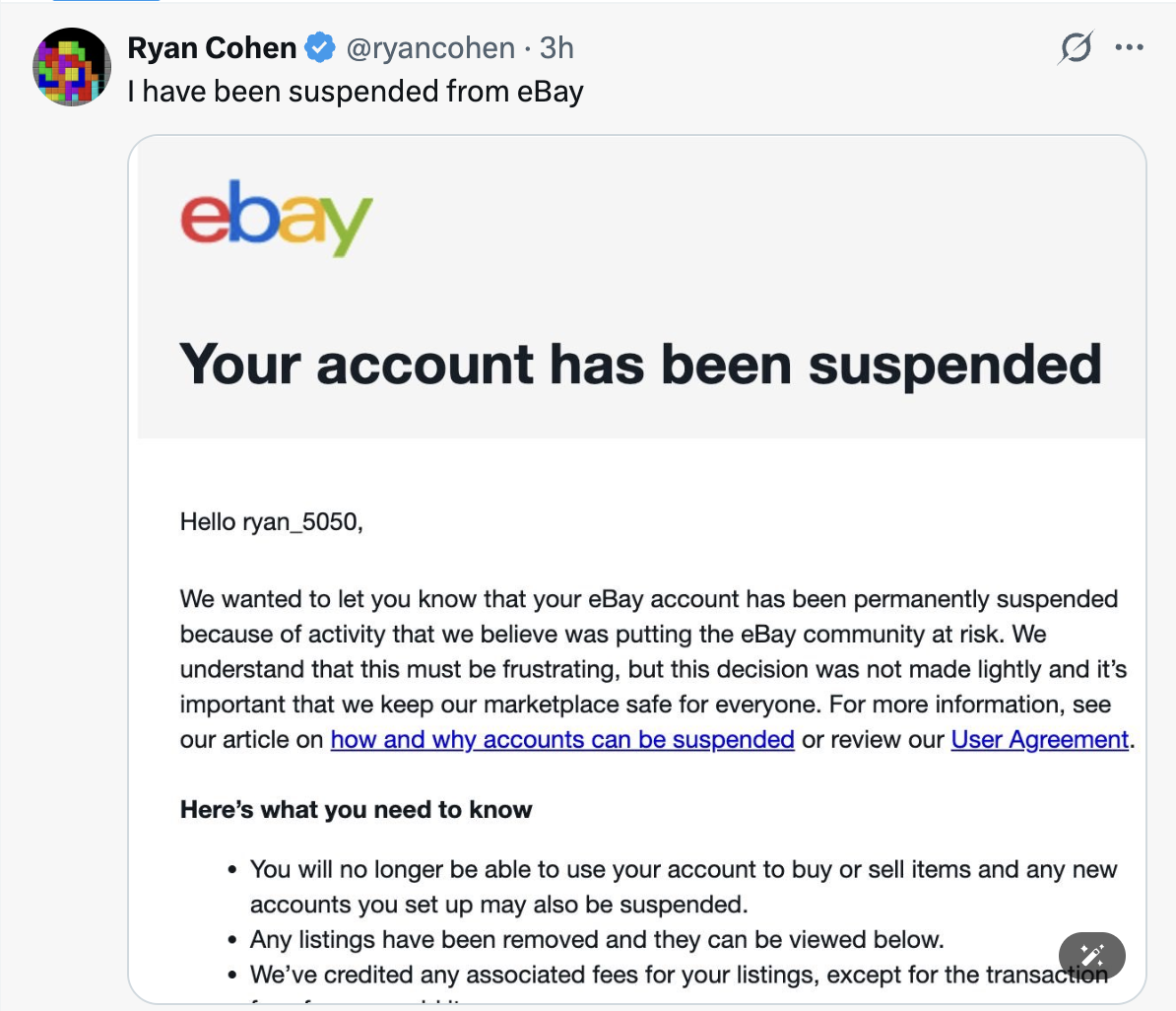
Just 24 hours earlier, he had listed a pair of socks on his personal eBay account with the caption: “Selling things on eBay to raise money to buy eBay.”
It sounds like a joke, but he was serious. Because just three days prior, he had thrown a $56 billion acquisition offer at eBay’s board.
A Flimsy Offer
On May 4th, GameStop announced a non-binding acquisition proposal for eBay at $125 per share.
GameStop stated in its announcement that the acquisition offer would be paid 50% in cash and 50% in GameStop common stock. This represents a 20% premium over eBay’s Friday closing price of $104.07 and a 46% premium over the closing price on February 4th (when the game retail giant began increasing its stake in the company).
On Monday, eBay’s share price rose about 5% to around $109, well below GameStop’s $125 offer. Meanwhile, GameStop’s stock fell around 10%, indicating investor skepticism about the deal’s completion.
GameStop’s current market capitalization is approximately $11.2 billion, a fraction of the $56 billion transaction size. Although the company has secured a $20 billion financing commitment letter from TD Bank, the funding gap remains substantial.
What about the rest? Cohen provided the answer in front of CNBC’s cameras: “We’re offering half cash, half stock, and we have the ability to issue additional shares to complete this deal.”
In other words, printing stock. Using the equity of a company worth $11.2 billion to acquire shares in a company valued at $55.5 billion. For eBay shareholders to accept GameStop stock as consideration, GameStop’s share price would likely need to quintuple first.
So, what does the market think?
Traders on Kalshi estimate only a 26% probability of GameStop completing the acquisition in 2026, although the total trading volume on the new contract is very low, just over $2,000.
Traders on the Polymarket platform are even more pessimistic, estimating only a 15% probability of GameStop completing the acquisition.
Citing sources familiar with the matter, Semafor reported that eBay’s board met this week to review the offer, but the deal “appears to be dead on arrival,” as Cohen failed to convince any major shareholder to publicly support him.
A Carefully Staged Performance
On May 6th, 48 hours after making the offer, Cohen began listing items on his personal eBay account – socks, miscellaneous items, personal belongings – with auction bids totaling tens of thousands of dollars.
He also launched a barrage of attacks on eBay’s board via Twitter, accusing them of mismanagement. That day, he first received a notice from eBay stating he had reached his monthly listing limit. Then his account was suspended.
The suspension notice citing “risk to the eBay community,” paired with someone trying to acquire eBay, paints an absurd picture.
But this is just Cohen’s act. If the price tag couldn’t intimidate the board, he would use noise to activate GME’s retail investor base. Get the stock price soaring first; only then can stock be used as currency for the deal.
Why is Cohen pursuing this acquisition?
Here’s the backdrop. In early 2026, GameStop’s board adjusted Cohen’s compensation plan. If the company’s market cap reaches $100 billion, he could receive up to $35 billion in stock incentives. Currently, GameStop’s market cap is only about $11.2 billion. Reaching $100 billion by selling game discs seems nearly impossible, so the only way is to increase market cap through acquisitions.
And Cohen’s entire “selling socks to buy eBay” script was never written for the board; it was written for the retail investors on Reddit’s WSB forum.
From Bitcoin to eBay
Zooming out, you’ll find Cohen’s script is the same, from Bitcoin to eBay.
In February 2025, he flew to meet Saylor. Three months later, he announced entry. According to a Reuters report, GameStop spent $513 million to buy 4,710 Bitcoins at an average cost of about $108,917.
While Saylor leveraged Strategy’s entire balance sheet, issuing debt and buying weekly, Cohen stopped after buying $500 million worth, which accounted for just 10.4% of GameStop’s cash reserves at the time. Strategy adds positions almost weekly, but GameStop didn’t buy a single Bitcoin more.
Then, around January 23, 2026, GameStop transferred all 4,710 Bitcoins to Coinbase Prime, preparing to liquidate.
After transferring the Bitcoin, Cohen gave a series of interviews to foreign media, where he heavily discussed the acquisition plan, vowing to transform GameStop into an investment holding platform “similar to Berkshire Hathaway.” When pressed by reporters about the Bitcoin strategy, he uttered the now-frequently-quoted line: “This strategy is more attractive than Bitcoin.”
What is this “more attractive strategy”? It now appears to be the $56 billion acquisition of eBay.
The logic chain thus closes: First, use the Bitcoin narrative to boost the stock price and attention. When book losses appear, pivot to the next, grander narrative – a M&A holding platform, building a Berkshire-like hundred-billion-dollar empire. Each story is bigger than the last, but none have truly materialized.
Saylor has faith, but Cohen is a performer. He doesn’t need a closed transaction loop; a closed narrative loop is sufficient. The Bitcoin story is told, so he moves to eBay. After eBay, what’s next? No one knows, but there will certainly be a next one.
Why eBay?
eBay has stable cash flow, stable GMV, and stable shareholder returns. It’s a target with $31 billion in annual revenue. A combined company just needs to maintain eBay’s valuation multiple to potentially break through the market cap threshold.
So, what’s Cohen after?
One explanation: he needs a bigger story than Bitcoin.
GameStop’s core issue has never been a lack of cash; the $9.4 billion in cash reserves on its balance sheet is real ammunition. But as a game retailer built on physical stores, physical games, and second-hand trading, GameStop’s traditional business has long been eroded by digital downloads, platform-owned stores, and subscription services, unable to support an $11.2 billion market cap.
Retail investors are buying into Cohen, into the meme, into the possibility of “the next Berkshire.”
But possibility needs constant feeding.
A Bitcoin treasury can feed it for a while. When the flywheel reverses, a more thrilling narrative is needed. Acquiring a publicly traded company five times your size – that story is exciting enough.
Does the deal need to go through? It doesn’t matter.
What matters is that after the offer is made, CNBC invites him on, the Wall Street Journal writes a feature, Reddit explodes again, and GME’s stock price experiences volatile swings for a few days. During that volatility, options bulls can profit, retail investors get the illusion of “winning again,” and Cohen himself can cash out some equity incentives.
And selling socks plus getting suspended generates a massive wave of free publicity.
When Performance Art Meets Capital PasarS
It’s important to note that Cohen is a serial entrepreneur with real achievements; he sold Chewy to PetSmart for $3.35 billion. He knows eBay’s board won’t sell the company to an opponent with only one-fifth of its market cap. The $56 billion acquisition will most likely fail. He knows TD Bank’s $20 billion isn’t enough, and diluting shares through issuance will be directly vetoed by eBay shareholders.
But he doesn’t care. Performance is all he needs.
And the true audience of this performance is liquidity itself, the attention economy. In an era where all assets are priced by narratives, whoever generates the loudest noise can capture the most liquidity in the short term.
Getting your account suspended for selling socks is a hundred times more effective than sending out a formal press release. Overnight, every financial media outlet writes about Cohen, every social platform shares that suspension screenshot. Free global exposure, worth far more than the transaction value of the items listed.
Capital markets today can barely distinguish performance art from investment actions. In the past, submitting an offer was for a real acquisition. Now, submitting an offer is to trigger stock price volatility. Volatility creates profit, and profit is the exit path. Cohen and his ilk play this game best.
Cohen will never truly bet the house; he’s always preparing for the next performance. But one thing is clear right now. When a publicly traded company CEO has to rely on selling socks on eBay to prove he’s serious about acquiring eBay, only to be permanently banned by eBay for “posing a risk to the community” – this, in itself, is the most precise footnote about the capital markets of our era.
When the tide goes out, the fastest runners are always the transient followers, while true believers may also scoff at the performance.
Artikel ini bersumber dari internet: GameStop CEO sells socks to buy eBay: A $56 billion performance art piece
Related: DeepSeek V4 Goes Live: Zhipu & MiniMax Plummet, Nvidia Panics
As soon as the model was out, the capital markets responded in three distinct yet interconnected ways. Different Reactions from the Capital Markets On the A-share computing power chain, almost all stocks saw gains. Cambricon recorded 11 consecutive days of gains, rising 3.7% in a single day and pushing its monthly cumulative increase past 60%. Haiguang Information hit the daily 10% limit intraday, closing up 8.4%. SMIC’s A-shares rose 4.91%, while its Hong Kong shares gained 8.81%. Hua Hong Semiconductor’s Hong Kong shares peaked at +18% intraday, closing up 12%. The Kechuang Chip Guotai ETF attracted 2.4 billion yuan in a single day, reaching an all-time high in scale. On the Hong Kong-listed large model company front, the picture was different. Zhipu (02513.HK) fell 8.07% with a short-selling ratio of…
相关文章
























 Bahasa Indonesia
  English
  繁體中文
繁體中文  简体中文
简体中文  日本語
日本語  Tiếng Việt
  العربية
  한국어
한국어  हिन्दी
  اردو
اردو  Русский