







The “Ebb Tide” of the ve Token Model: Why Are Three Major Protocols Voluntarily Abandoning Their Former Ace?Underlying Mechanism Analysis
Original Compilation: AididiaoJP, Foresight News
Over the past 12 months, three major DeFi protocols have successively abandoned the ve token model.
The triggers for Pendle, PancakeSwap, and Balancer were different, but their conclusions were highly consistent.
The ve token model was once regarded as the ultimate solution for DeFi tokenomics. Users lock tokens, gain governance rights, earn fees, achieving long-term incentive alignment, all without centralized governance. Curve proved the model viable, and from 2021 to 2024, dozens of protocols followed suit.
But this situation has changed.
Within a year in 2025, three protocols with tens of billions in Total Value Locked (TVL) concluded that the mechanism’s drawbacks outweighed its benefits. The reason wasn’t a theoretical flaw, but a failure in execution: low participation rates, captured governance, emissions flowing to unprofitable pools, and token prices plummeting even as usage grew.
Note: The ve token model (Vote-escrow Tokenomics) is one of the most representative token economic models in the DeFi space, first proposed and successfully implemented by Curve Finance in 2020. It achieves deep alignment of incentives among users, liquidity providers (LPs), and the protocol by forcing long-term locking of governance tokens. Simply put, users lock the protocol’s tokens for a period (typically up to 4 years) in exchange for veTokens, thereby gaining the right to vote on how new tokens are distributed, enjoy higher yields, and receive protocol revenue sharing. The goal is to achieve long-term protocol binding and reduce selling pressure.
Pendle: From vePENDLE to sPENDLE
The Problem
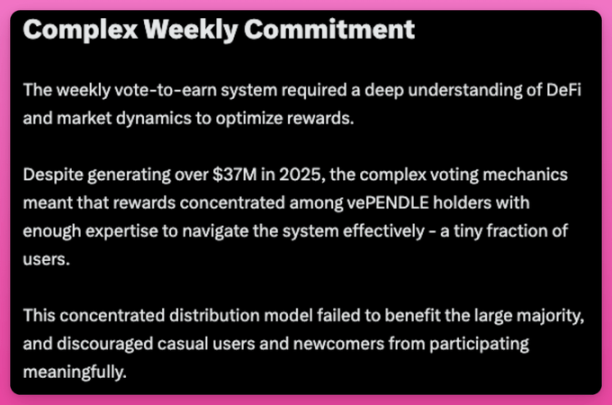
The Pendle team disclosed that despite a 60x revenue growth over two years, vePENDLE had the lowest participation rate among all veToken models—only 20% of the PENDLE supply was locked.
The mechanism originally designed to align incentives ended up excluding 80% of holders. More decisively, the breakdown per pool: over 60% of pools receiving emissions were operating at a loss.
A few high-performing pools were subsidizing the majority of value-destroying pools. Highly concentrated voting power led emissions to flow where large holders had positions (often wrappers), before being distributed to end-users.
Source: https://x.com/pendle_fi/status/2013431342546157825?s=20
For comparison, Curve’s veCRV lockup rate is around 50% or higher. Aerodrome’s veAERO lockup rate is about 44% with an average lock duration of ~3.7 years, making Pendle’s 20% notably low. In yield markets, its locking incentives were unattractive relative to the opportunity cost of capital. Meanwhile, Aerodrome had distributed over $440 million to veAERO voters as of March.
Alternative: sPENDLE
- 14-day withdrawal period, or pay a 5% fee for instant withdrawal
- Algorithm-driven emissions, reduced by ~30%
- Passive rewards, voting only on key PPP matters
- Transferable, composable, re-stakable
- 80% of revenue used to buy back PENDLE
sPENDLE is a liquid staking token, pegged 1:1 to PENDLE. Rewards come from revenue-funded buybacks, not inflationary emissions.
The algorithmic model cuts emissions by ~30% while redirecting resources to profitable pools.
Existing vePENDLE holders receive a loyalty boost (up to 4x multiplier, decaying over two years from the Jan 29 snapshot).
An address linked to Arca accumulated over $8.3 million worth of PENDLE within six days.
But not everyone agreed with the decision. Curve founder Michael Egorov argued that the ve token model is an extremely powerful mechanism for incentive alignment in DeFi.
PancakeSwap: From veCAKE to Tokenomics 3.0 (Burn + Direct Staking)
The Problem
PancakeSwap’s veCAKE was a classic case of bribe-driven misallocation. The gauge voting system was captured by Convex-style aggregators, notably Magpie Finance, which siphoned emissions while bringing little actual liquidity to PancakeSwap.
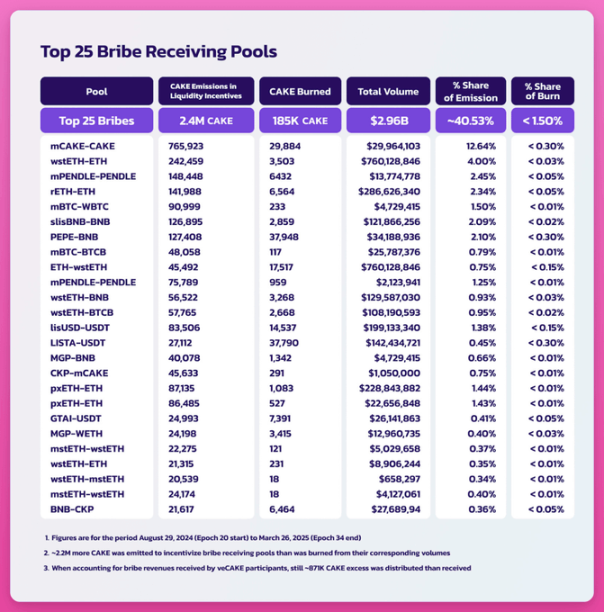
Data before shutdown showed: pools receiving over 40% of total emissions contributed less than 2% of CAKE burned. The ve model spawned a bribery market where aggregators extracted value, while pools generating real fees were under-incentivized.
Source: https://forum.pancakeswap.finance/t/cake-tokenomics-proposal-3-0-true-ownership-simplified-governance-and-sustainable-growth/1237
However, this shutdown was orchestrated. Michael Egorov called it “a textbook governance attack,” suggesting CAKE insiders erased governance rights of existing veCAKE holders and potentially forced unlocked their own tokens post-vote.
Cakepie DAO, one of the largest CAKE holders, raised irregularities regarding the vote. PancakeSwap offered Cakepie users up to $1.5 million in CAKE compensation.
Alternative
- 100% of fee revenue used for CAKE burning
- Emissions directly managed by the team
- 1 CAKE = 1 vote (simple governance)
- ~22,500 CAKE/day, target to reduce to 14,500
- 100% fee revenue for CAKE burning, no revenue sharing
- Goal: 4% annual deflation rate, 20% total supply reduction by 2030
All locked CAKE/veCAKE positions can be unlocked penalty-free during a 6-month 1:1 redemption window. Revenue sharing was redirected to burning, with burn rates for key pools increased from 10% to 15%. PancakeSwap Infinity launched alongside the redesigned pool architecture.
Post-Transition Results
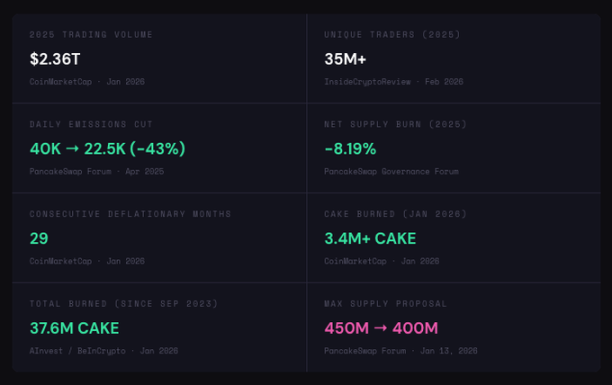
- 8.19% net supply reduction in 2025
- 29 consecutive months of deflation
- 37.6 million CAKE permanently removed since September 2023
- Over 3.4 million CAKE burned in January 2026 alone
- Cumulative trading volume $3.5 trillion ($2.36 trillion in 2025)
The deflationary strategy performed well, but CAKE price remains around $1.60, down 92% from its all-time high.
Balancer: veBAL Phased Shutdown (DAO + Zero Emissions)
The Problem
Balancer’s failure was a compound cascade of governance capture, security exploits, and economic insolvency.
The fight with a whale erupted first. In 2022, a whale named “Humpy” manipulated the veBAL system, directing $1.8 million worth of BAL to a CREAM/WETH liquidity pool they controlled over six weeks. During the same period, that pool generated only $18,000 in revenue for Balancer.
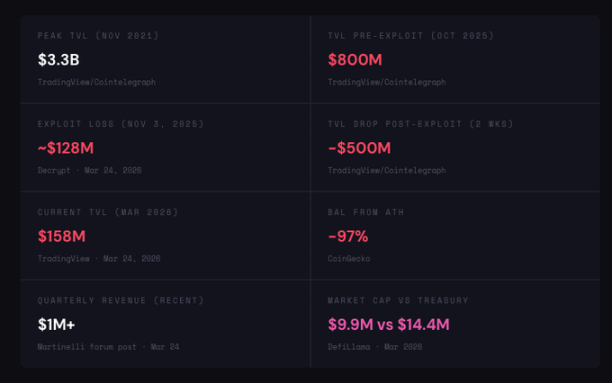
Then came the exploit. A rounding vulnerability in Balancer V2’s swap logic was exploited across multiple chains, causing ~$128 million in losses. TVL dropped by $500 million within two weeks. Balancer Labs again faced untenable legal risks.
Alternative
- 100% of fees go to the DAO treasury
- BAL emissions reduced to zero
- 100% of fees allocated to the DAO treasury
- BAL buybacks at a set price for exit liquidity
- Focus areas: reCLAMM, LBP, stable pools
- Lean team via Balancer OpCo
The old DeFi model centered on token rewards is being phased out.
Despite tokenomics issues, Martinelli noted Balancer “is still generating real revenue,” over $1 million in the past 3 months:
“The problem is not that Balancer doesn’t work, but that the economic mechanisms around Balancer don’t work. These are fixable.”
Whether a lean DAO can sustain $158 million TVL without incentives remains an open question. Notably, Balancer’s market cap ($9.9 million) is currently below its treasury ($14.4 million).
Underlying Mechanism Analysis
The three exit cases above are symptoms; structural issues are the root cause.
A recent analysis by Cube Menukarkan outlined three scenarios where the ve-token model can fail.
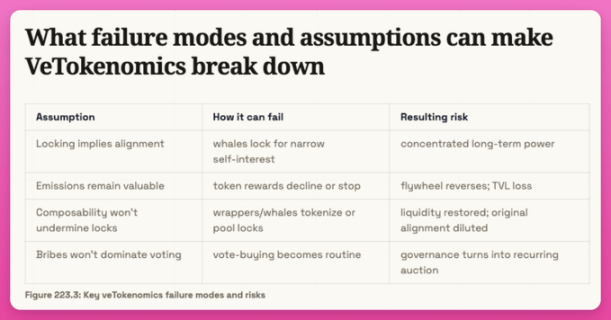
Source: https://www.cube.exchange/vi/what-is/vetokenomics
Assumption 1: Emissions must retain value. If token price crashes, emission value drops → LPs exit → liquidity, volume, fees drop → further selling. A classic reverse flywheel forms (seen in CRV, CAKE, BAL).
Assumption 2: Locking must be real. If locked tokens can be wrapped into liquid versions (e.g., Convex, Aura, Magpie), the “lock” loses its meaning and creates exploitable inefficiencies.
Assumption 3: There must be a genuine allocation problem. The ve model works when a protocol has a recurring need to decide where incentives go (e.g., an AMM). Without this need, gauge voting becomes unnecessary overhead.
Diagnostic Test:
Does the protocol have a real, recurring allocation problem where community-directed emissions create measurably more economic value than team-directed allocation?
If the answer is no, the ve token model adds complexity without adding value.
Fee-to-Emission Ratio
The Fee-to-Emission Ratio refers to the dollar value of fees generated by the protocol divided by the dollar value of emissions distributed.
When this ratio is above 1.0x, the protocol earns more in fees from liquidity than it pays to attract that liquidity. Below 1.0x, it is subsidizing activity at a loss.
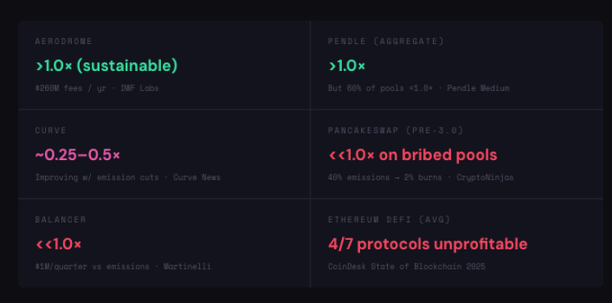
Pendle’s exit revealed a nuance: the aggregate ratio masked the reality at the individual pool level.
Pendle’s overall fee efficiency was over 1.0x (revenue > emissions). But when the team broke it down by pool, over 60% of pools were themselves loss-making.
A few high-performing pools (likely large stablecoin yield markets) were subsidizing all others. Manual gauge voting directed emissions to pools beneficial to whales, not those generating the most fees.
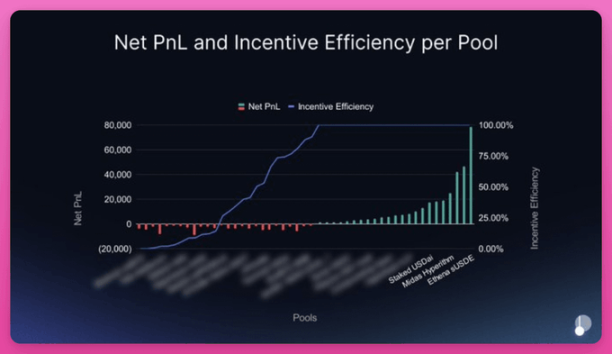
A similar pattern emerged with PancakeSwap, specifically regarding CAKE burn.
The Liquidity Locker Paradox
The ve token model creates a problem: inefficient capital lockup. Liquidity lockers solve this by wrapping locked tokens into tradable derivatives. However, in solving the capital efficiency problem, they introduce governance centralization. This is the paradox at the core of every ve token model.
In Curve’s case, this paradox produced a stable (if centralized) outcome. Convex holds 53% of all veCRV. StakeDAO and Yearn hold additional shares.
With Convex, individual governance is effectively mediated through vlCVX voting. But Convex’s incentives are highly aligned with Curve’s success; its entire business depends on Curve functioning well. This centralization is structural, not parasitic.
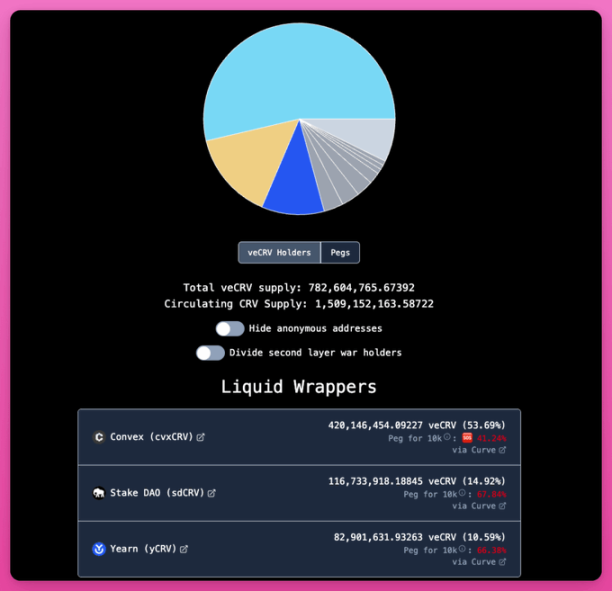
In Balancer’s case, the paradox was destructive. Aura Finance became the largest veBAL holder and the de facto governance layer. But with no other strong contenders, it allowed a malicious whale (Humpy) to independently accumulate 35% of veBAL and game the gauge limits to extract emissions.
In PancakeSwap’s case, Magpie Finance and its aggregators captured gauge votes via bribes and directed emissions to pools creating minimal value for PancakeSwap.
The ve token model requires locked capital to function, but locked capital is inefficient, so intermediaries emerge to unlock it, and in doing so, they centralize the governance power that locking was meant to distribute. The model creates the conditions for its own capture.
Curve’s Rebuttal: Why the ve Token Model Still Matters
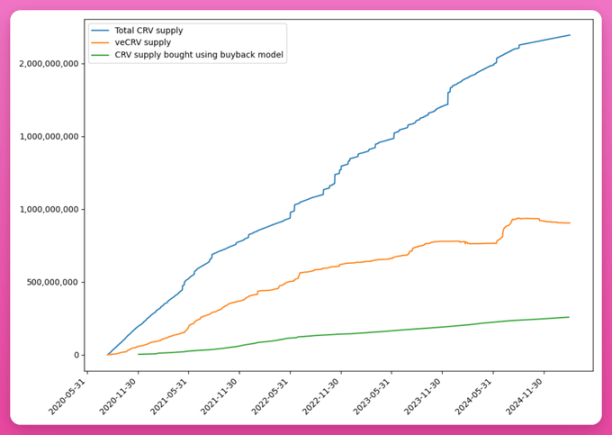
Curve’s conclusion: veCRV consistently locks roughly three times the number of tokens that a comparable burn mechanism would have removed.
https://news.curve.finance/beyond-burn-why-vecrv-unlocks-sustainable-tokenomics-for-curve/
Lock-based scarcity is structurally deeper than burn-based scarcity because it simultaneously generates governance participation, fee distribution, and liquidity coordination, not just supply reduction.
In 2025, Curve’s DAO removed the veCRV whitelist, expanding DAO governance participation. Protocol metrics also performed strongly:
- Trading volume grew from $119B in 2024 to $126B in 2025
- Pool interactions more than doubled to 25.2 million transactions
- Curve’s share of Ethereum DEX fees rose from 1.6% in early 2025 to 44% in December, a 27.5x increase
But the counter-argument must be seen: Curve occupies a unique position as the core pillar of stablecoin liquidity on Ethereum, and 2025 was a year of major stablecoin growth. There is a real, market-driven, organic demand for gauge-directed liquidity. Stablecoin issuers like Ethena structurally need Curve pools. This creates a bribery market based on real economic value.
The three protocols that left the ve model lack this condition. Pendle’s value proposition is yield trading, not liquidity coordination. PancakeSwap is a multi-chain DEX. Balancer is programmable pools. None have a structural reason for external protocols to compete for their gauge emissions.
Kesimpulan
The ve token model is not universally broken. Curve’s veCRV and Aerodrome’s ve(3,3) remain healthy.
But the model only works where gauge-directed emissions serve a real economic demand for liquidity. Meanwhile, other protocols are opting for revenue-backed buybacks, deflationary supply mechanisms, or liquid governance tokens as alternatives to the ve token model.
Perhaps it’s time for DeFi to develop a new incentive mechanism that benefits both the protocol and token holders’ long-term interests.
Artikel ini bersumber dari internet: The “Ebb Tide” of the ve Token Model: Why Are Three Major Protocols Voluntarily Abandoning Their Former Ace?Underlying Mechanism Analysis
Related: When Teams Hedge Risks with Prediction Pasars, a Trillion-Dollar Financial Market Emerges
Here’s a simple example: A basketball club promises its head coach a $20 million bonus if the team makes the playoffs. This is a straightforward incentive; if the team wins enough games and qualifies for the playoffs, the bonus is paid. From a financial perspective, however, this promise represents a significant liability. Once the team makes the playoffs, the $20 million must be paid out, regardless of the team’s annual revenue or financial health. To manage this risk, teams typically purchase insurance. Brokers design policies and find insurance companies willing to underwrite them; these insurers may then transfer part of the risk to reinsurers to avoid bearing the full exposure alone. The final price of this protection is negotiated privately between institutions. The premium implicitly contains a judgment of the…
相关文章































 Bahasa Indonesia
  English
  繁體中文
繁體中文  简体中文
简体中文  日本語
日本語  Tiếng Việt
  العربية
  한국어
한국어  हिन्दी
  اردو
اردو  Русский