







Did Jane Street “Manipulate” BTC? Decoding the AP System, Understanding the Power Struggle Behind ETF Creation and Redemption Pricing
“They were fcking us the whole time.”
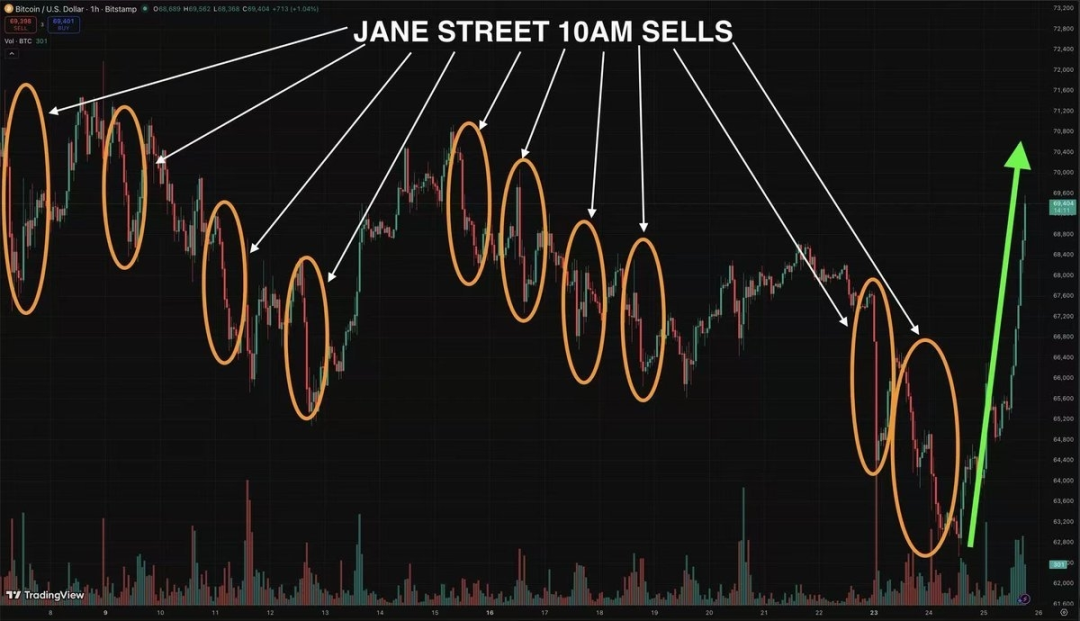
This expletive, circulating on Reddit and CT (Crypto Twitter) following the lawsuit, along with an epic short squeeze involving over $240 billion in liquidations, has directed the market’s fury towards a single target: Jane Street Capital.
At 10 AM, the liquidity freeze point for the Asian market over the past few months, the tip of the iceberg was finally revealed with the U.S. Department of Justice’s complaint. It all traces back to the Wall Street top-tier market maker Jane Street Capital, founded in 2000, which is accused of executing a months-long “shell game” between spot and derivative order books by exploiting the creation and redemption mechanism of spot ETFs through targeted ETF arbitrage in the market.
It wasn’t until the lawsuit brought this controversy into the public eye that discussions around the ETF arbitrage mechanism and price discovery structure rapidly intensified. The market subsequently experienced a violent rebound, leading to an epic short squeeze with over $240 billion in liquidations.
But was Jane Street truly the culprit who pressed the suppression button? That is a question worth at least $10 billion.
1. Did Jane Street Really Suppress the BTC Price?
This question deserves an accurate answer. The most important point to understand first is that this isn’t just a question about Jane Street.
This is a question about the structural characteristics of the Bitcoin ETF framework, which applies equally to every Authorized Participant (AP) in the ecosystem. Taking BlackRock’s IBIT alone, this list includes Jane Street Capital, JPMorgan, Macquarie, Virtu Americas, Goldman Sachs, Citadel Securities, Citigroup, UBS, and ABN AMRO.
The role of these institutions is profoundly misunderstood by the outside world, even among seasoned industry veterans. This misunderstanding deserves correction before any conclusions are drawn.
The first thing to understand about APs is that they occupy a marginal exception within the regulatory framework of Reg SHO (the SEC’s regulation on naked short selling). For instance, Reg SHO requires short sellers to locate shares before shorting, but APs are exempt due to their contractual rights to participate in creations and redemptions.
While this sounds procedural, its practical consequences are significant. It means any AP can create shares at will—no borrowing costs, no capital tied up in the traditional sense associated with shorting, and no hard deadline to close the position beyond commercially reasonable terms.
This is the gray area: a regulatory exemption designed for orderly ETF market-making is, structurally, indistinguishable from regulatory arbitrage with unparalleled duration. This exemption is not unique to any single company. It is a prerequisite for membership in the AP club.
2. What Does This AP Exemption Mean?
Normally, if IBIT trades below its Net Asset Value (NAV), you would expect arbitrage buyers to step in, redeem shares for Bitcoin, and close the gap. But any AP itself is that arbitrage buyer; they control the pipeline. This means their incentive to close that gap is different from that of a third-party trading desk without creation/redemption rights.
It sounds complex, but a simple analogy makes it clear:
Layer 1: What is Normal “Gap Closing”?
Imagine a blind box on the market (this is the IBIT ETF). Everyone knows the blind box contains a real Bitcoin voucher worth $100 (this is the NAV). But today, due to market panic, the blind box is priced at $95.
Following normal logic, smart merchants (arbitrage buyers) would frantically buy the blind box for $95, then go to the official issuer to open it, exchange it for $100 worth of Bitcoin, sell it, and pocket the $5 difference.
And precisely because everyone is scrambling to buy the blind box for arbitrage, its price would quickly be pushed up by buy-side pressure, returning to $100. This is called “closing the gap.”
Layer 2: The AP with the “Monopoly Channel”
But in the real world of Bitcoin ETFs, ordinary trading firms and retail investors are not qualified to go to the official issuer to “open the blind box” (i.e., they lack creation/redemption rights). Only a few privileged Wall Street investment banks (APs) in the entire market can do this. In other words, APs monopolize the only channel to exchange ETFs for real Bitcoin (they control the pipeline).
Layer 3: Why Don’t APs Play by the Arbitrage Rules?
If it were an ordinary third-party merchant seeing this $5 risk-free spread, they would act immediately. But APs are different; they calculate a more shrewd account: “Since only I can open the blind box, why rush? If I deliberately don’t pull the price back to $100, but instead use the current illusion of a $95 low price to short or go long in another casino (like the Bitcoin futures market), I might make $20!”
To summarize in one sentence: The market originally had an automatic correction mechanism (when prices fall too much, someone will buy for arbitrage, pushing the price up). However, because the “only switch” to execute this correction mechanism is in the hands of the APs, and the APs find that “not correcting, maintaining the spread” allows them to make more money elsewhere, they have no incentive to pull the price back to normal levels.
Retail investors are waiting for the arbitrage army to save the price, unaware that the only arbitrage army (the APs) is right beside them, using this spread to make money in other markets.
3. The Problem Isn’t Jane Street, It’s the AP Architecture
IBIT’s short exposure could, in principle, be hedged by going long Bitcoin spot, but this is not mandatory as long as the chosen instrument maintains a tight correlation.
The obvious alternative is BTC futures, especially considering their capital efficiency. This essentially means that if the hedging instrument is futures instead of spot, then spot is never bought. And since the natural arbitrage buyer chooses not to buy spot, this price gap cannot be closed through the natural arbitrage mechanism.
It’s worth noting that the spot/futures basis itself is the domain of the entire basis trading community, which works to keep this relationship tight. But every separation between the hedging instrument and the underlying asset introduces impure basis risk (dirty basis risk), which stacks up throughout the structure—and under stress conditions, basis risk is precisely where market dislocation appears.
The final piece of the puzzle involves the SEC’s recent approval of in-kind creation and redemption. Under the previous cash-only regime, APs were required to deliver cash to the fund, and then the custodian used that cash to buy Bitcoin spot. This buying action was a structural regulator—it forced spot purchases as a mechanical consequence of creation.
In-kind creation and redemption completely removes this. Now, any AP can directly deliver Bitcoin, with the timing and counterparty of its acquisition entirely at their discretion: OTC desks, negotiated pricing, minimizing market impact.
The broadest interpretation of this flexibility is that an AP could maintain derivative positions aimed at capturing funding rate or volatility profits during the window between establishing a short and completing the in-kind delivery—while ensuring every single step still fits the definition of legitimate AP activity.
And this is precisely the crux of the problem. The beginning looks like normal market-making, and the end looks like normal market-making. It’s the middle process that is difficult to clearly categorize. This is not an indictment of any single company. Every AP on the IBIT list, and by extension, every AP for every Bitcoin ETF, operates within the same structural framework, enjoys the same exemptions, and therefore possesses the same theoretical capability. Whether any of them exercised this capability in a manner bordering on coordinated activity is a question that falls squarely within the scope of the “surveillance-sharing agreements” the SEC required upon ETF approval.
Whether these agreements are sufficient to capture behavior simultaneously spanning spot, futures, and ETF markets (even including cross-border trading venues) remains a genuinely open question.
In short, Jane Street is merely in the spotlight. The real problem is deeply embedded in the underlying architecture of Bitcoin ETFs, a framework designed by Wall Street veterans themselves. No single AP is explicitly suppressing the Bitcoin price. What the AP structure can suppress is the integrity of the price discovery mechanism itself, which may have far more profound implications than the former.
Therefore, the truly worthwhile question is not whether a specific company is the villain, but whether a regulatory framework built for 20th-century traditional finance is suitable for hosting a 21st-century emerging asset whose “value lies in being outside the control of regulatory bodies.”
This might be the tuition the kripto market must pay upon entering the “era of big institutions.” After all, while we crave the liquidity irrigation from Wall Street, we do not wish to passively accept the black-box games they construct using regulatory exemptions.
This is not just the answer about Jane Street; it is the ultimate question of the Bitcoin ETF era.
Artikel ini bersumber dari internet: Did Jane Street “Manipulate” BTC? Decoding the AP System, Understanding the Power Struggle Behind ETF Creation and Redemption Pricing
Related: 2025 Prediction Pasar Review: Total Trading Volume Exceeds $50 Billion, Top Two Players Hold Over 97.5% Market Share
Author|Wenser (@wenser 2010 ) As 2025 concludes, the prediction market sector has presented its own report card. According to data from PredictionIndex.xyz, the total trading volume for the prediction market sector in 2025 reached $50.25 billion. Excluding Kalshi and Polymarket, the trading volume for the rest of the ecosystem was $1.25 billion. Additionally, data released by KalshiData shows that Kalshi’s total nominal trading volume for the year amounted to $23.8 billion, a year-on-year increase of 1108%. With both Polymarket and Kalshi achieving valuations exceeding $10 billion, such performance undoubtedly injects a strong dose of confidence into the capital markets and user base. In 2026, the prediction market sector is set to remain a focal point in crypto. Odaily will provide a review and brief analysis of the overall data for the prediction…
相关文章

































 Bahasa Indonesia
  English
  繁體中文
繁體中文  简体中文
简体中文  日本語
日本語  Tiếng Việt
  العربية
  한국어
한국어  हिन्दी
  اردو
اردو  Русский