







Why is there such a large price difference in SpaceX pre-market contracts across various exchanges?
लेखक: अज़ुमा (@अज़ुमा_एथ)

SpaceX’s trillion-dollar mega IPO is finally approaching.
You open the exchange, ready to establish a position before the IPO, only to find… SPCX is trading at 169 USDT on Binance, 155 USDT on OKX, and 154 USDC on Hyperliquid. The pre-market contract prices across the three platforms are all different, with a particularly large spread between Binance and the other two. Why is this happening?
Simply put, this situation arises, in part, because different platforms have independent price discovery mechanisms, but the more critical reason is that the share count data and valuation conversion methods used by each platform are not identical.
First, it’s important to clarify that the SPCX currently listed on Binance, OKX, Bitget, and Hyperliquid is not SpaceX’s actual stock, but rather a derivative designed around the future IPO price. These products will ultimately be settled based on SpaceX’s market capitalization and share count data post-IPO. Therefore, their prices essentially reflect the market’s expectations for SpaceX’s final valuation. Since SpaceX is not yet listed, there is no fixed anchor for these expected prices. This uncertainty is the root of the current price spread arbitrage game.
Differences in Share Count Data Across Three Major अदला-बदलीएस
Let’s look back at the historical announcements for the SpaceX pre-market contracts on Binance, OKX, and Hyperliquid.
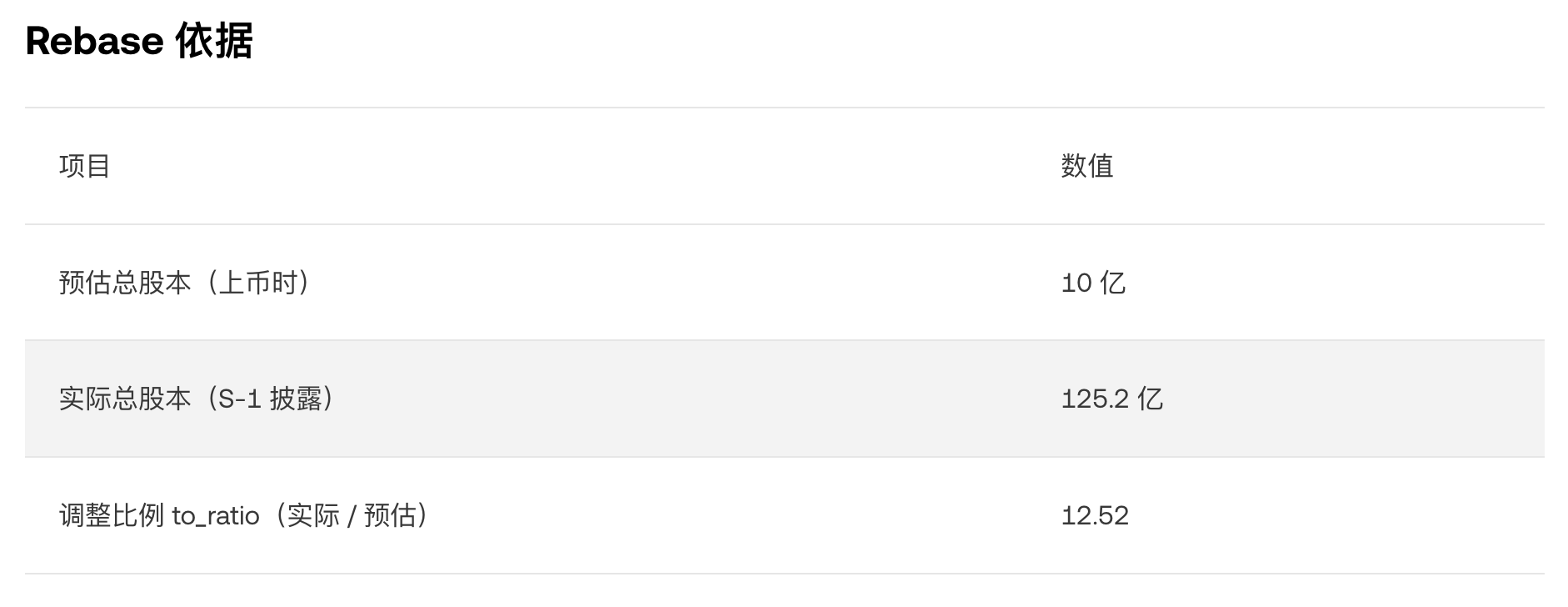
OKX listed its SPACEX pre-market contract on May 7, with an initial estimated share count of 1 billion shares. Consequently, the contract price was consistently above 2000 USDT shortly after listing;Then, on June 2, based on SpaceX’s S-1 filing, OKX adjusted the share count to 12.52 billion shares(Odaily Note: This adjustment process is called a Rebase, and we will use this term going forward), renaming the SPACEX pre-market contract to SPCX. Correspondingly, the SPCX contract price was “adjusted” to the 150-200 USDT range.
Hyperliquid, through the HIP-3 market Trade.xyz, listed its SPCX pre-market contract on May 17.Regarding the share count, Trade.xyz initially disclosed it was based on approximately 11.87 billion shares derived from private market transaction data, but the community discovered that Trade.xyz subsequently removed this information from its documentation.
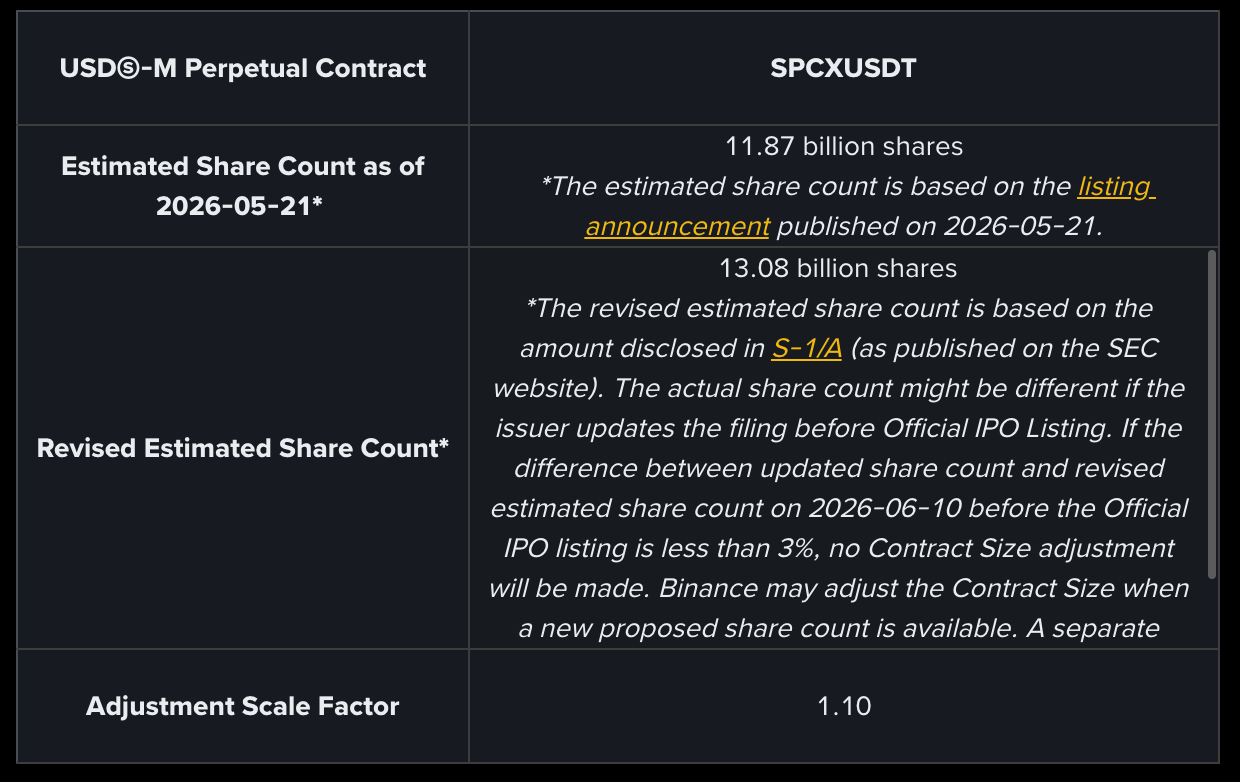
Binance launched SPCX pre-market contract trading on May 21, also with an initial share count of 11.87 billion shares;On the evening of June 8, Binance announced it would rebase SPCX, directly adjusting the share count to 13.08 billion shares as disclosed in the latest IPO plan (an increase of 556 million shares from the 12.52 billion in the S-1, accounting for the IPO’s additional issuance). The rebase is scheduled to be executed at 16:30 Beijing time tomorrow.
In summary, the current situation is now clear:
- OKX is currently using the share count of 12.52 billion from the S-1 filing. It is currently uncertain whether they will perform another rebase.
- Hyperliquid (Trade.xyz) previously disclosed using 11.87 billion shares, but since the related statements have been removed, the market estimates the likelihood of a subsequent rebase is extremely low, assuming it may be tracking the actual share count by default.
- Binance currently uses a share count of 11.87 billion shares but will rebase to 13.08 billion shares tomorrow.
Comparing Actual Prices Across the Three Platforms
With this share count data, we can calculate the “real price” actually reflected by the SPCX pre-market contracts on the three platforms based on real-time prices.
As of 17:00 Beijing time, the real-time quotes for the SPCX pre-market contracts on Binance, OKX, and Hyperliquid were 169.62 USDT, 155.35 USDT, and 154.62 USDC, respectively.
Using this static data and the share count information discussed above, we get the following calculation results:
- Binance is currently at 169.62 USDT. After the rebase tomorrow, it will adjust to approximately 154.2 USDT.
- OKX is currently at 155.35 USDT. If another rebase occurs (adjusting to the 13.08 billion share count), the corresponding price would be approximately 148.7 USDT.
- Hyperliquid is currently at 154.62 USDC. If a rebase occurs, the corresponding price would be approximately 140.3 USDC.
At first glance, it seems Hyperliquid has the cheapest price, doesn’t it? Not so fast! The current situation is thatthe market expects OKX and Hyperliquid are unlikely to perform another rebase before SpaceX completes its IPO.
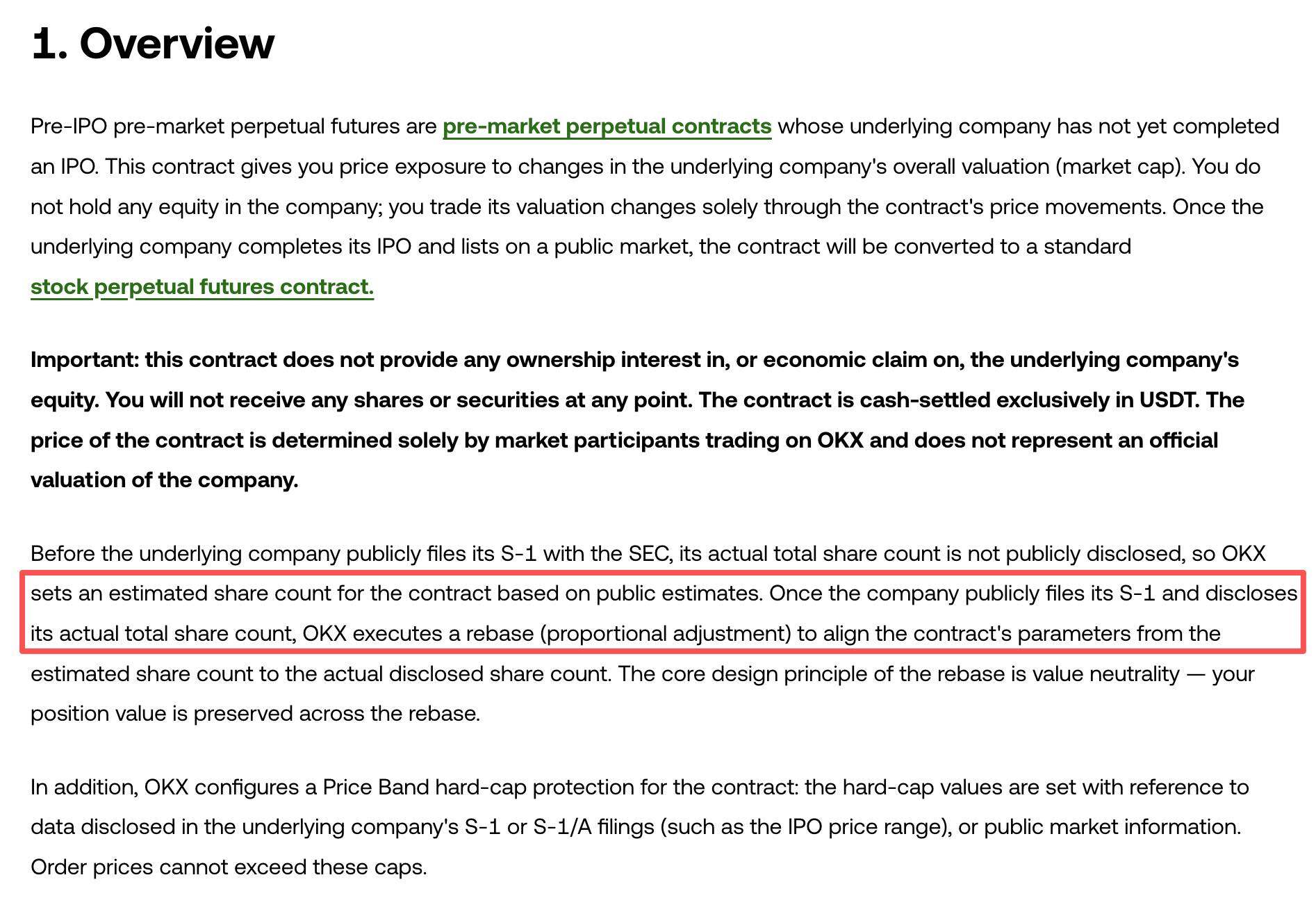
The reason for OKX is that it has already performed one rebase, and its official documentation for the pre-market contract only mentioned “rebasing based on the S-1 share count,” a step now completed.
For the reason behind Hyperliquid’s stance, one can refer to the analysis by arbitrage expert “Silicon Bird|Ray” (X: @limxn6), who suggests the likelihood of a subsequent rebase is extremely low.
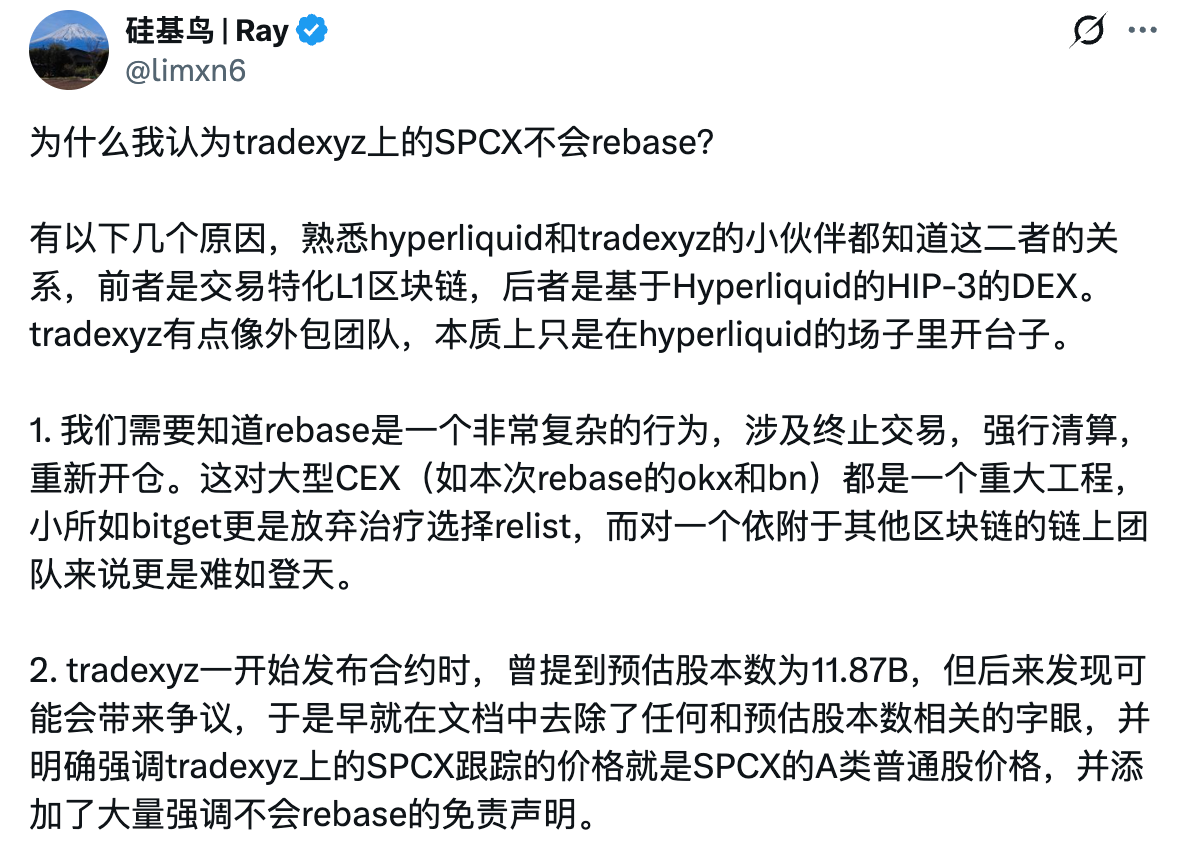
Therefore, while the prices on OKX and Hyperliquid appear highly attractive post-rebase, this price point may never materialize.
A more realistic price comparison should be: Binance (154.2 USDT)
Two conclusions can be drawn here.First, compared to Binance, there is almost no arbitrage opportunity left on OKX and Hyperliquid (after Binance announced the rebase last night, the arbitrage spread was as high as 10%). Second, the premium on OKX and Hyperliquid can still be attributed to the market pricing in their minimal probability of a rebase, with OKX’s higher premium indicating a greater perceived likelihood of a rebase compared to Hyperliquid.
Measuring the Same Thing with Different Rulers
As SpaceX’s IPO approaches and market rules become clearer, the best arbitrage window may have already passed.However, for ordinary investors, this price game surrounding SPCX provides an excellent sample for observing the operational logic of the pre-market.
Many are accustomed to interpreting the pre-market contract price directly as the “future stock price.” But as our analysis shows, the pre-market trade is not just about a simple number. Behind the price lies not only the market’s assessment of the company’s future valuation but also the exchange’s product design, choice of share count metrics, and participants’ expectations regarding rule changes.
In other words, when you see different SPCX quotes on Binance, OKX, and Hyperliquid,they don’t necessarily signify a major divergence in the market’s view of SpaceX. More likely, they represent different rulers measuring the same target.
यह लेख इंटरनेट से लिया गया है: Why is there such a large price difference in SpaceX pre-market contracts across various exchanges?
Recently, a dispute resolution regarding rampant in-game bots caught GMA’s attention — Abstract chain’s competitive baking game Rugpull Bakery was embroiled in controversy over automation script proliferation in Season 2. Players accused bot accounts of undermining fairness, and the team ultimately chose to “legalize” them in Season 3 while adding a 30% passive prize pool. This incident not only exposed the human-machine asymmetry in traditional Play-to-Earn models but also became a catalyst for AI Agents moving from the periphery of gaming to core sovereignty. With the OnchainChemists team officially releasing skill.md and agent.json to provide official operational guides for AI Agents, Web3 gaming has bid farewell to the era centered on manual human labor and entered the Agentic Gaming epoch characterized by autonomous decision-making, algorithmic optimization, and on-chain economic entities.…
相关文章































 हिन्दी
  English
  繁體中文
繁體中文  简体中文
简体中文  日本語
日本語  Tiếng Việt
  العربية
  한국어
한국어  Bahasa Indonesia
  اردو
اردو  Русский