







Panorama of Crypto AI Protocols: Starting from Ethereum’s Main Battlefield, How to Build a New Operating System for AI Agents?
Over the past two years, we have witnessed AI’s transformation from an “assistive tool” to an “autonomous economic participant.” AI Agents are no longer just chatbots that answer questions; they have begun to autonomously initiate transactions, call APIs, manage asset portfolios, and even hire other Agents to complete tasks.
However, the prerequisite for all this is that these Agents need identity, payment channels, reputation records, and a verifiable execution environment.
And these needs are precisely the problems that blockchain is best at solving.
As often discussed, the Ethereum Foundation established the decentralized AI (dAI) team in September 2025. Vitalik Buterin published a systematic AI strategic framework in early 2026. Meanwhile, a series of protocol standards centered around Agent identity, payment, and execution have already been launched and are operational on the mainnet. At the same time, new public chain ecosystems like Solana are also building AI infrastructure along their respective paths.
Therefore, this article also attempts to use the Ethereum ecosystem as the main axis, supplemented by important developments on other public chains, to outline the complete landscape of current क्रिप्टो AI protocols.
1. Vitalik’s AI Blueprint: Ethereum Aims to Be the “Trust Layer” for the AI World
In February 2026, Vitalik Buterin published a systematic post on X, specifically revising the “Crypto × AI” cross-framework he proposed two years ago.
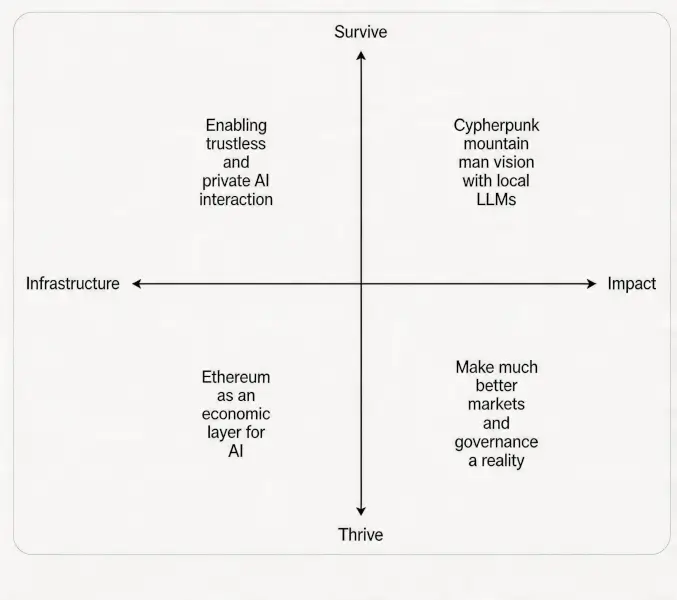
In the post, he revisited the ideas proposed two years ago, suggesting that the accelerated push towards Artificial General Intelligence (AGI) often resembles the unchecked speed and scale that Ethereum itself was created to challenge. He explicitly opposed simplifying AI development as an “AGI race” and instead advocated that Ethereum should become the direction-setter for the AI world.
In other words, what he truly cares about is not how to make AI lose control faster, but how to build AI’s expansion on verifiable, auditable, and constrained infrastructure.
Overall, Vitalik’s framework consists of four core pillars.
First is trustworthy AI interaction tools. He advocates for using tools like local large language models (local LLMs) and zero-knowledge proof payment mechanisms, allowing users to utilize AI services without exposing their identity or raw data.
This stance is not merely abstract. In April 2026, Vitalik publicly shared his own local LLM usage setup. After testing multiple hardware configurations, he chose to run the 35-billion-parameter open-source model Qwen3.5 locally on a computer equipped with an NVIDIA 5090 GPU. All computations are performed locally, aiming to bring inference speed to a level suitable for daily use and minimize reliance on cloud-based models.
Of course, the symbolic significance of this is greater than its practical meaning, but it also indicates that, at least in his view, the truly worthwhile direction for AI is not just more powerful models, but more controllable models.
Second is the AI economic coordination layer. This includes Ethereum supporting payments between Agents, security deposits, dispute resolution, and reputation accumulation through smart contracts, enabling programmable economic relationships between machines. Third is AI as the interface for Web3. For example, local AI assistants can help users draft transactions, audit smart contracts, and interpret formal verification proofs, becoming a bridge for ordinary people to enter the complex on-chain world.
Finally, there are AI-enhanced governance systems, such as using AI to upgrade mechanisms like prediction markets, quadratic voting, and public fund allocation, finding a balance between automation and human judgment.
Overall, the core idea of this framework can be condensed into one sentence: Ethereum is not about accelerating AI, but about making AI operate in a verifiable, auditable, decentralized environment.
So, how exactly is this to be achieved?
2. From Identity Protocols, to Payment Protocols, to Execution Protocols, to Verifiable AI
If Vitalik’s framework is the macro blueprint, then the recent wave of protocol evolution in the Ethereum ecosystem has begun to embed this methodology into a concrete tech stack.
The first infrastructure node most worthy of attention is ERC-8004.
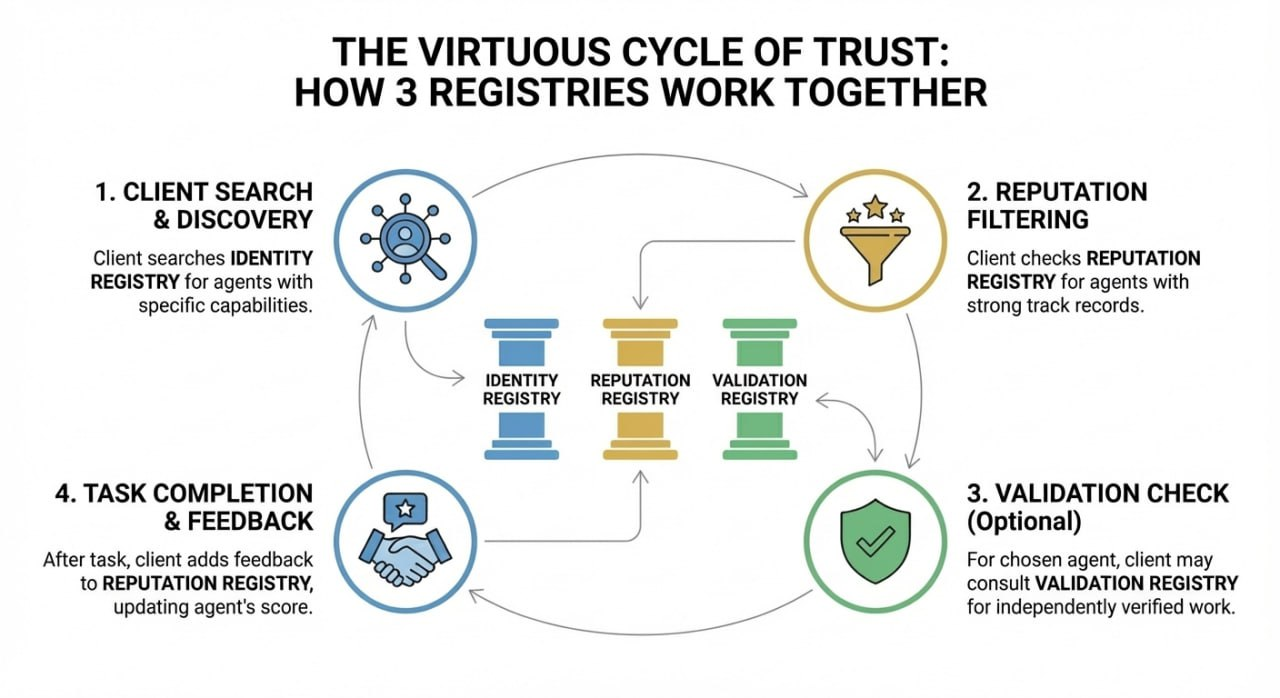
As Ethereum’s identity, reputation, and verification standard designed for AI Agents, it is spearheaded by the Ethereum Foundation’s dAI team and developed in collaboration with Google, Coinbase, and MetaMask. It almost encompasses the three key entry points of AI, transactions, and wallets (Extended reading: The New Ticket to the AI Agent Era: What is Ethereum Betting on by Pushing ERC-8004?).
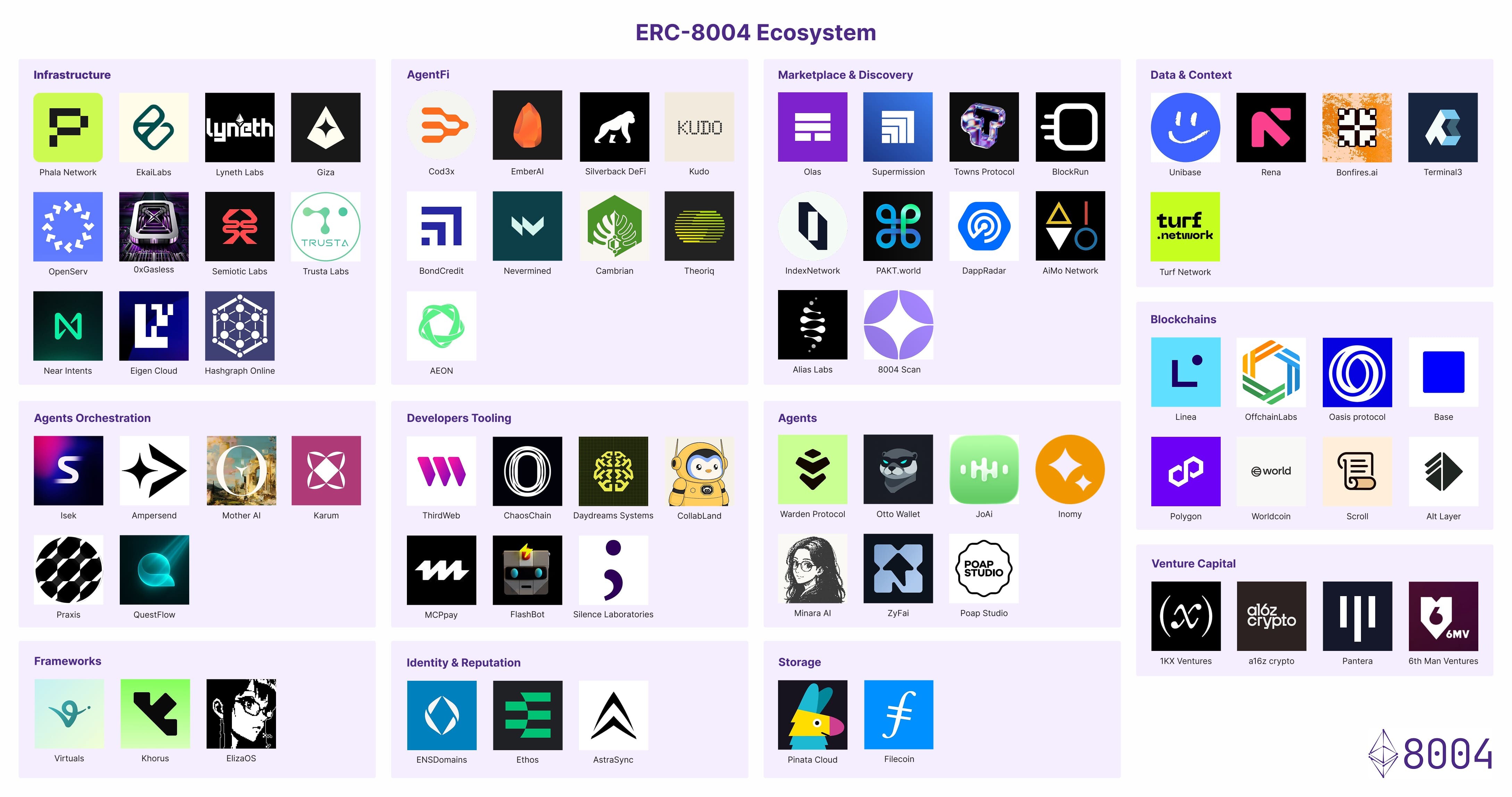
As its official name, Trustless Agents, suggests, its core logic is not complex algorithms, but rather aims to give AI verifiable identity, reputation, and capability proofs on-chain. To put it simply, its design is very restrained, focusing on only three things:
- Identity Registry: Based on the ERC-721 standard, each AI Agent is “NFT-ized,” meaning AI Agents can be looked up, referenced, and integrated into other protocols just like wallet addresses.
- Reputation Registry: Can be understood as the “Yelp” for AI, allowing users or other Agents who have actually interacted with an Agent to submit feedback. These evaluations can be linked to on-chain payments or escrow behaviors, ensuring reputation is not a narrative generated out of thin air, but a historical record built upon real economic activities.
- Verification Registry: For high-value or high-risk tasks, historical reputation alone is insufficient. Therefore, ERC-8004 reserves a third-party verification interface, allowing endorsement of an Agent’s capabilities or execution process through methods like Trusted Execution Environments (TEE) or zero-knowledge proofs.
If identity answers the question “Who is the Agent?”, then payment infrastructure represented by the x402 protocol answers the question “How does the Agent transact?”.
As is well known, x402 is an open HTTP payment protocol jointly initiated by Coinbase and Cloudflare. Its basic principle is quite clever, reviving the long-dormant HTTP 402 status code (“Payment Required”). When an Agent attempts to access a paid service, the server returns a 402 status code with payment requirements. The Agent completes the payment with stablecoins and then gains access.
The entire process is embedded within the HTTP request flow, requiring no account registration, credit cards, or manual intervention. In other words, this is a payment system designed for machines, not humans.
It is worth noting that just earlier this month, the Linux Foundation essentially officially took over the x402 Foundation and received the x402 protocol contributed by Coinbase. The official statement is very clear: x402 aims to embed payment directly into HTTP interactions, allowing AI agents, APIs, and applications to exchange value as easily as they exchange data.
In my opinion, the importance of this news has been greatly underestimated. On one hand, it’s due to x402’s potential penetration and significant influence in AI and internet payments. On the other hand, it’s the remarkably strong lineup. Of course, x402’s promotion has always involved these giants, but this time the effect is clearly synergistic (1+1>2).
Furthermore, the V2 version of x402 is also striving to expand payment methods. It not only supports on-chain stablecoins but also integrates with traditional ACH (Automated Clearing House) and card networks, aiming to bridge the gap between AI Agents and the real-world financial system.
Finally, beyond identity and payment, the third piece of the puzzle Ethereum has recently added is the execution layer.
In April 2026, Biconomy, in collaboration with the Ethereum Foundation’s “Improve UX” direction, promoted ERC-8211, attempting to solve the most practical bottlenecks for AI Agents in the DeFi world. For instance, complex on-chain operations are often not a single call but multi-step, dynamic, and failure-prone execution chains.
We can simply understand it as a “smart batching” mechanism specifically designed for AI Agents and complex DeFi operations. This is because, in traditional on-chain operations, executing a complex DeFi strategy often requires multiple independent transactions: withdrawing funds from a lending protocol, swapping tokens, and then depositing into another protocol.
Each step requires separate signing and confirmation, which is already cumbersome for human users and becomes a bottleneck for AI Agents that require high-frequency autonomous operations. ERC-8211’s solution is to allow multiple blockchain operations to be combined and executed within a single transaction. Each step dynamically parses actual values during execution, and subsequent steps can only proceed if predefiआवश्यक शर्तें पूरी की जाती हैं।
For example, an Agent can complete in a single signed transaction: withdrawing funds from Aave → swapping the actual received amount on Uniswap → depositing the swap result into Compound—all executed atomically without writing new smart contracts.
Looking at these three together, Ethereum’s recent trajectory is quite clear: ERC-8004 answers “Who are you, and why should others trust you?”, x402 answers “How do you pay for services?”, and ERC-8211 answers “How do you efficiently complete complex operations?”.
In other words, what the AI Agent economy truly lacks has never been just smarter large models, but an open, composable, and extensible protocol stack. And this is precisely what Ethereum excels at.
3. Beyond Ethereum: Solana, DePIN, and Decentralized Computing
Of course, even though Ethereum holds a leading position in standard-setting and trust infrastructure, the क्रिप्टो AI ecosystem is far from being limited to one chain.
A more accurate statement is that Ethereum is competing for the standard and trust layers, while other ecosystems are demonstrating different advantages at the execution and compute layers.
Solana is the most typical example. The reason its presence is increasingly felt in discussions about Agent payments stems from the fact that AI Agents’ demands from a chain are not about ideological correctness, but about “low latency, low cost, and sufficient stability.” In Solana’s official introduction to x402, it directly highlights millisecond-level finality and extremely low transaction costs as key selling points for machine payments. This also explains why Solana is more likely to handle those high-frequency, small-value, instant-feedback-required Agent interaction scenarios.
Meanwhile, the Agent toolchain around Solana is rapidly maturing. The official Solana Agent Kit on GitHub allows Agents on any model to autonomously execute over 60 different Solana actions, covering scenarios like trading, token issuance, lending, airdrops, Blink, and cross-chain operations, and is widely reused by many on-chain projects and developers.
Therefore, looking at today’s landscape, the division of labor in crypto AI is becoming clearer. Ethereum seems more focused on the underlying abstraction of protocol standards, identity/reputation, and trusted execution. Solana holds practical advantages in high-frequency payments and low-friction interactions. The value of decentralized compute networks will also be repriced as more Agents truly enter production environments.
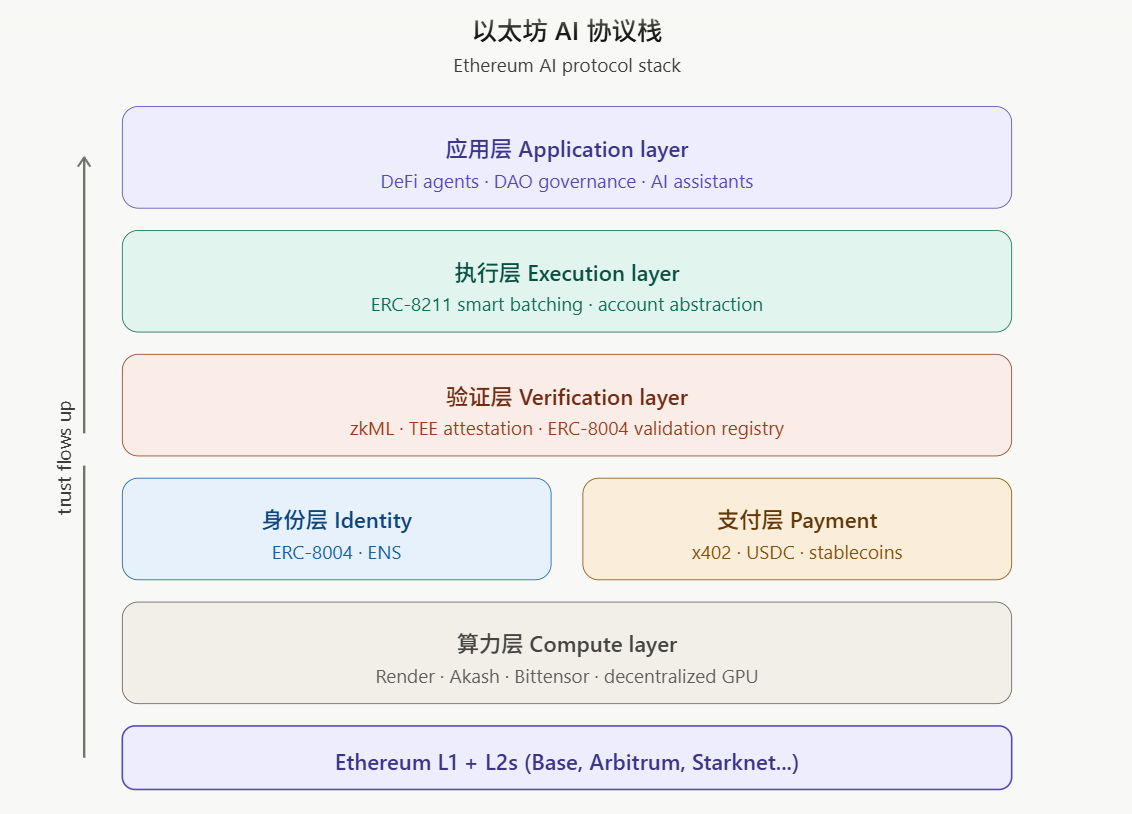
Overall, looking back from the vantage point of April 2026, the landscape of crypto AI protocols has taken initial shape:
- Identity Layer: ERC-8004, as the Ethereum-led Agent identity standard, has expanded to multiple chains like Base.
- Payment Layer: x402 has grown from an experimental project by Coinbase to a global standard under the governance of the Linux Foundation.
- Execution Layer: Standards like ERC-8211 simplify complex on-chain operations for Agents.
- Verification Layer: Technologies like zkML, TEE, and cryptographic proofs are beginning to provide verifiability for high-value Agent interactions.
- Competitive Landscape: Ethereum focuses on the standard and trust layers, Solana on the high-frequency execution layer, and Bittensor could serve as a supplement in dimensions like compute, forming a complementary rather than zero-sum structure.
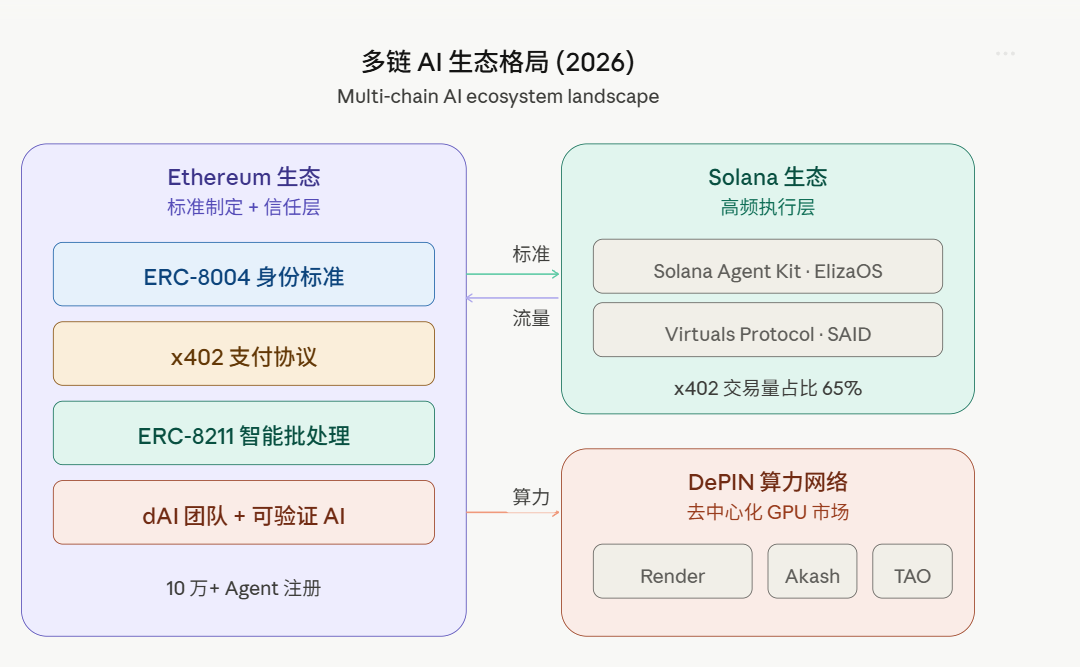
Looking ahead to the second half of the year, Ethereum’s new upgrades will likely promote L1 scaling, native account abstraction, and post-quantum security. Among these, the widespread adoption of account abstraction will undoubtedly significantly lower the barrier to using Agent wallets. The deep integration of x402 and ERC-8004 might also give rise to a closed-loop Agent economy, covering Agent identity registration, service discovery, payment initiation, and reputation accumulation, all completed on-chain.
In Conclusion
Ethereum and blockchain are not about accelerating the arrival of AI, but about ensuring that when AI arrives, the world does not spiral out of control.
After all, in the Web2 world, AI’s identity is defined by big companies’ API Keys, payments are carried by credit card systems, and trust is backed by centralized platforms. This system barely functions in scenarios for human users, but under the new paradigm where millions of AI Agents need to collaborate autonomously 24/7, it is increasingly inadequate.
Standard-setters centered around Ethereum, efficient execution layers represented by Solana, and decentralized compute supported by DePIN might just build a brand new set of infrastructure for the AI Agent economy.
यह लेख इंटरनेट से लिया गया है: Panorama of Crypto AI Protocols: Starting from Ethereum’s Main Battlefield, How to Build a New Operating System for AI Agents?
Related: Odaily Interview with SharpLink: Ethereum’s “Productive Capitalist”
Author|Fangzhou Hao On-site Interview|Cody “ETH Guards,” are you still there? Amid the current widespread pessimism, I heard a statement—”ETH that is not staked has no productivity”—hold on, let’s first understand the person who said this: Matt Sheffield (X@sheffieldreport), CIO (Chief Investment Officer) of SharpLink. Recently, SharpLink, which positions itself as a “next-generation digital asset treasury,” high-profile announced that it would deploy $200 million worth of ETH on-chain through the qualified custodian Anchorage Digital, entering into a two-year yield enhancement collaboration with Linea, ether.fi, and EigenCloud. This move not only aims to earn ETH yields exceeding native staking but also intends to establish a compliant model for institutional-grade DeFi operations. Its core logic is very clear: firmly believing Ethereum is severely undervalued at present, the company is maximizing the ETH-per-share at…
相关文章
































 हिन्दी
  English
  繁體中文
繁體中文  简体中文
简体中文  日本語
日本語  Tiếng Việt
  العربية
  한국어
한국어  Bahasa Indonesia
  اردو
اردو  Русский