







Starting at $5, Decided in Hours: DeriW Trading Competition Edge Hour Officially Launches
With the rapid development of on-chain derivatives trading, the demand for competitive and gamified trading products among Crypto traders is continuously growing.
An increasing number of traders not only hope to simply generate profits but also wish to validate their own strategies and risk management capabilities in a fair environment. However, there remains a significant gap in the current market for competitive trading products — traditional trading competitions are inherently biased towards large-capital players, while Prop Trading Challenge platforms often require lengthy evaluation cycles with high participation barriers, making it difficult to meet the fast-paced demands of the Crypto market.
Against this backdrop, the decentralized contract trading platform DeriW officially launched Edge Hour on March 24 — a competitive product centered around “time-limited trading challenges,” attempting to offer a new competitive trading experience with shorter cycles and lower barriers.
Hands-on Experience: Faster-Paced, More Direct Trading Competition
From a product positioning perspective, Edge Hour can be seen as the Crypto version of a Prop Trading Challenge, but with innovative upgrades designed to be more aligned with the Crypto market. The entire process has a lower barrier (minimum $5), a faster pace (1 – 8 hours), more controllable costs (losses are limited to the entry fee), and more substantial potential profits (2-10x rewards).
In the actual experience, users first need to select the challenge duration (four options: 1, 2, 4, 8 hours), the entry fee ($5 – $500), and the reward level (2x – 10x). After selection, the interface directly displays the profit target and the maximum drawdown limit. Users can then immediately start the challenge and trade perpetual contracts like BTC and ETH within the specified time. The challenge is deemed successful when the account position reaches the profit target without hitting the drawdown line.
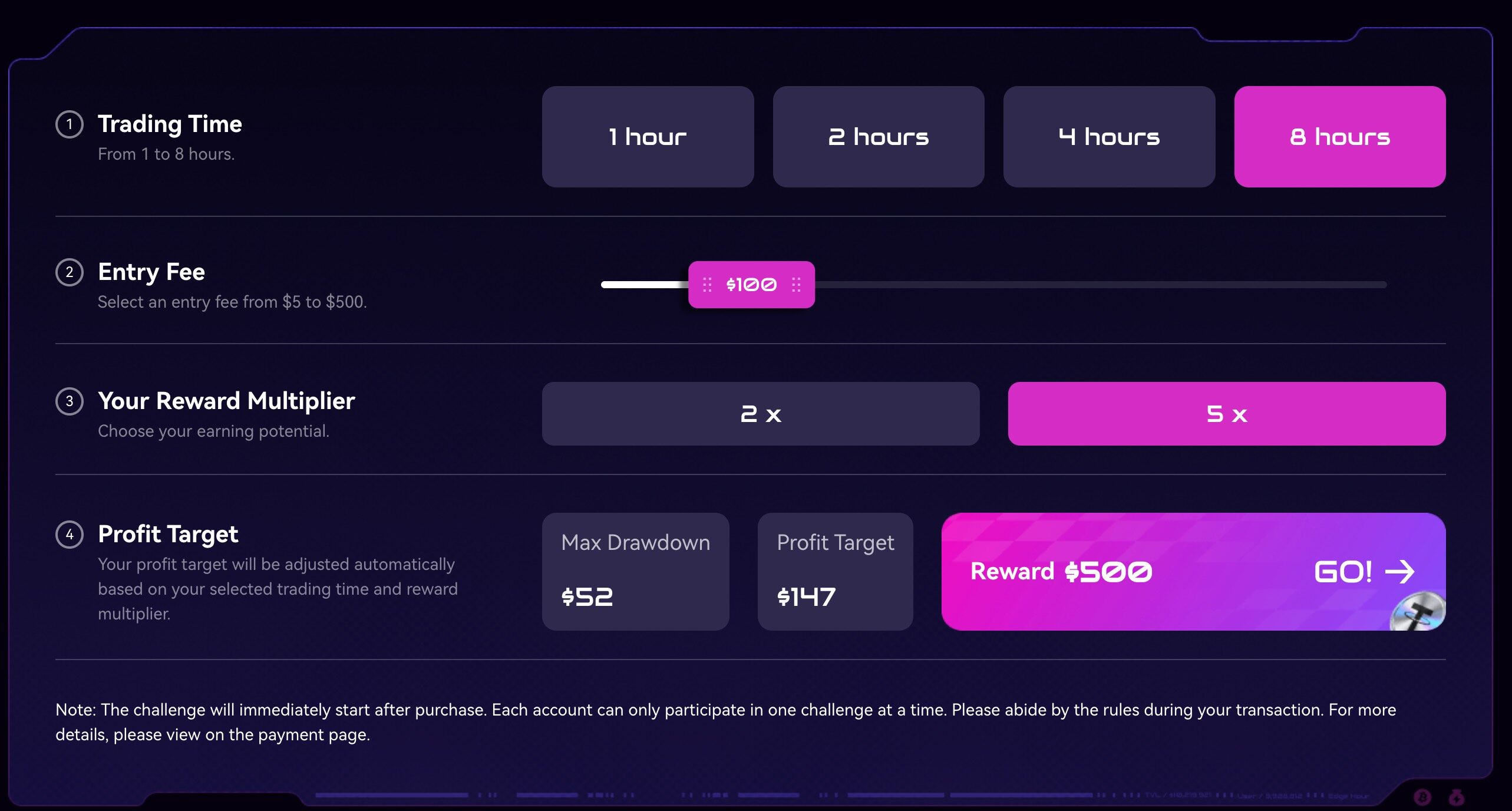
As shown in the image above, when I selected an 8-hour challenge cycle, a $100 entry fee, and a 5x reward, Edge Hour automatically provided a $147 profit target and a $52 drawdown limit. This means if I succeed in the challenge, I can receive a $500 reward; if I fail, I only lose the $100 entry fee.
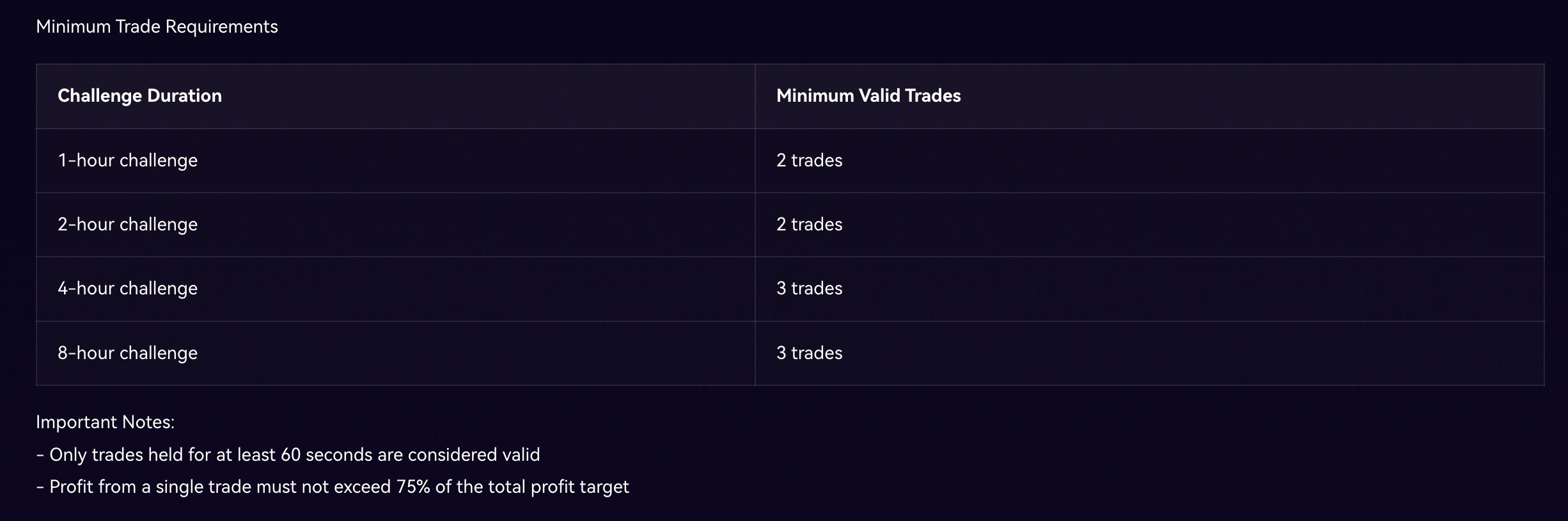
It’s important to note that to filter out speculative users and pure “luck-based” participants, Edge Hour requires users to hold each position open for at least 60 seconds. Different challenge durations also have different minimum trade count requirements (as shown in the image below), and the profit from a single trade cannot exceed 75% of the total profit target.
Regarding the reward mechanism, Edge Hour’s challenges and settlements are executed publicly and transparently on-chain. After the challenge ends, rewards are directly distributed to the user’s wallet, and all transaction records are verifiable.
Overall, Edge Hour’s participation process and profit structure are very clear — “Investment ➡️ Challenge ➡️ Success ➡️ Multiplier Return.” The logic is intuitive and offers a strong sense of competitive fun.
Six Core Advantages: Rewarding True Skillful Players
Around Edge Hour, DeriW has designed the product across multiple dimensions to provide traders with a competitive environment where they can best demonstrate their trading abilities, rewarding true “experts” with excess returns, all while ensuring fairness and transparency as much as possible.
Specifically, Edge Hour’s core advantages are reflected in the following six points.
- Fair Competitive Environment: Edge Hour provides all participants with the same virtual trading capital of 10,000 USDT, eliminating unfair factors arising from differences in capital size. Under this mechanism, victory or defeat is determined solely by trading skill and risk control ability. Compared to traditional leaderboard-style trading competitions, large-capital users no longer have a natural advantage, and small-capital traders also have a fair chance to compete. Furthermore, all trading data is recorded on-chain and verifiable, further ensuring transparent and credible results.
- Low Barrier, High Reward: Edge Hour lowers the participation barrier to an extremely low level, with a minimum entry fee of only 5 USDT. The user’s risk is capped at the loss of the entry fee, yet they can achieve reward multipliers of 2x to 10x. This structure allows traders to test strategies at a very low cost while having high profit potential, significantly lowering the barrier to entry.
- Shorter Competition Cycles: Traditional trading competitions often suffer from long cycles and extended waiting times. Edge Hour offers four challenge duration options: 1 hour, 2 hours, 4 hours, and 8 hours. Users can choose to participate based on their own schedule and receive feedback within hours, greatly improving participation efficiency.
- Focus on Genuine Trading Ability: Edge Hour ensures competition results are driven by genuine trading skill through several rules: each trade must be held for at least 60 seconds; profit from a single trade cannot exceed 75% of the target; there are requirements for minimum trade count and maximum drawdown. These rules aim to prevent high-frequency scalping and single-bet gambling, ensuring the challenge reflects a complete trading strategy.
- Social Referral: Edge Hour allows participants to invite friends during the challenge. Inviters can receive additional rewards, while invitees can get time extensions and fee discounts, thereby driving ecosystem growth through social propagation. This design combines trading competition with social referral, enhancing user engagement.
- Technical Guarantee: This is DeriW’s true ace in the hole. Edge Hour operates on DeriW Chain (a Layer3 network based on Arbitrum Orbit), featuring millisecond-level matching speed, zero Gas fees, high concurrent processing capacity (80,000 TPS), and on-chain transparent settlement. These ensure a smooth and fair challenge process.
Catering to Diverse Trading Needs, Filling a बाज़ार Gap
From a broader perspective, the launch of Edge Hour actually reflects the evolution of the Crypto trading ecosystem towards greater diversification.
In the early stages, Crypto trading primarily revolved around spot trading and long-term holdings. Subsequently, derivative tools like perpetual contracts gradually became popular, ushering the market into an era of high-frequency and leveraged trading. As the user base evolves, trading demands have further diversified — some pursue long-term investment, some prefer short-term volatility, and others wish to validate their strategic abilities in a fair competitive environment.
However, there remains a significant gap in the current market for such “trading skill validation” products. On one hand, traditional trading competitions lean more towards “capital size competition.” Leaderboard mechanisms often give large-capital users a natural advantage, making it difficult for small-capital traders with excellent strategies to stand out in long-cycle competitions. On the other hand, while Prop Trading Challenges emphasize skill assessment, their long cycles and complex rules make them ill-suited for the fast-paced nature of the Crypto market.
Edge Hour carves a new path between these two. By providing a unified starting point of 10,000 USDT in virtual capital, Edge Hour eliminates differences in capital size, making trading skill the sole variable. Through 1–8 hour challenge cycles, Edge Hour allows for rapid validation of trading results. The on-chain transparent settlement mechanism ensures the entire competitive process is publicly verifiable and immutable.
From this perspective, Edge Hour is not merely a product feature innovation; it also introduces a new paradigm for competitive trading in the Crypto market — participating at a lower cost, completing challenges within a short timeframe, and determining outcomes based on trading ability rather than capital size.
The emergence of this model also signifies that the form of trading products is evolving from “mere trading tools” to a comprehensive experience of “trading + competition + social interaction,” with Edge Hour being a representative attempt under this trend.
A New Direction for Decentralized Trading
For DeriW, the launch of Edge Hour not only enriches its product matrix but also further strengthens its differentiated positioning within the decentralized derivatives sector.
Over the past few years, competition among decentralized trading platforms has primarily focused on liquidity, fees, and performance. As the market matures, user experience and product form innovation are becoming new competitive dimensions. In other words, those who can provide a more engaging, fairer, and more entertaining trading environment are more likely to attract the new generation of trading users.
Against this backdrop, Edge Hour was born — it integrates trading skill validation, risk control training, and competitive experience, transforming trading from an isolated operational act into a participatory, comparable, and shareable interactive experience. Industry trading demands will continue to segment, and user structures will keep evolving. Short-cycle, skill-oriented competitive trading products like Edge Hour may become an important component of the next phase of the Crypto trading ecosystem. Meanwhile, DeriW will leverage Edge Hour to accelerate its evolution from a “trading platform” to a “trading ecosystem.”
यह लेख इंटरनेट से लिया गया है: Starting at $5, Decided in Hours: DeriW Trading Competition Edge Hour Officially Launches
Related: Musk’s Terafab: One Man Challenges the AI Chip Dominance
Tesla, SpaceX, and xAI are jointly building Terafab—a $250 billion 2-nanometer chip fabrication plant. It integrates chip design, lithography, manufacturing, packaging, and testing all under one roof. The first product, Tesla AI5, boasts single-chip performance close to NVIDIA’s H100, with claimed inference costs 10 times cheaper. Sample chips are planned for late 2026, with mass production in 2027. Target capacity: 1 terawatt of AI computing power annually—50 times the current global total AI computing power. 80% of these chips will be sent into space, running AI on satellites and distributed back to Earth via Starlink. Only 20% will remain on Earth. Because the electricity required for 1 terawatt of computing power is simply beyond what Earth’s power grid can supply—space offers 5 times the solar radiation, higher vacuum cooling efficiency,…
相关文章
































 हिन्दी
  English
  繁體中文
繁體中文  简体中文
简体中文  日本語
日本語  Tiếng Việt
  العربية
  한국어
한국어  Bahasa Indonesia
  اردو
اردو  Русский