







Lobster Skill is Just the Appetizer, OpenClaw is Recreating the Eve of the iPhone’s Explosion
Even during the National Two Sessions, Gao Wen, a National People’s Congress deputy and academician of the Chinese Academy of Engineering, mentioned this phenomenon in his speech, saying, “Now everyone is extremely anxious, afraid they haven’t started ‘raising a lobster’.”
However, now that we have the “lobster,” what exactly are people using it for? A relatively normal and ideal case study might look like this:
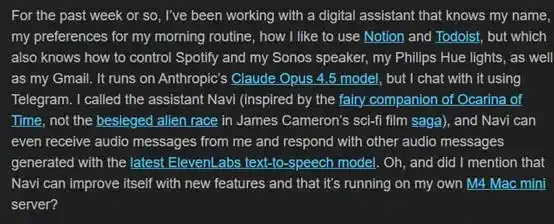
“For about the past week, I’ve been using a digital assistant that knows my name, understands my morning routine, knows how I like to use Notion and Todoist, and can also control Spotify, my Sonos speakers, my Philips Hue lights, and my Gmail. It runs on Anthropic’s Claude Opus 4.5 model, but I communicate with it via Telegram. I named this assistant Navi. Navi can even receive my audio messages and generate other audio responses using the latest ElevenLabs text-to-speech model. Oh, and I haven’t mentioned that Navi can self-improve through new features, and it’s running on my own M4 Mac Mini server?”
The author of the above case study also mentioned that he has already burned through 180 million tokens on the Anthropic API, possibly spending $2000 to “raise the lobster.”
It might sound like the cost of “raising a lobster” is not low, and what it can do doesn’t seem that grand. It’s more like a “XX Assistant” that can communicate with people in a human-like way and help humans complete more automated tasks. In fact, this is precisely the role the “lobster” can play at this stage—an “AI assistant.”
If we look at the top 100 installations on ClawHub and roughly categorize them, we can better appreciate that using large language models for these tasks might often be “using a sledgehammer to crack a nut”:
– Information Retrieval: Searching, extracting, integrating, and summarizing information from various sources (external links, local files, APIs). Practical use cases include having your Google, Baidu, etc., searches AI-optimized and summarized, having the “lobster” send you daily weather forecasts, real-time Bitcoin prices, etc.
– Productivity (Workflow Automation): Handling emails, Notion, GitHub, Obsidian, Slack, etc., and further enabling cross-platform task automation to simplify workflows, solving multi-platform issues through a single entry point.
– Developer औजारs: Professional tools for developers and technical users, providing code management, API interaction, server management, etc. Can improve development efficiency and automate code, testing, and deployment. These resonate with programmers, such as interacting with GitHub via command line, handling issues, PRs, CI runs, and advanced queries.
– Content Creation: Utilizing AI’s generative capabilities to create or edit multimedia content like text, images, and audio.
– IoT Control: Connecting and controlling smart home devices, audio systems, and other smart home hardware. For example, having curtains and lights open/close at specified times.
Overall, the “lobster’s” viral popularity isn’t because it excels at the above tasks, but because it can do them comprehensively like a “secretary.” Compared to most users who might simply use an AI tool as a search engine or an automatic photo editor, the “lobster” allows people to use chat software like Telegram to assign various types of tasks to it in a conversational manner, as if talking to a boss. This novelty gets amplified through word-of-mouth, arguably unprecedented since AI entered people’s lives.
We can even view the current phase where the “lobster” seems to have “nothing to do” from a more optimistic perspective. In the early days of the iPhone, we could only use it to play games like Labyrinth, Angry Birds, Fruit Ninja—games that “demonstrated what a touchscreen could do.” In terms of content and fun, they might not have been as good as the many JAVA games on Nokia. But now, young people play Honor of Kings, Delta Force on their phones, and many only play mobile games, not PC games.
If we turn our gaze to the current क्रिप्टोcurrency market, the “lobster” could once again significantly lower the learning barrier between क्रिप्टोcurrency and the general public, and tangibly address the widespread investment needs of the masses.
This, of course, does not refer to trading memecoins or using the “lobster” to launch tokens. Nowadays, the variety of tradable assets on-chain is increasingly rich—US stocks, crude oil, gold, Pokémon cards… we can trade them all on-chain in a decentralized, 24/7, barrier-free manner. This trading volume is not small at all. On February 6th, Hyperliquid’s on-chain Perp DEX, Trade.xyz, which focuses on US stock trading, saw a 24-hour trading volume of $5.45 billion, hitting a record high.
In an era of abundant information, what often prevents us from capturing new investment opportunities is “not knowing how to get started.” For example, a while ago, memory prices surged. Everyone could get this information, but for non-Korean citizens, directly buying SK Hynix stock was quite troublesome. Account opening, fund settlement, etc., hindered the public from making immediate investment moves based on such information.
But if the path becomes:
– Let the “lobster” have a wallet
– Use a credit card to buy stablecoins and fund the “lobster” wallet
– Tell the “lobster” the specific asset you want to invest in
– The “lobster” completes the buy/sell on-chain
And all of this is done simply through chatting like with a friend, this would undoubtedly be an explosive growth opportunity for both the “lobster” and cryptocurrency.
We also have prediction markets, so we can imagine even more. For example, while taking a taxi, chatting with the driver. The driver says he thinks the next US president will be A, you think it will be B. When you can’t agree, you use voice-to-text to give your “lobster” an instruction—help me place a $100 bet that B will win.
Your “lobster” understands your intent, automatically finds the prediction market with the best liquidity to place the order. The driver immediately follows, using voice commands through the car’s infotainment system, and also uses his “lobster” to place a $100 bet on A winning in the prediction market.
We might even need the “lobster” to implement minor spending control features to prevent kids from making impulsive purchases on-chain card markets while showing off their Pokémon cards to each other.
If the “everything tokenization” memecoin trend sparked by pump.fun was version 1.0 of the attention economy, then this new paradigm of ordinary people using AI more simply, like the “lobster,” has the potential to become version 2.0—it can find any asset and channel we want to invest in instantly on-chain and execute according to our intent. Furthermore, it could expand the on-chain ecosystem from investment to consumption, truly unlocking the Mass Adoption that blockchain has pursued for years.
The future is happening.
यह लेख इंटरनेट से लिया गया है: Lobster Skill is Just the Appetizer, OpenClaw is Recreating the Eve of the iPhone’s Explosion
Related: Beyond Self-Criticism, What Else Is Vitalik Pondering?
Starting from the second half of 2025, he has been posting lengthy articles intensively on Twitter, with a frequency, length, and breadth of topics rarely seen in his public discourse over the past decade. This does not resemble a successful founder preaching, but more like an anxious thinker trying to rekindle something from the ruins. We have reviewed all his public tweets from 2025 to the present and found his interests to be extremely broad: from underlying consensus mechanisms to upper-layer social governance, from cryptography to AI ethics, from geopolitics to social media, all bear traces of his deep contemplation. Amidst these diverse topics, we attempt to distill the keywords he mentions most frequently and the core propositions he cares about most. These thoughts not only concern the future of…
相关文章
































 हिन्दी
  English
  繁體中文
繁體中文  简体中文
简体中文  日本語
日本語  Tiếng Việt
  العربية
  한국어
한국어  Bahasa Indonesia
  اردو
اردو  Русский