







Have the Key “Contributors” Successively Departed, Shattering Aave’s DAO Dream?
On March 3rd, Aave Chan Initiative (ACI), the core governance team of the Aave protocol, announced it would cease operations and exit AAVE.
This is the second major contributor to leave within two weeks—previously, on February 20th, BGD Labs, the development team for the Aave V3 codebase, announced its departure.
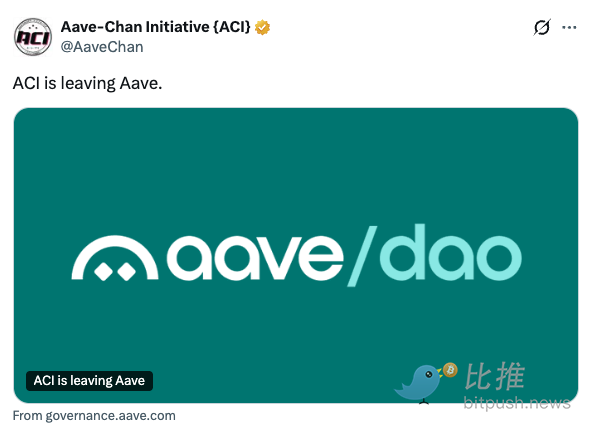
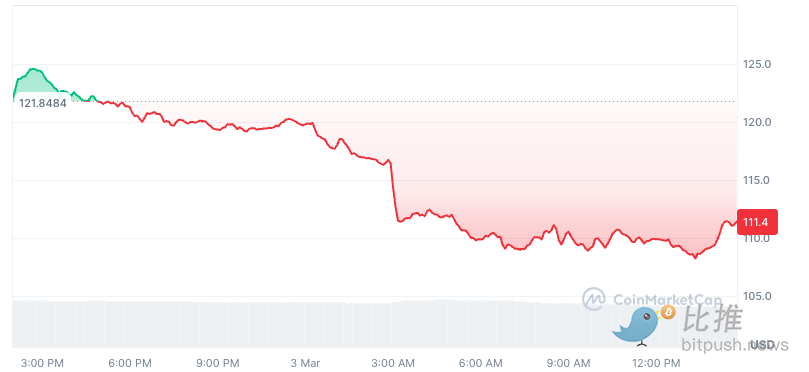
Following the announcement, the price of the AAVE token fell by over 11%.
As one of the most successful DAOs (Decentralized Autonomous Organizations) in DeFi history and a leading DeFi protocol with nearly $27 billion in TVL, it is experiencing profound internal turmoil.
From Revenue Attribution Disputes to Bundled Voting
The seeds of this crisis were sown as early as last December.
At that time, Aave Labs switched the transaction aggregator on its frontend interface from ParaSwap to CoW Swap without prior governance discussion. The fees that originally flowed to the DAO treasury were instead directed to Aave Labs’ account.
Faced with questions, Aave founder Stani Kulechov responded that the frontend was built by Labs, so its revenue naturally belonged to Labs; only the smart contracts and liquidity pools belonged to the DAO. While this explanation held water legally, it sparked discontent within the community.
To quell the controversy, Aave Labs proposed a plan called “Aave Will Win” in February this year. The main contents included: requesting DAO approval for approximately $51 million in funding for V4 development. In exchange, all future revenue from Aave-branded products would be allocated to the DAO, and Aave V4 would be established as the sole technical foundation, gradually phasing out V3.
The problem was that these three matters were bundled together. Support revenue going to the DAO but think the funding amount is too large? No choice. Believe V3 still has value and shouldn’t be sidelined? Also no choice. It was either accept the entire package or reject it entirely.
ACI’s Grievance: Opaque Voting
In its exit statement, ACI’s core accusation was that a significant portion of the votes supporting the proposal came from addresses associated with Aave Labs. The temperature check vote passed by a narrow margin of 52.58%, and ACI believes the outcome might have been different without these “self-votes.”
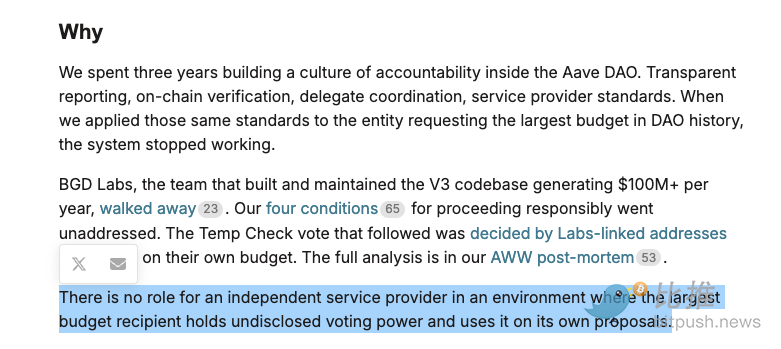
ACI founder Marc Zeller wrote: “If the largest budget recipient can use its undisclosed voting power to force through its own proposals, then independent service providers lose their raison d’être within the DAO.”
ACI did try to address the issues. Before the vote, it proposed four conditions, including stricter on-chain milestone tracking and restrictions on budget recipients self-voting, but none were adopted.
This conflict highlights structural issues in DAO governance.
Aave Labs controls the codebase, brand domains, social media, and development discourse. BGD Labs maintains the main version V3—which contributes over 75% of the protocol’s revenue and 97% of its total deposits. ACI is responsible for governance coordination and business development, claiming to have driven 61% of governance actions over the past three years and helping Aave’s DeFi market share grow from under 50% to over 65%.
These three teams were meant to check and balance each other. But with BGD and ACI leaving one after another, it’s hard to be fully reassured by the remaining power center, regardless of its statements.
Stani Kulechov responded after ACI’s announcement: “Thank you Marc for years of contributions, the protocol will continue to operate normally.”
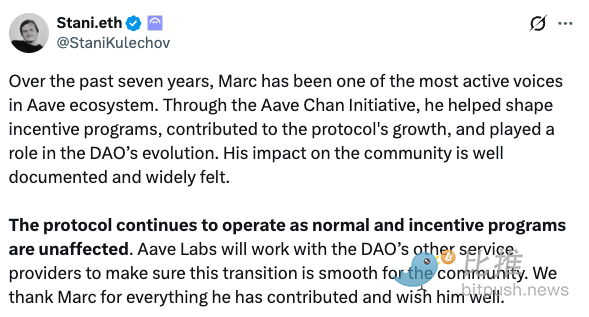
But this response didn’t address the core issue: when the people most capable of assessing V3’s technical risks have already left, how can the DAO confidently stake its future on the untested V4?
Another noteworthy detail is that institutional investor Blockchain Capital later stated that their AAVE holdings could not participate in the snapshot vote because their custodian platform did not support it. This reveals another reality of DAO governance: while nominally a collective decision by token holders, voting power is often concentrated in the hands of a few.
The Governance Dilemma of DAOs
ACI stated that during the four-month transition period, it will transfer or open-source tools and responsibilities such as the governance dashboard, incentive frameworks, and committee roles. But some things are hard to transfer: three years of accumulated governance experience, familiarity with protocol details, and the interpersonal networks for coordinating different stakeholders.
Data shows that ACI spent $4.6 million from the DAO over the past three years, helping the GHO stablecoin grow from $35 million to $527 million. Who will take over this work in the future remains unknown.
This turmoil at Aave is essentially a microcosm of the governance dilemma faced by DAOs.
In theory, a DAO is a community of token holders. But in practice, governance is often dominated by founding teams, early investors, and core developers. These roles are rule-makers, rule-enforcers, and sometimes budget recipients. When conflicts of interest arise, whether “procedural justice” is sufficient becomes the focal point of controversy.
A DeFi practitioner commented: “This isn’t about who’s right or wrong, but about the fact that when interests and positions diverge, the existing governance mechanisms don’t provide an effective way to resolve it.”
What Happens Next?
The revisions to the “Aave Will Win” proposal during the ARFC stage will be the first window to observe the direction of events. If Kulechov’s promised “structural improvements” materialize—unbundling the proposal package and clarifying the boundaries of voting behavior—it might draw a line under this turmoil.
If consensus cannot be reached, the most extreme possibility is that BGD and ACI could start anew, forking a new protocol. Although liquidity barriers are high, it’s not impossible—the simultaneous departure of core developers and the governance team provides both the technical foundation and community basis for a fork.
For Aave, the immediate problem is how to fill the void left by the departure of two core teams. The longer-term issue is how to find a more sustainable balance between the founder’s vision, the interests of core developers, and the will of the community. If it cannot resolve the paradox of “power concentration,” even the strongest protocol may lose its first-mover advantage in endless internal strife.
यह लेख इंटरनेट से लिया गया है: Have the Key “Contributors” Successively Departed, Shattering Aave’s DAO Dream?
According to the official announcement from JustLend DAO, this burn corresponds to an estimated value exceeding $21 million. Combined with the amount from the first JST burn, the cumulative number of JST tokens burned has reached 1,084,890,753, accounting for 10.96% of the total supply. This means that in less than three months, JST has achieved the permanent removal of over one-tenth of its total supply, demonstrating an astonishing deflationary pace. From a broader perspective, this burn marks a fundamental evolution in JST’s value narrative. It is transitioning from a governance token to an equity-like asset anchored to the growth of ecosystem cash flows. This process not only enhances the scarcity and value foundation of the JST token but also provides a clear, actionable path for the decentralized finance sector—one where…
相关文章

































 हिन्दी
  English
  繁體中文
繁體中文  简体中文
简体中文  日本語
日本語  Tiếng Việt
  العربية
  한국어
한국어  Bahasa Indonesia
  اردو
اردو  Русский