








CZ’s one-two-three punch sparks a surge in interest for a 16-year-old’s on-chain CPU project

Over the weekend, CZ’s one-click trifecta — like, comment, and follow — once again thrust TapeOut, a protocol launched by a developer who is only 16 years old, into the spotlight.
On August 15, a developer named Blonskr announced the creation of an on-chain CPU on BNB Chain, which he dubbed Behemoth, proudly declaring, “This is one small step for me, but a giant leap for BNB Chain.” The announcement initially made little waves in the community, until the next day when CZ commented on and followed the young developer, setting the wheels of fate in motion…
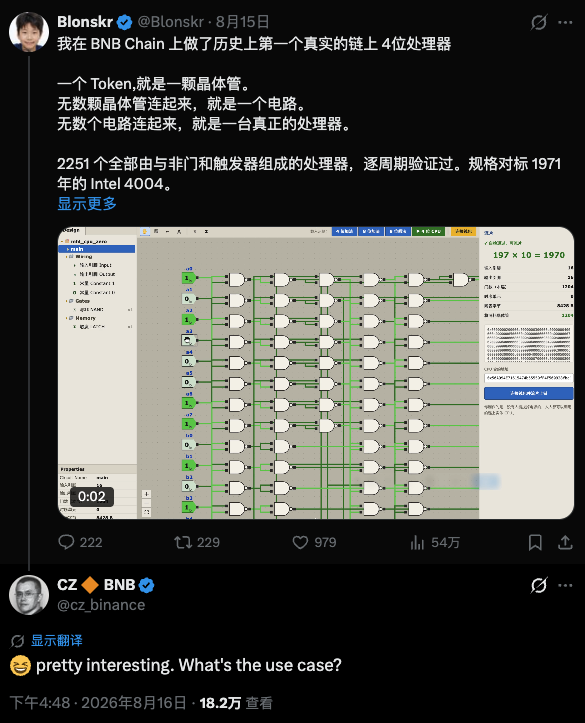
TapeOut: On-Chain Hardware Manufacturer Infrastructure, Mint 代幣 Returns Already Up 18x
The on-chain CPU Behemoth praised by CZ was designed by Blonskr using his TapeOut Protocol, which he positions as infrastructure for on-chain hardware manufacturers. While it may sound impressive, the protocol hasn’t introduced any new asset types or protocol standards — it essentially remains an EVM mining machine game model, just with a “circuit design” gameplay twist.
The TapeOut protocol features two asset types: the multi-token standard ERC-1155 and NFT (ERC-721). Burning ERC-1155 tokens generates NFT mining machines. The protocol is still in its early stages, and the NFT miners cannot yet produce new tokens — though Blonskr claims this feature is already in development.
In the TapeOut universe, “one token equals one transistor.” To simulate real circuit design, transistors (tokens) are divided into NAND gates and LATCH flip-flops. To assemble a circuit, users must first mint or purchase these two token types, then arrange and drag them on the TapeOut circuit canvas. Once the circuit is complete, clicking “tape out to chain” mints the circuit NFT, which users can view in their portfolio.
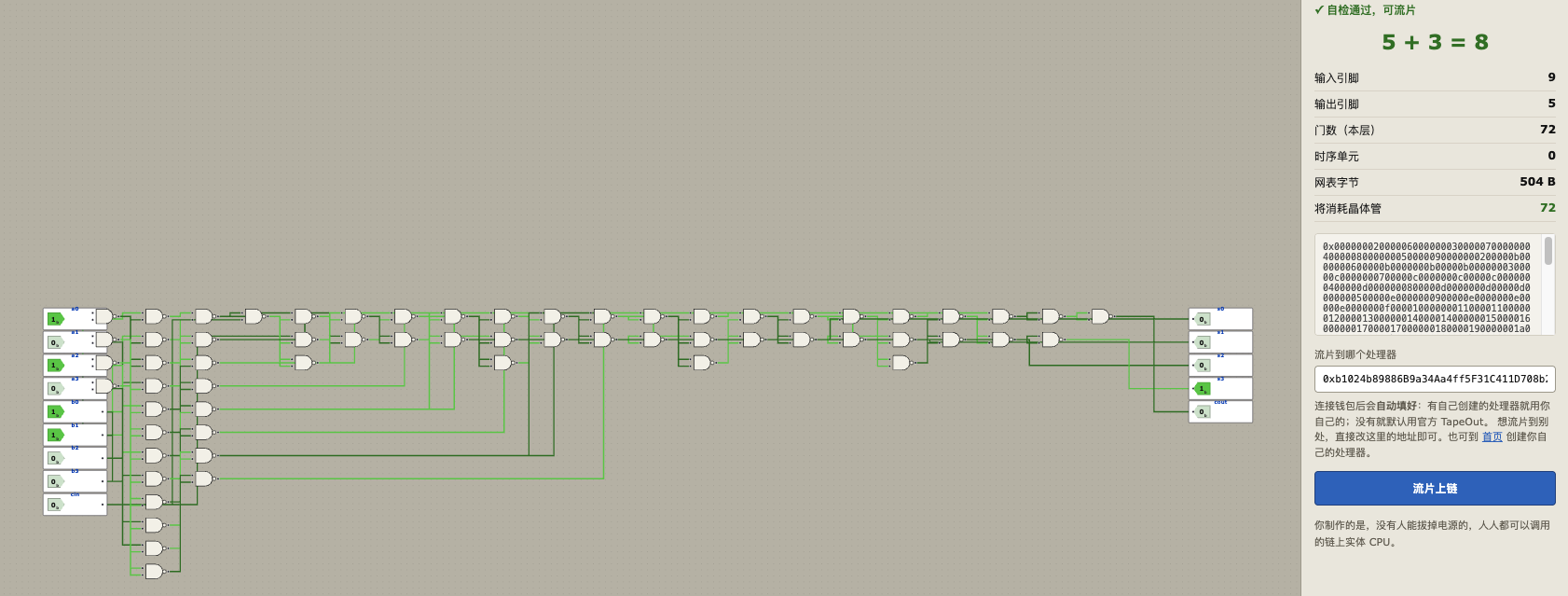
TapeOut’s circuit canvas
These NFTs are also divided into different collections, with each collection requiring different transistor tokens to mint. Users can also launch their own NFT collections, specifying the number of NFTs, the required transistor count for minting, and the mint price of transistors. For instance, the most popular circuit NFT collections currently are Behemoth and TapeOut, both launched by Blonskr himself.
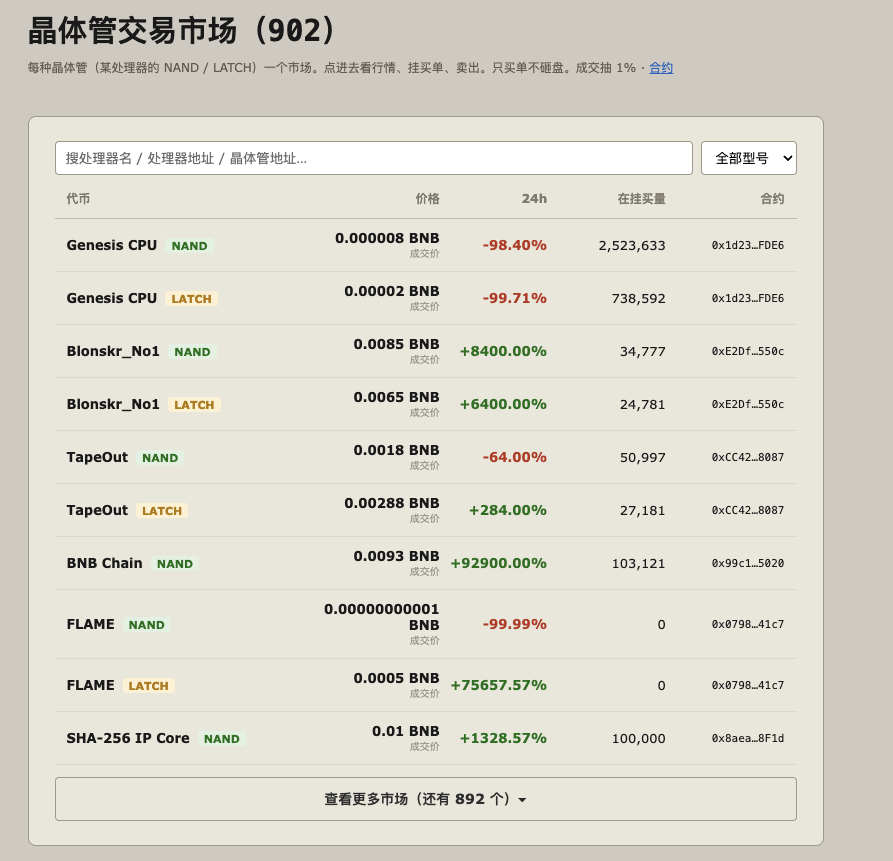
The team hasn’t launched an NFT 市場 yet, but a transistor token exchange is already live, utilizing a DEX on-chain order book. Behemoth and TapeOut transistors have both been fully minted, so acquiring these specific transistors requires purchasing them on the secondary market.
As shown below, in the official transistor exchange, Behemoth (Blonskr_No1) NAND transistors have surged to 0.0085 BNB — a 17x increase from the mint price of 0.0005 BNB — while its LATCH transistors have also risen 13x. Synthesizing circuit NFTs burns transistor tokens, but the market’s current speculative focus remains primarily on transistor token prices, with no significant price action on the synthesized circuit NFTs yet.
According to official data, TapeOut’s trading volume over the last 24 hours has reached 1,300 BNB, approximately $800,000.
Overall, TapeOut feels like a circuit design mini-game — somewhat entertaining but with limited replayability. For those with a purely liberal arts background or lacking knowledge of electronic circuits, there remains a learning curve, and assembling circuits can be daunting without 人工智慧-assisted learning.
A 16-Year-Old Idealist?
In reality, TapeOut isn’t a particularly complex project — it just layers some knowledge about CPUs and circuit design to create an entry barrier. TapeOut’s future trajectory is also fairly predictable: it will likely embrace the on-chain mining machine narrative. For on-chain miners, veteran 加密貨幣 players are all too familiar with this model. Despite the various twists and combinations, the essence remains the same: buying NFT miners to mine tokens, with investors calculating payback periods and project teams focusing on managing token deflation mechanisms and market prices.
According to KOL Wang Dayou’s disclosure, Blonskr is a developer who is just 16 years old and has primarily built small applications before. Compared to most of his peers, Blonskr is already quite accomplished. He appears to be an idealistic teenager stepping into the crypto world, still brimming with curiosity about the on-chain universe. While TapeOut may not be polished, it represents his own way of creating something at this age.
For a 16-year-old who hasn’t yet fully shed his illusions about the world, earning CZ’s attention is already a point of pride — after all, others in the past have been dubbed “crown princes” thanks to CZ’s attention and comments. However, once TapeOut enters its financialization phase, it means some people will make money from it, while others will lose money.
At that point, the question remains: can Blonskr withstand the fury and criticism from those who’ve suffered losses in the crypto space, and can he maintain his idealism on this unexpected journey into the mainstream? It’s a cause for concern.
本文源自網路: CZ’s one-two-three punch sparks a surge in interest for a 16-year-old’s on-chain CPU project
Related: NOXA exits the stage, who will claim the crown of Robinhood Chain token issuance?
Author: Asher (@Asher_ 0210) NOXA, the hottest token launch platform on Robinhood Chain, suddenly announced the suspension of its token issuance business during peak traffic. Over the past ten days, NOXA has almost dominated the Meme hype on Robinhood Chain. The platform issued approximately 60,000 tokens in total, once accounting for over 75% of all new token issuances on the chain. It also gave rise to CASHCAT, a Meme coin with a market cap peaking above $200 million. Additionally, NOXA’s cumulative protocol fees exceeded $14.5 million, with daily fees for several consecutive days before the crash even surpassing those of Pump.fun. However, this explosion lasted less than two weeks before NOXA exited the scene due to ownership disputes. Who can take over from NOXA and become the next leading token…






























 繁體中文
繁體中文  English
  简体中文
简体中文