








MSX US Stock Daily Watch: FMS 2026 Storage Summit: HBF Standard Debuts, Samsung, SK Hynix, and Micron Bet Big on Capacity
Today’s Observation
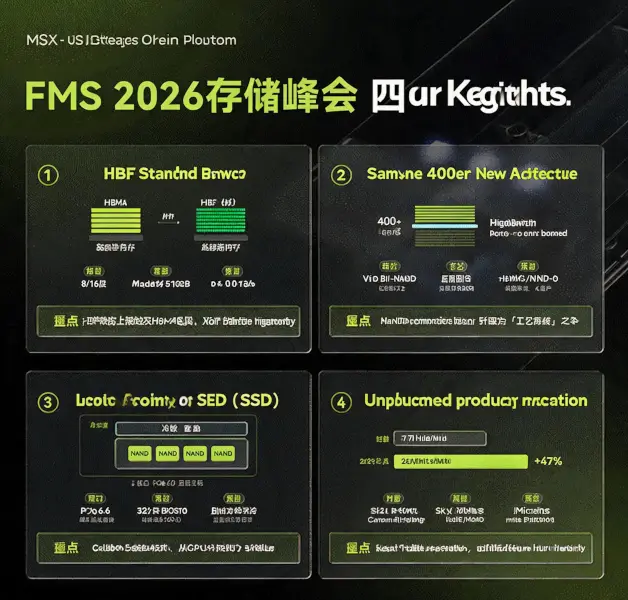
FMS 2026 was held August 4–6 in Santa Clara, USA, marking the 21st edition of the world’s largest independent storage industry summit. At the same event, three industry giants presented three mutually incompatible answers to the “人工智慧 memory wall”: SK Hynix and SanDisk jointly released the first standard specification for High Bandwidth Flash (HBF), adding a new tier beneath HBM; Samsung unveiled BV-NAND with over 400 layers, employing a wafer bonding process for the first time in the industry; and Kioxia integrated direct cold-plate liquid cooling into enterprise SSDs for the first time, tackling constraints from the thermal management side.
Data in a Minute
• The first HBF standard specification was released by SK Hynix and SanDisk through OCP, supporting 8-layer and 16-layer stacking with a maximum single-device capacity of 512GB
• HBF read bandwidth ranges from 0.4–3.0 TB/s, with the upper limit entering HBM4’s bandwidth territory, yet it is officially positioned as a new tier below HBM rather than a replacement
• Samsung unveiled V10 BV-NAND with over 400 stacked layers, marking the industry’s first use of wafer bonding technology
• Samsung also previewed zHBM and zNAND-O, both still in the concept stage and not yet in mass production
• SK Hynix released its 10th-generation 375-layer 4D NAND, achieving a 2.5x improvement in power efficiency over the previous generation
• Kioxia’s CM10 is the first enterprise SSD to combine PCIe 6.0, 332-layer BiCS10, and direct cold-plate liquid cooling
• Reports indicate Samsung plans to increase monthly HBM production from approximately 170,000 wafers to approximately 250,000 wafers, a gain of roughly 47%, targeting completion by end of 2026
MSX View
The most noteworthy signal from this summit lies not in any single product, but in the shifting role of storage within 人工智慧 systems. Thermal budgets have spilled over from GPUs all the way to SSDs, and the addition of a new tier beneath HBM all point to the same conclusion: storage has become a constraint on whether compute can run at full capacity. It’s worth noting that while HBF’s bandwidth ceiling has reached HBM4 territory, its underlying medium remains flash memory, with latency and write endurance on a different scale from DRAM. Its official positioning is always as an incremental tier, not a replacement—a nuance most prone to being amplified and misinterpreted in media coverage. What deserves closer attention is that the three routes are mutually incompatible, industry standards are far from converging, yet all three companies have simultaneously committed production capacity. Capacity decisions are made far ahead of demand realization—this is precisely the root cause of the storage cycle. In the short term, synchronized capacity expansion is a signal that AI demand has been jointly confirmed by all three players; in the medium term, whether supply timing aligns with demand is the true variable of this cycle.
About MSX
MSX is a leading RWA trading platform dedicated to providing secure, efficient, and transparent access to global financial markets. As one of the earliest on-chain US stock trading platforms in the world, MSX has consistently remained at the forefront of the industry, driving market transformation through continuous innovation.
The platform deeply integrates blockchain technology with a compliance framework, offering comprehensive spot and derivatives trading for nearly 400 tokenized stocks and Pre-IPO assets, perfectly bridging the gap between traditional finance and the digital asset industry.
Centered on the core mission of “enabling free circulation of high-quality assets,” MSX has built a diversified digital financial services ecosystem encompassing US stock spot and perpetual contracts, 加密貨幣-to-加密貨幣 trading, Pre-IPO, and the MSX Research Institute, designed to provide global investors with round-the-clock, high-performance access to premium assets.
Official Website: https://msx.com/
Now available globally on the App Store and Google Play.
Risk Disclosure: Macroeconomic conditions and US stock market fluctuations are highly volatile. This content is provided solely for academic and research observation purposes by the MSX Research Institute and does not constitute any investment advice.
TL;DR Goldman Sachs expects most semiconductor sub-sectors to have room for upward revisions in Q2, but the SOX has already risen approximately 87.8% in the single quarter. AI capex, DRAM/HBM, advanced packaging, and EDA tools are the primary drivers of this round of earnings upgrades. Goldman Sachs prefers AMD, AMAT, and ON, while being more cautious on ARM and KLAC; Qnity requires holding an attitude subject to limitations after its price surge. Semiconductors Still Have Room for Upgrade, but the AI Chain is Starting to Diverge Goldman Sachs reported that Q2 results or subsequent guidance for companies in computing, memory storage, semiconductor equipment, and some analog semiconductor firms could still exceed market expectations. The main theme in the computing sector remains AI servers. Server CPU demand, cloud provider ASIC projects,…































 繁體中文
繁體中文  English
  简体中文
简体中文