








From “Fear of Missing Out” to “Fear of Holding”: How Long Will the Momentum Sell-off Last? This is the biggest suspense in the current market.
Original Source: Wall Street Sights
Beneath the seemingly calm surface of global stock markets, a historic collapse of momentum strategies is accelerating. Goldman Sachs trader Benny Quek warns that positions in 人工智慧 and the tech sector are far from cleared, and volatility will persist in the third quarter.
The momentum factor has fallen for five consecutive weeks, with levered ETFs experiencing a historic crash. 市場 sentiment has swiftly shifted from “fear of missing out” (FOMO) to “fear of holding” (FOHO). Meanwhile, the core narrative of AI is shifting from capital expenditure to profit margins and returns on investment, with credit spreads for hyperscale cloud operators widening sharply, putting pressure on the market.
Multiple pressures are building simultaneously — geopolitical conflicts, oil price fluctuations, interest rate trends, and the resurging risk of tariffs are all vying to dominate market pricing. Goldman Sachs’ risk appetite indicator remains elevated, while the implied correlation among S&P 500 constituents is extremely low. This combination provides structural support for going long on index volatility.
Momentum Collapse Enters Fifth Week, Levered ETFs Bear the Brunt
The rout of the momentum factor represents the most prominent structural feature of the current market.
According to Goldman Sachs trader Benny Quek in his latest “Weekend Thoughts” report, the unwinding of momentum strategies has been ongoing for five consecutive weeks, accompanied by a historic crash in levered ETFs.
Taking the South Korean market as an example, the size of levered ETFs has halved from a peak of $53 billion to roughly half. Levered exposure as a percentage of market free-float market cap has fallen from a peak of 3.3% to 2.1%.
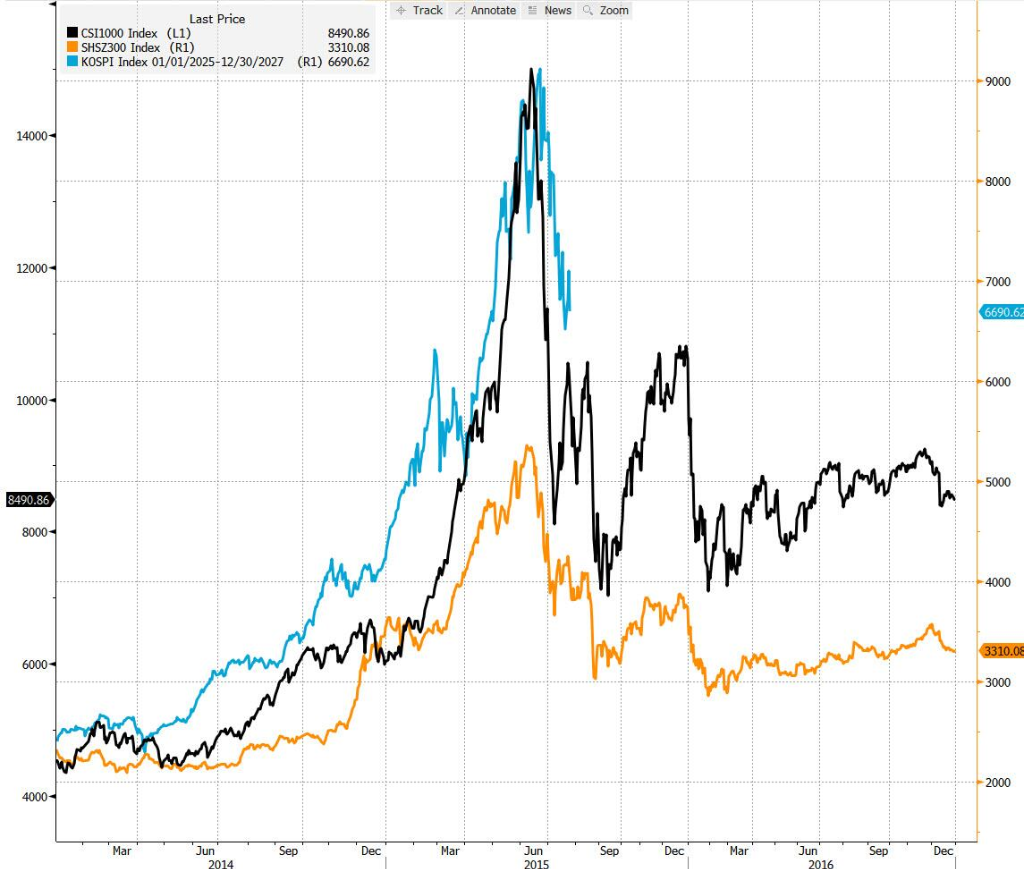
The daily rebalancing flows for Samsung and SK Hynix, as a percentage of average daily trading volume over the past month, have also fallen sharply from 40% and 26% to 15% and 14%, respectively. The KOSPI has fallen for five consecutive weeks, presenting an unsettling parallel to the trajectory of China’s CSI 1000 index from 2014 to 2015.
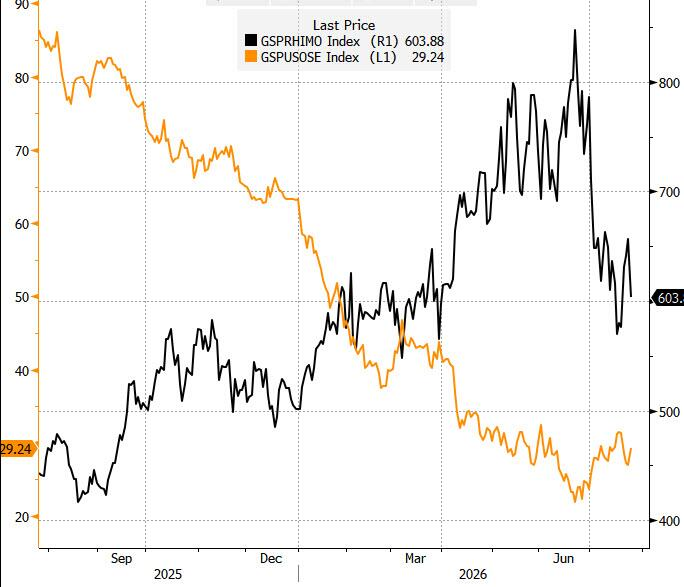
The US market is also under pressure. The high vs. low momentum stock pair dropped 8% in a single day last Friday. Although it still finished the week up 4%, the sheer volatility vividly reveals the fragility of positions.
AI Narrative Shifts, Hyperscale Cloud Credit Spreads Under Pressure
The logic of the AI trade is undergoing a fundamental transformation.
Quek notes that market focus has shifted from the headline capital expenditure figures of hyperscale cloud operators to more pressing core issues: profit margins, return on investment, and the continuously rising scale of debt issuance.
Goldman Sachs estimates that AI-related bond supply has reached $489 billion year-to-date, with 40% coming from hyperscale cloud operators. This is equivalent to 1.5 times the total forecasted amount for the full year 2025. Concurrently, credit spreads for hyperscale cloud operators are widening sharply, making the pressure from rising debt financing costs unavoidable.
From a market cap perspective, the S&P 500’s market value has increased by $31 trillion since December 2022. Goldman Sachs’ estimates for AI’s potential value are $9 trillion, $8 trillion, and $28 trillion under base, optimistic, and blue sky scenarios, respectively. This comparison suggests that the current market expansion has already priced in a significant portion of AI’s potential upside.
Positions Far From Cleared, Volatility Remains the Theme for Q3
Quek explicitly states that he believes positions in AI, tech, and momentum strategies are far from reaching the “clean” state anticipated by the market. He maintains a high degree of vigilance regarding sustained high volatility in the third quarter.
He favors a “barbell” strategy to navigate the current environment, simultaneously allocating to defensive assets and select offensive positions to cope with directionless choppy markets.
From a technical indicator perspective, although volatility at the individual stock and factor level has surged dramatically, the implied correlation among S&P 500 constituents remains at extremely low levels. Quek points out that this divergence provides an additional structural reason for being long index volatility — low correlation means index-level volatility is underestimated. If correlation rebounds, index volatility will be amplified.
Goldman Sachs’ risk appetite indicator currently remains elevated, suggesting that overall market sentiment has not fully priced in the aforementioned risks. This further supports a cautious outlook on volatility.
Rotation and Divergence: Structural Opportunities in Asian Markets
Despite the overall pressured environment, signs of capital rotation are quite evident in Asian markets. The Jakarta Composite Index (JCI) in Indonesia has rebounded 16% from its lows, and India recorded the strongest monthly foreign inflows in the region. Capital is rotating from high-momentum, high-valuation sectors toward assets with more defensive and value-oriented characteristics.
From a sector perspective, the rotation trend is even clearer. The relative price ratio of software stocks versus semiconductors has broken above its 50-day moving average, indicating that structural rebalancing within the market is still underway.
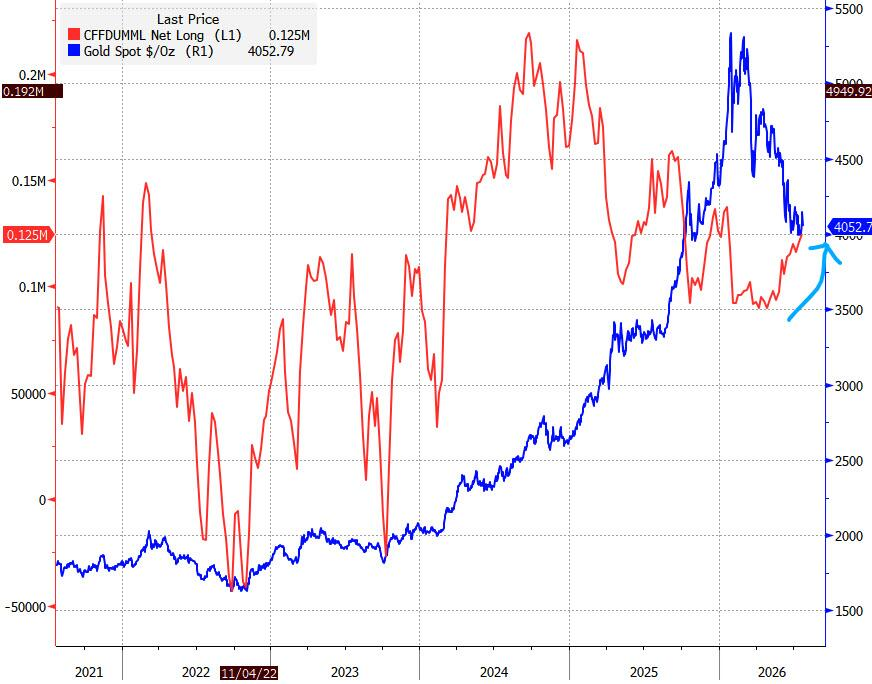
此外, the gold market is showing notable signals. CFTC gold futures positioning is increasing, an indicator historically leading spot gold prices. Meanwhile, China’s gold imports in June rose to a two-year high, meaning the underlying support from safe-haven demand cannot be ignored.
Quek also expects that with the US midterm elections approaching, the market will face more headline-driven volatility.
Historical data shows that US stocks typically trade sideways in the run-up to midterm elections before trending higher afterward. This pattern may provide a temporary temporal anchor for the currently pressured market. However, before that, how long the momentum stampede will continue remains the market’s biggest question mark.
Global stocks were flat overall last week, but this number masks fierce internal turmoil. The market had largely ignored the ongoing geopolitical conflicts, oil price trends, and interest rate changes. However, these three forces are now simultaneously entering the market’s field of vision, vying for pricing power.
At the same time, the tariff issue has heated up again, adding new uncertainty to an already fragile market sentiment. Quek notes that the volatility this year has been extremely exhausting for investors, and the market is in a complex phase where multiple narratives intertwine, making direction difficult to discern.






























 繁體中文
繁體中文  English
  简体中文
简体中文