








700 billion market cap Robinhood’s crypto trading revenue couldn’t beat Hyperliquid
In the early morning of April 29, Beijing time, Robinhood released its first quarter financial results after the US stock market close.
Robinhood’s first-quarter 加密貨幣currency-related revenue was $134 million, with in-app notional trading volume reaching $24 billion, down 47% and 48% year-over-year respectively.
Despite the decline in 加密貨幣 trading data, Robinhood made up the shortfall in other areas. The company’s overall first-quarter transaction revenue increased 7% year-over-year to $623 million, primarily driven by a 320% surge in event contract revenue. Additionally, revenue from options and stocks was $260 million and $82 million respectively, up 8% and 46%.
Overall, Robinhood’s first-quarter revenue was $1.07 billion, a 15% increase year-over-year; net profit was $346 million, up 3% year-over-year. While not spectacular, the overall single-digit growth was somewhat satisfactory, especially given the crypto trading data, which drives stock price increases, was nearly halved.
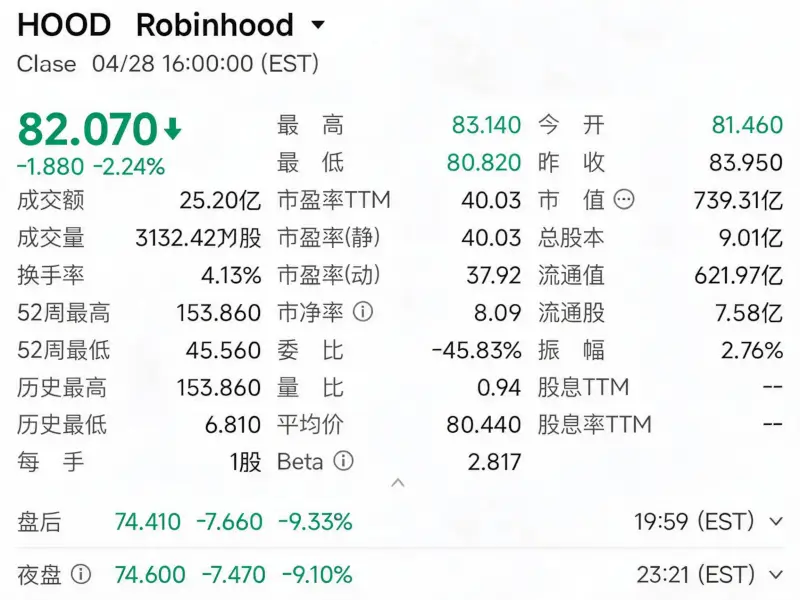
But what truly caused Robinhood’s stock price to plummet nearly 10% in after-hours trading was the high expenditure incurred for promoting the “Trump Account.”
Robinhood stated that the company’s expenses jumped 18% in the first quarter and warned that its “Trump Account” promotion plan would require an additional $100 million investment. Furthermore, Robinhood indicated that the contracts for such accounts were based on a cost-plus model, resulting in lower profit margins.
This so-called “Trump Account” is an account established for American children under the “Big and Beautiful Act,” with Robinhood acting as the broker and initial trustee.
For this company with one foot in the crypto world, the point of discussion on CT is not stock price or performance, but rather the fact that this former popular retail brokerage has crypto business revenue that doesn’t even surpass Hyperliquid.
An analyst from Blockworks, going by the X handle shaunda devens, illustrated a comparison between Robinhood and Hyperliquid data with a single chart.
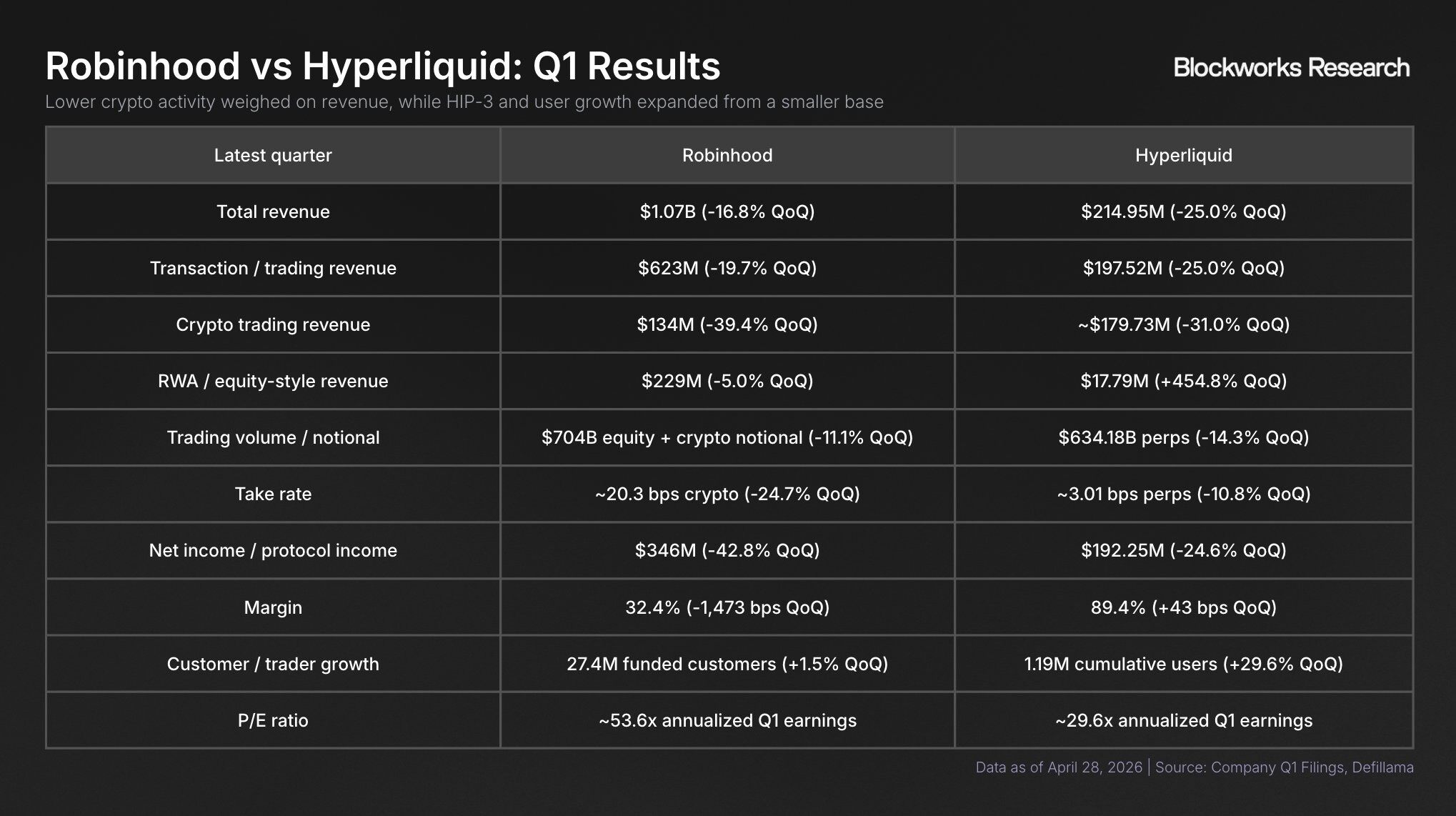
Due to business diversification, many data points lack high comparability. However, in terms of crypto trading, although both Robinhood and Hyperliquid saw revenue decline by over 30% in the first quarter, Hyperliquid’s revenue from crypto trading was nearly $180 million, while Robinhood’s was only $134 million.
In terms of overall profit, Robinhood’s first-quarter net profit was $346 million, while Hyperliquid’s total protocol revenue was approximately $192 million. While it’s impossible to know Hyperliquid’s cost structure, it’s highly likely not very high, meaning its pure profit could at least exceed half of $346 million.
Many of Hyperliquid’s supporters on X therefore believe Hyperliquid is significantly undervalued. Robinhood’s user base far exceeds Hyperliquid’s, and its fees are also higher than Hyperliquid’s.
Even under these circumstances, Robinhood’s estimated price-to-earnings (P/E) ratio based on first-quarter data exceeded 50 times, while Hyperliquid’s was less than 30 times.
Another researcher from Blockworks raised some doubts about this, noting that Hyperliquid’s token FDV (Fully Diluted Valuation) has reached $39 billion. If this figure is used for calculation, everything seems quite reasonable.

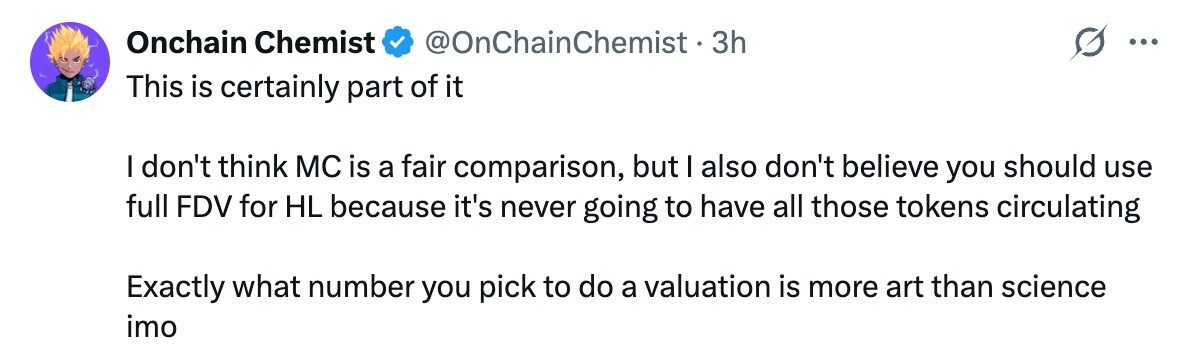
Opponents argue that using FDV to value a project is akin to valuing Robinhood based on its future potential stock issuance. A user with the X handle “On-Chain Chemist” also stated that valuation has always been an art, not a science.
How to value an on-chain project has always been a topic worth discussing. DeFi projects like Hyperliquid are relatively easier to value among on-chain projects. Often, drawing parallels to brokerages in the stock market can provide a rough valuation range. But calling it rough is because it’s difficult to dig deeper for thorough analysis.
DeFi projects operate under relaxed regulations, have no tax pressure, and have no leverage limits. To some extent, they cater to speculative demand. However, what patterns this speculative demand will exhibit is the core reason why it’s currently difficult for the market to estimate a project’s future revenue.
Furthermore, the relationship between a project’s token and the project itself is currently not clearly 德菲ned. Buying Robinhood stock makes you, to some extent, a shareholder, but buying Hyperliquid tokens doesn’t seem to grant any actual power over the Hyperliquid project itself.
Settling transactions on a chain is a major advancement Web3 brings to the world. In the future, we may see more cases like Hyperliquid, where profitability surpasses that of traditional companies. But how to value these emerging platforms might, as previously mentioned, be an art, not a science.
本文源自網路: 700 billion market cap Robinhood’s crypto trading revenue couldn’t beat Hyperliquid
Related: I used Skill Creator, and my content creation efficiency increased by 300%.
Original Editor: Biteye Core Contributor Denise As a content creator, you’ve likely experienced this workflow: Research → Brainstorm topics → Write content → Self-doubt → Endless revisions → Formatting torture → Publish → No one reads it. The problem isn’t a lack of effort, but rather: relying on intuition, dealing with scattered information, hitting creative blocks, not knowing what’s wrong after writing, time-consuming formatting, slow output, and inconsistent quality. The solution is to reconstruct this entire workflow with “skills” for the recurring steps. By writing these skills, you can turn implicit experience into explicit tools, making the entire chain from information gathering to final output more systematic, significantly improving both efficiency and quality. This article focuses on teaching you how to write your own skills, using the actual workflow of…































 繁體中文
繁體中文  English
  简体中文
简体中文  日本語
日本語  Tiếng Việt
  العربية
  한국어
한국어  Bahasa Indonesia
  हिन्दी
  اردو
اردو  Русский