







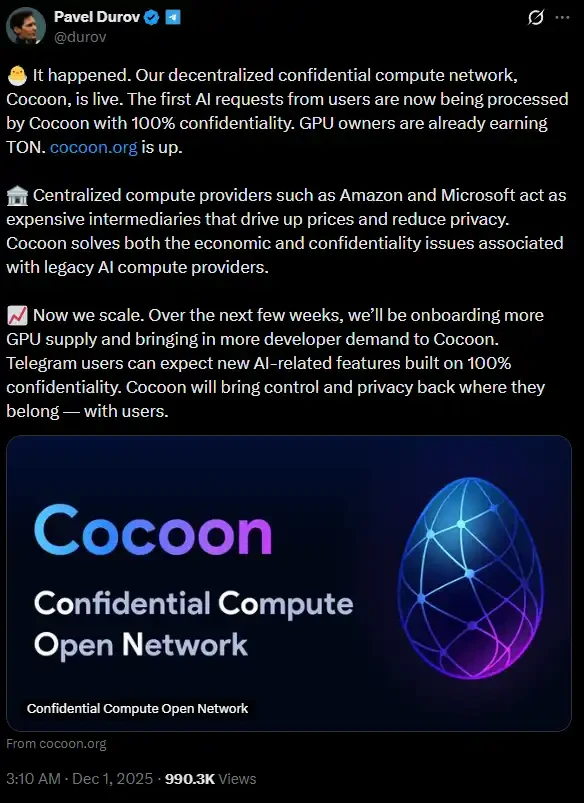
The Cocoon network consists of three parts:
Client: Sends a work request to the agent and pays the agent a fee after the request is completed.
Proxy: Routes work requests to worker nodes. Protected by a TEE, the proxy selects suitable nodes based on the worker node’s device model, load, and reputation, and pays the fees collected from clients to the nodes. The nodes also take a commission. Telegram plans to allow anyone to run their own proxy in the future, making the Cocoon network completely decentralized.
Worker node: Executes AI inference requests in a TEE-protected virtual machine, and the agent pays the request fee from the client after execution.
In other words, anyone can earn $TON by using their own GPU as a worker node. Cocoon allows GPU owners to contribute AI computing power to the decentralized network on TON. By simply running the Cocoon protocol stack on a GPU server that supports TEE, they can provide private, verifiable AI model execution and transparently receive $TON payments for each processed request.
Pavel Durov stated that some AI-related features of Telegram, such as message translation, are already partially supported by Cocoon. He also mentioned Telegram’s features such as speech-to-text and summarization, indicating that Cocoon did not lack practical applications from the outset, and believes that Telegram mini-programs will bring more usage demand to the Cocoon network in the future.
Compared to Telegram gift NFT that previously generated hype in the 加密貨幣currency world, Cocoon is more like a decentralized AI computing network built by Telegram, combining blockchain and $TON as a payment method, starting from the built-in functionalities of Telegram. It’s unlikely to issue its own token, limiting its potential for speculation. However, this project may reflect a long-term trend: increasing concern about privacy when directly exposing data to centralized AI companies during AI usage. In the cryptocurrency space, we’ve already seen more and more privacy-focused projects touting “protecting data sovereignty.” (Related reading: 12 New Projects, a List of Privacy Projects Officially Mentioned by Solana )
Currently, the Cocoon network has a total TVL of approximately 4487 TON, with 30 worker nodes, 18 agents, and 12 customers. This data is from just over a day after its official launch, and it is still in its very early stages.

Supported by the practical application needs of Telegram’s built-in functions and the TON incentive, the existence of the TON incentive also reduces the expectation of issuing tokens. Whether the Cocoon network can develop at a different pace from other crypto computing projects in the cryptocurrency circle still needs to be tested over time.
本文源自網路: Telegram Cocoon is now online; your graphics card can now mine TON!
Related: The NYSE’s desperate attempt to save itself by betting $2 billion on Polymarket.
Author: Chloe, ChainCatcher In early October, ICE announced a massive $2 billion investment in Polymarket, sending shockwaves through the market. Almost simultaneously, Kalshi also announced a $300 million funding round at a $5 billion valuation. Overnight, the market landscape for prediction platforms was elevated to mainstream finance. Why did ICE need to make this move, transforming platforms that had long operated in a gray area into legal prediction tools? Are established Wall Street exchanges facing an urgent need for business transformation? The NYSE’s predicament: market share being eroded, and data business declining. Looking at the current competitive landscape of US stock exchanges, the “US Equity Market Structure Compendium 2024” report indicates that the US stock trading market is highly fragmented and dispersed. The NYSE, owned by ICE, accounts for approximately…






























 繁體中文
繁體中文  English
  简体中文
简体中文  日本語
日本語  Tiếng Việt
  العربية
  한국어
한국어  Bahasa Indonesia
  हिन्दी
  اردو
اردو  Русский