







From crypto exits to U.S. stock selloffs: Unraveling the universal capital withdrawal playbook
Original Translation: Saoirse, Foresight News
You may have already noticed that after inflating private company valuations to trillions of dollars, venture capital firms are finally ready to cash out. Their only problem is finding enough exit liquidity.
Let’s be clear: I am not accusing the San Francisco venture capital circle of illegal activities. What I am criticizing is that their actions are profoundly unethical and have destroyed the original social contract of capitalism.
The Original Agreement

The Baby Boomer generation was the last to benefit from this era’s prosperity.
The U.S. does not have a European-style high-welfare state system, and it was never supposed to need one. The old social contract was: the stock market is America’s welfare system. Traditional fixed-benefit pensions were phased out, replaced by individual contribution accounts; the retirement system was supplanted by 401k plans; Social Security was only meant as a safety net, with no one relying on it alone for retirement.
The underlying rule was: every ordinary worker would become a shareholder, and the dividends of capital appreciation would lift them up as well. Even if wage growth stagnated and wealth inequality widened, it didn’t matter, because everyone’s retirement account was compounding in the background. Everyone was on the same wealth train, and in the end, things wouldn’t turn out too badly.
This is also why wealth inequality in the U.S. is politically tolerable. You could accept your boss earning four hundred times your salary, as long as your retirement account grew along the same curve as your boss’s assets. Passive index funds were the purest embodiment of this agreement. A supermarket cashier, a teacher, a plumber could all enjoy the market returns generated by professional capital’s value discovery without paying a cent, peacefully sharing in the dividends. The capital market back then was a public dividend pool for everyone.
But for this agreement to work, certain preconditions were necessary: the public market had to be the place where value was truly created; the dividends of wealth appreciation had to be shared broadly; every new increment of capital growth had to be includable in index funds. These conditions were true for a long time. Today, they have all failed.
This is everything they stole from you.
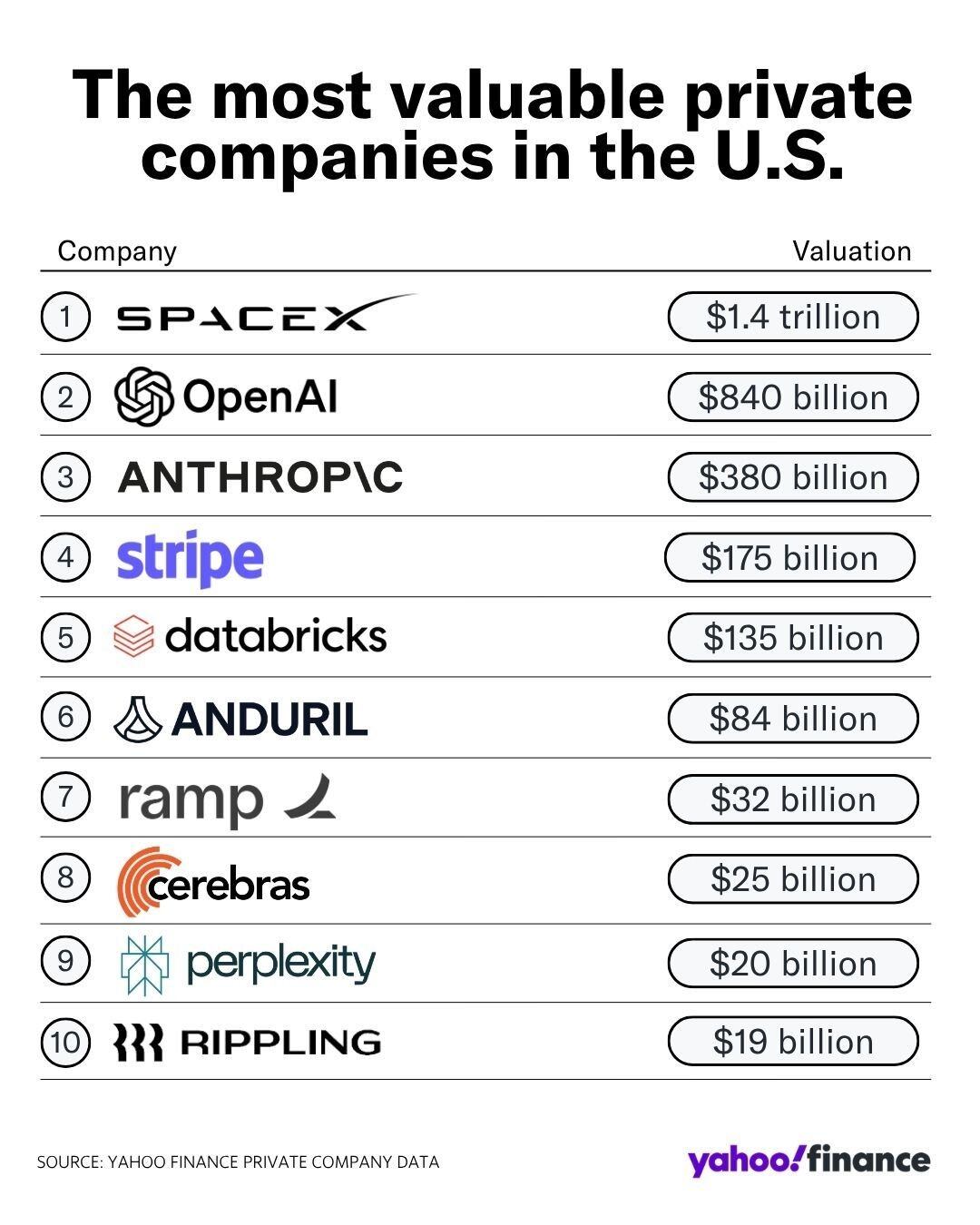
When companies stay private until they are valued at trillions of dollars before going public, the public market no longer creates value; it only cashes it in. Everything happening in the stock market today is wealth distribution, not compounding growth. Every cent of profit that should have flowed into ordinary retirement funds during a company’s growth phase now ends up in the pockets of pre-IPO equity holders. After its IPO, Figma’s valuation halved within weeks compared to its private round; Klarna’s valuation plummeted by 90%. This is precisely the outcome this system was designed to produce.
The industry also noticed that ordinary retail investors were being shut out from these gains. So they offered a narrative: democratizing investment, broadening investment channels, bridging the wealth gap, opening the private market to retail investors. But the reality is the opposite: they are simply allowing retail investors to buy the chips that insiders accumulated at a fraction of the current valuation, right at the peak of a decade-long private market bull run. Private venture capital products for retail investors are not investment opportunities; they are tools for insiders to distribute their chips at high prices. Even Naval’s own promotional logic confirms this.
(Note: Naval Ravikant, the leading advocate for democratizing private investment in Silicon Valley’s venture capital circle, is directly accused by this article of being the public relations driver for VCs to cash out at high prices by harvesting retail liquidity.)
The Carefully Designed Exit Strategy
Các mật mã circle was the first to fully understand this harvesting playbook.
Early-stage crypto project foundations hold large amounts of locked native tokens. Retail purchasing power is already exhausted, token unlock dates are approaching, and there are no buyers.
So they found a solution: package these unwanted locked tokens as compliant equity assets that traditional financial institutions can buy. Mã thông báos that retail investors would never directly buy are transformed into stocks. Institutions buy them compliantly, and retail investors can also enter through brokers. The chips are distributed smoothly, the SEC silently acquiesces, the project founders successfully cash out, and the buyers are marked for harvesting from the start.

Incidentally, Naval was an early entrant into the crypto space and is well-versed in this.
After seeing this playbook succeed, the San Francisco venture capital circle simply scaled it up to the trillion-dollar capital market. Private venture capital products for retail investors were the first channel; Nasdaq’s rule change was the second.
Nasdaq’s proposed new rule: For companies with very few publicly traded shares at IPO, the index weighting is directly amplified by 5 times, updated quarterly during index rebalancing. Take SpaceX as an example: upon listing with only 5% of shares in public float and a total valuation of $1.75 trillion, passive index funds would be forced to buy the stock equivalent to a $438 billion market cap. This purchase would occur 15 days after listing, bypassing any market price discovery. The insider lock-up period would be precisely timed to expire at the next index rebalancing. When the weight is maxed out, passive funds are forced to buy massively, and insiders legally cash out. SpaceX plans to list mid-year, with the index rebalancing at year-end. The entire process is perfectly orchestrated.
Index funds, once the shield protecting ordinary retail investors from insider capital harvesting, have now become the tool for capital to cash out. Your retirement savings are being systematically harvested by this mechanism.
The logic of the crypto circle and the venture capital circle is identical: insiders accumulate positions at low prices in markets inaccessible to retail; the assets appreciate; purchasing power in the native market is insufficient to support distribution at high prices; a new packaging vehicle is created to tap into another pool of capital – specifically, pension funds and passive index funds that buy blindly based on rules without considering price; insiders exit smoothly, and new retail investors are left holding the high-priced chips. The entire process is perfectly legal because the packaging itself is compliant. Regulatory agencies are ineffectual because this institutionalized harvesting is not illegal within the existing rules.
The Final Outcome
Many of today’s chaotic phenomena stem from this: Sam Altman facing public backlash, self-driving cars being vandalized, data centers seeing public protests. The ordinary people rising up don’t understand theories of exit liquidity. But they feel it viscerally: the world is divided into early entrants and late buyers, and the gap between these two classes is widening at a pace that no amount of hard work, talent, or opportunity can bridge.
The elite tech class has demonstrated in practice: ordinary people’s public capital is being continuously harvested to create excessive wealth for a group that already holds the advantage.
The K-shaped divergence of wealth will become increasingly extreme. This won’t be a normal market correction, because a market correction presupposes that participants still believe the existing rules are fair.
The resistance and conflict we see now have essentially evolved into a societal political struggle.
Bài viết này được lấy từ internet: From crypto exits to U.S. stock selloffs: Unraveling the universal capital withdrawal playbook
Key Events for Next Week March 9 Iran Conflict Enters Second Week, Continues to Impact Global Situation; SharpLink to Hold 2025 Earnings Call on March 9; March 11 US to Release February CPI Data on March 11; March 13 US to Release January PCE Data on March 13; From March 9 to March 15, more noteworthy industry events are previewed below. March 9 Iran Conflict Enters Second Week, Continues to Impact Global Situation Odaily: The conflict in Iran has entered its second week. The latest developments include: Iran’s Assembly of Experts has made a final decision on the new Supreme Leader candidate; the Israel Defense Forces stated they will continue to hold the successor to Khamenei and anyone attempting to appoint him accountable. Furthermore, the navigation situation in the Strait…
相关文章
























 Tiếng Việt
  English
  繁體中文
繁體中文  简体中文
简体中文  日本語
日本語  العربية
  한국어
한국어  Bahasa Indonesia
  हिन्दी
  اردو
اردو  Русский