







Beyond Money Printing, Tether Aims to Take Over Everyday Payment Gateways with a Wallet
In the power landscape of Web3, Tether has long played the role of a silent yet immensely wealthy shadow dollar printing press.
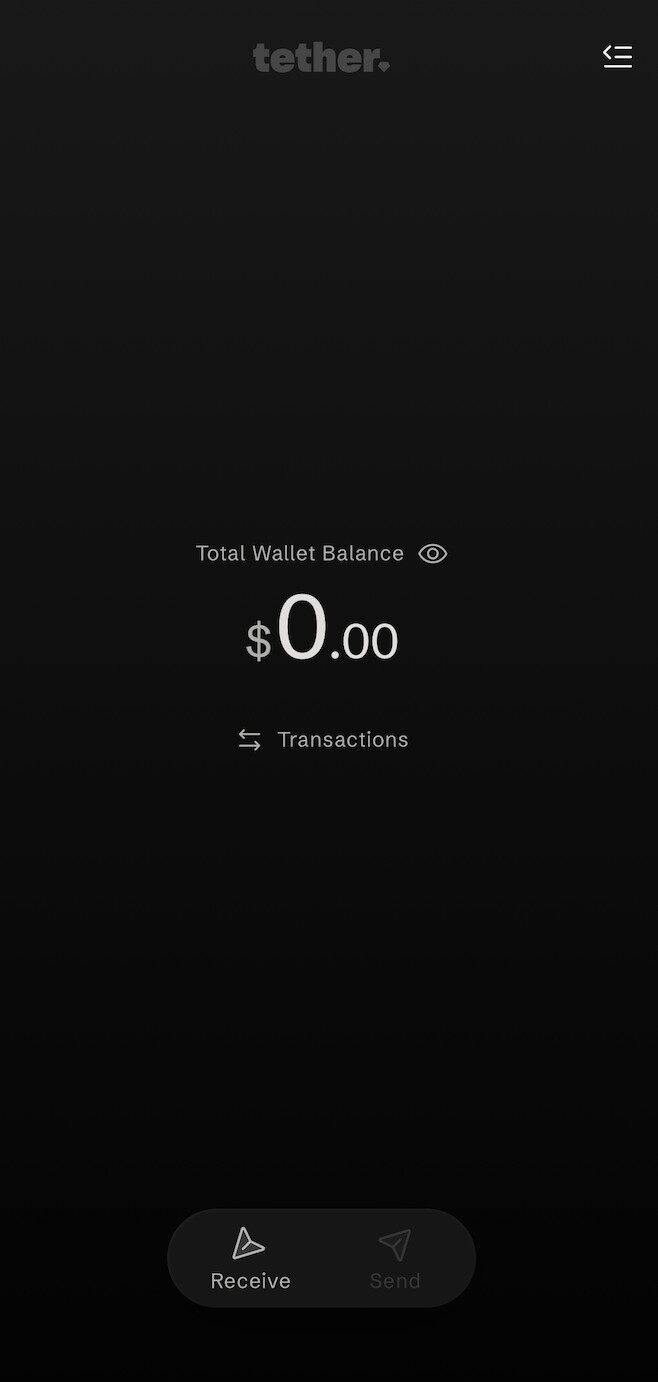
On the evening of April 14th, Tether announced the official launch of Tether Wallet, calling it “The People’s Wallet.” The emergence of this product essentially represents the “interface sinking” of this stablecoin giant, directly reaching end-users.
From an asset issuer to a user gateway. Previously, Tether was only responsible for “printing money”; now it wants to bất chấpne how people transfer and hold assets. By directly capturing C-end traffic, Tether is transforming into a closed-loop ecosystem with traffic sovereignty.
This is also a defense of its shadow dollar status. In emerging markets, USDT has already become the de facto standard substitute. However, as Circle continuously strengthens its compliance narrative and squeezes the market, Tether must lower the physical barriers to use, firmly locking the billions of users abandoned by traditional finance within its official gateway.
What is the True Core of Tether Wallet?
In the product logic of Web3, user experience has always been a false proposition. When you ask a user on a street in Latin America trying to transfer $10 to manually copy down 12 illogical English words and warn them that “losing them means bankruptcy,” financial inclusivity has already died at the starting line.
The core highlight of Tether Wallet lies in its attempt to use a transparent, white-box approach to dismantle the three major hurdles of self-custody wallets: addresses, fees, and seed phrases. It focuses on “simplicity” and “convenience,” compressing the experience to its most minimal form.
First, humanizing on-chain addresses.
For a long time, hexadecimal long-string addresses have been the biggest obstacle to mass adoption. Tether Wallet introduces a payment username system (e.g., name@tether.me). This means that in cross-border transfer scenarios, USDT completely sheds the obscurity of a mật mã asset, becoming as simple as sending an email or a message.
Based on actual testing, Tether Wallet requires email registration and login. Currently, payment usernames must and only support lowercase letters and numbers, with a length limit of 4 to 15 characters.
Second, truly abstracting Gas, with fees directly deducted from the transferred asset.
Tether Wallet itself does not charge fees and supports directly using the transferred asset to cover network fees.
The technology isn’t groundbreaking, but being natively integrated by Tether carries a completely different meaning: it completes the payment experience loop at the protocol layer. This “Gas abstraction,” natively integrated by the issuer, means it completes the payment experience loop from the underlying protocol level. Users only need to care about how much to transfer, not the “toll.”
Third, self-custody design and cloud backup solution.
Tether Wallet employs a self-custody design; all transactions are signed and confirmed on the user’s own device before being sent to the blockchain. Tether Wallet also provides an encrypted cloud backup solution (Cloud Backup). Wallet data is encrypted and stored on Tether’s servers, while the key is stored in the user’s own iCloud / Google Drive. Neither party alone can unlock it; they are only combined when the user logs in on their device. To restore the wallet on a new device, simply log in with the registered email.
Of course, users can still choose to manually back up their wallet.
Currently, Tether Wallet supports the following assets and networks:
· USDT: Ethereum, Polygon, Plasma, Arbitrum
· XAUT: Same as above
· USAT: Ethereum
· Bitcoin: On-chain + Lightning Network
It is worth noting that currently 45% of the circulating USDT supply is on Tron, but Tether Wallet does not currently support Tron.
When Stablecoins Transition into High-Frequency Payment Assets
When the barrier to payment is lowered to just needing an email and a username, USDT is no longer merely a value anchor in the crypto world. It begins to exert a terrifying gravitational effect, attempting to swallow up the entire real world’s small-value cross-border settlements.
First, it’s a dimensional reduction attack on traditional cross-border payment intermediaries. Before tether.wallet, laborers in emerging markets who wanted to send money to their families had to pay high fees and endure settlement cycles lasting several days. The logic of Tether Wallet is: Since USDT is already the shadow standard currency in these regions, then instant, low-cost transfers can be achieved through the Lightning Network or other blockchains.
Then there’s the survival squeeze on competing stablecoins. In the past, Circle (USDC) or PayPal (PYUSD) attempted to capture market share through compliance and institutional backing.
But Tether realizes that on the retail side, liquidity inertia outweighs everything. When a user gets used to smooth transfers using @username in Tether’s official wallet, they have no incentive to switch to a payment tool with higher fees and a smaller ecosystem. Tether is turning its first-mover advantage into irreversible usage inertia.
The deeper impact lies in Tether redefining financial inclusion. This self-custody wallet gives Southeast Asian farmers and Latin American vendors who have never had a bank account an equal, unilaterally unclosable seat in the global financial infrastructure for the first time.
The Boundary of Power and Protocol Vitality in the AI Era
In the tether.wallet documentation, one term is mentioned twice: “Left behind.” However, as these groups forgotten by the traditional financial system flock into the new infrastructure built by Tether, a series of unresolved questions about power also surface.
First is the covert regulatory battle disguised as self-custody. Although Tether emphasizes that users own their private keys, when it natively integrates cloud backup functionality and supports the @username system, it inherently leaves nodes that can be intervened by regulators.
If regulators demand flagging specific accounts or pressure cloud data, Tether will be forced to choose between its “decentralization creed” and “commercial survival.” This will be a key battleground for the future struggle between crypto and sovereignty.
Secondly, AI Agents represent the second growth curve. Paolo Ardoino’s statement is highly prescient: this wallet is also prepared for AI Agents. In the future of interconnected everything, human biological identity may no longer be the core of financial accounts.
When an AI Agent needs to pay for computing power instantly, a stablecoin wallet that can be dispatched through a simple interface will become the “lifeblood” of machine civilization.
Finally, we need to confront that ultimate contradiction. Tether is a complex composite: it has a centralized core, yet it diffuses extremely decentralized tools outward.
This contradiction might precisely reflect the true state of current global financial evolution. The old order is difficult to shake, and the new order only grows in the cracks. Tether Wallet is not trying to create a utopia; it is merely opening a window in the wall of reality, letting people discover that dollar transfers can be as simple as sending a text message.
An era of global value transfer, silent yet powerful, led by a stablecoin giant, is accelerating its arrival. However, the premise for all this is: we must soberly recognize that convenience is never free. We cannot avoid a fundamental question: while pursuing efficiency and inclusion, how do we find a truly sustainable balance between the walls of the old order and the wild growth of the new order?
Bài viết này được lấy từ internet: Beyond Money Printing, Tether Aims to Take Over Everyday Payment Gateways with a Wallet
Related: Jensen Huang’s Latest Article: The “Five-Layer Cake” of AI
Original Compilation: Peggy, BlockBeats Editor’s Note: Artificial intelligence is evolving from a cutting-edge technology into the foundational infrastructure supporting the modern economy. In its first long-form article published on its official account, Nvidia attempts to systematically outline the industrial structure of AI from first principles: from energy and chips to data center infrastructure, and then to models and applications, forming a complete five-layer technology stack. The article points out that AI is not just a competition in software or models, but a global industrial construction involving energy, computing power, manufacturing, and applications. Its scale may become one of the largest infrastructure expansions in human history. Through the lens of this “five-layer cake,” Nvidia seeks to illustrate that the true significance of AI is not merely smarter software, but an infrastructure…
相关文章
































 Tiếng Việt
  English
  繁體中文
繁體中文  简体中文
简体中文  日本語
日本語  العربية
  한국어
한국어  Bahasa Indonesia
  हिन्दी
  اردو
اردو  Русский