







Translation: TechFlow
Overview: In a recent article, Grayscale Head of Research Zach Pandl argues that Ethereum’s current staking reward model faces two structural issues: L2s diverting activity, leading to reduced token burns and increasing net issuance; and staking friction approaching zero, which could eventually lock nearly all ETH into staking. The community is discussing implementing a staking reward cap curve, which Grayscale believes would be beneficial for ETH’s price in the long term.
The Ethereum community is considering modifying the network’s staking reward model. The core idea is to only incentivize staking up to a certain proportion, with no additional rewards beyond that point. If implemented, nominal yields for stakers would decrease. However, Grayscale believes this is positive for ETH’s price long-term for two reasons: first, controlling ETH inflation; second, strengthening the narrative of ETH as a store of value asset.
Two interconnected issues are driving this reform discussion.
Declining ٹوکن Burn, Rising Net Issuance
ETH’s supply is determined by the difference between new issuance and token burns. Currently, Ethereum’s L1 burns all base transaction fees; higher fees mean more ETH is burned, suppressing supply growth.
Changes over the past few years have disrupted this balance. As more activity migrates to L2 networks, L1 transaction fees and corresponding token burns have declined, causing net issuance to rise.
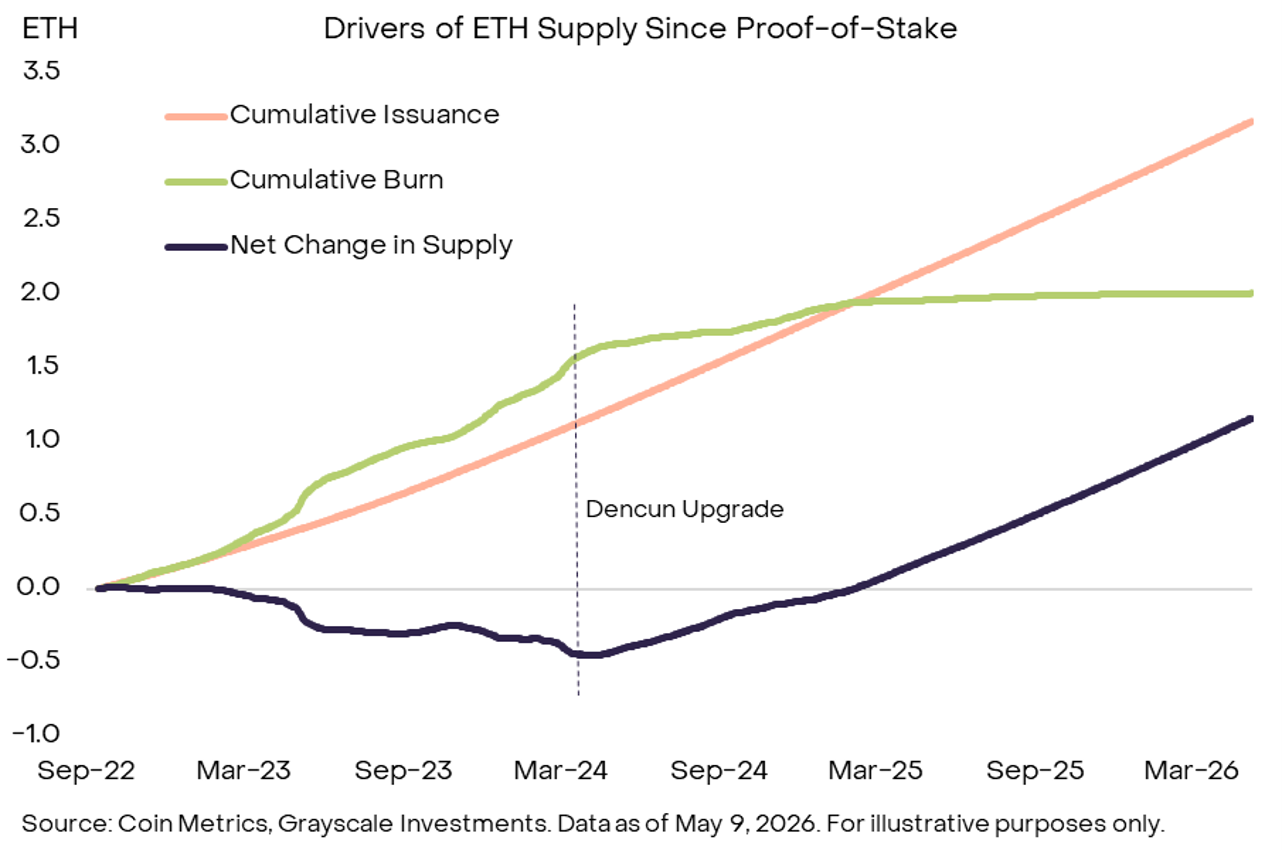
Figure Note: Exhibit 1 — Drivers of ETH supply changes since the PoS transition. Post-Dencun upgrade, cumulative burn (green line) has flattened, while cumulative issuance (orange line) continues to rise, causing the net supply change (dark line) to turn from negative to positive. Source: Coin Metrics, Grayscale Investments, data as of May 9, 2026.
Compounding this issue, Ethereum L1 is now actively choosing to scale to compete with high-throughput chains like Solana. Pandl states bluntly: L1 transaction fees will likely remain low for the foreseeable future, leading to persistently low token burns and further increasing net supply growth.
Staking Friction is Nearly Zero
When Ethereum first launched staking, users could not withdraw their assets; staked ETH was locked with poor liquidity, resulting in a risk premium. Now that withdrawals are enabled, liquidity has improved significantly, and this risk premium has evaporated.
More importantly, Liquid Staking Tokens (LSTs), تبادلہ-Traded Products (ETPs), and corporate ETH treasuries have all joined the staking ecosystem. The marginal cost of staking ETH is now close to zero. As long as the network continues to provide marginal rewards to stakers, nearly all ETH could eventually end up staked.
While staking is essential for the proper functioning of the Ethereum protocol, an excessively high staking ratio could be counterproductive.
This presents two risks. First, unnecessary dilution. Higher net issuance without a material increase in network security is akin to a country overspending on defense with no benefit to national security. Second, a tail risk of centralization, where dominant staking activity is controlled by a few large entities. This possibility exists due to the network effects among service providers.
Implementing a Staking Reward Cap Curve
One proposed solution is transitioning to a reward model that only incentivizes staking up to a certain level.
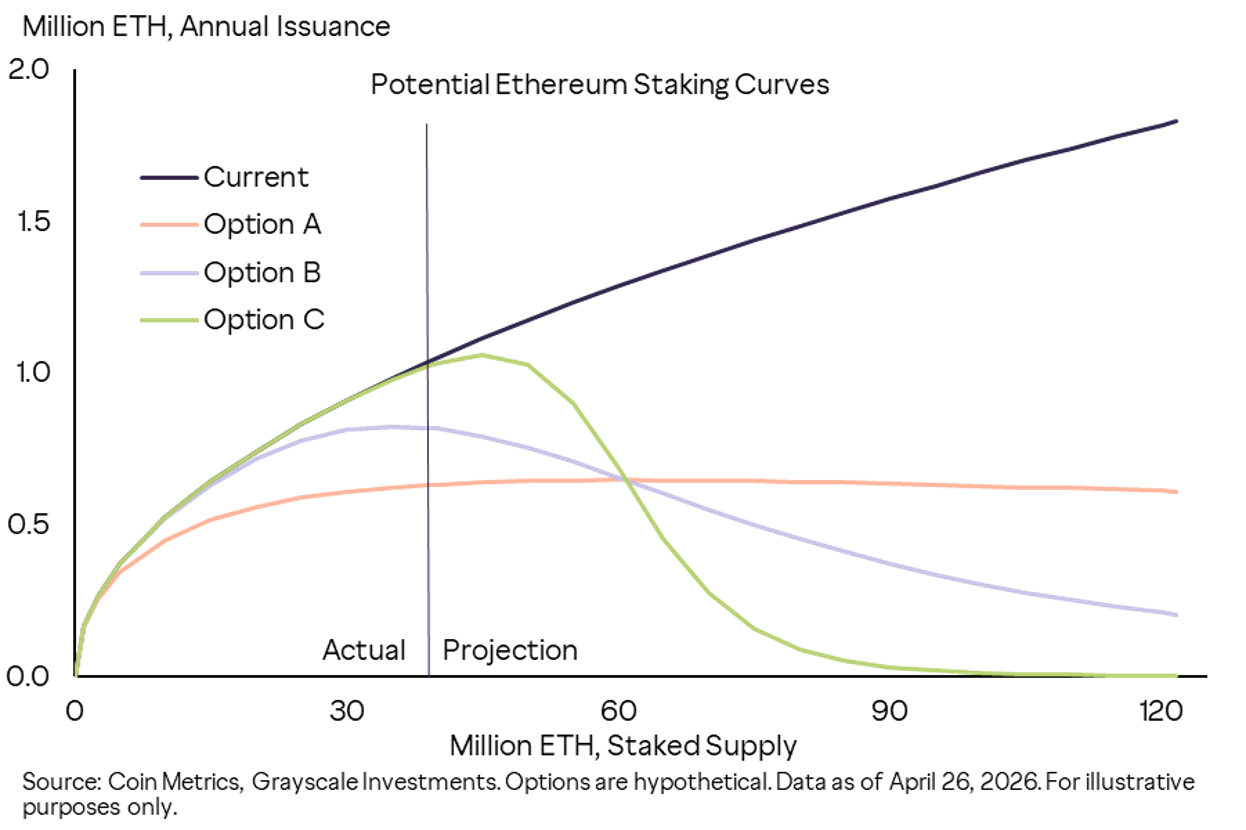
Figure Note: Exhibit 2 — Potential alternative staking reward curves for Ethereum consideration. Under the current model (dark line), annualized issuance grows linearly with the amount staked; Options A, B, and C propose various cap or inflection points at different staking levels, causing issuance to plateau or even decrease once the staking ratio exceeds a certain threshold. Source: Coin Metrics, Grayscale Investments, data as of April 26, 2026. All options are hypothetical.
Grayscale believes this change would be beneficial for ETH’s market value in the long term. ETH is a functionally useful commodity, not a financial claim like stocks or bonds, and should not be priced solely based on cash flows. Updating the staking reward model would lower supply growth and enhance ETH’s scarcity. For commodities, reduced supply is bullish for price; the same logic applies to ETH.
Lowering network tail risks and controlling long-term inflation could also boost demand for unstaked ETH as a digital store of value asset.
There is another easily overlooked perspective: the impact of ETH’s price volatility on investment returns far exceeds that of staking yields. The current annualized staking yield of around 3% is approximately equal to ETH’s daily price fluctuation (annualized volatility of ~60% over the past 360 days translates to a daily volatility of ~3%).
نتیجہ: Ethereum may modify its staking reward model to control long-term supply growth and mitigate specific tail risks. If implemented, Grayscale believes this would be positive for the price of ETH.
یہ مضمون انٹرنیٹ سے لیا گیا ہے: Grayscale: It’s Time to Rethink Ethereum’s Staking Model
Related: Bitcoin Encounters Resistance at $79,000, $65,000-$70,000 May Become Key Support
Original Translation: AididiaoJP, Foresight News Bitcoin remains suppressed below the Real بازار Price, with support located in the $65k to $70k range. Spot selling pressure is easing, capital flows are stabilizing, but demand remains weak. Heavy short positioning leaves room for a squeeze in a ranging market. Summary Price breakouts faced resistance at the Real Market Price (~$79k) and the Short-Term Holder Cost Basis, reinforcing a medium-term bearish bias. Short-term holder realized profits surged to $4 billion per hour, reflecting significant profit-taking pressure that limited the sustainability of bounces. A dense accumulation cluster between $65k and $70k forms short-term support, but a breakdown would weaken the short-term structure. Spot selling pressure is easing, with volume delta recovering towards neutral and early signs of buyer re-engagement. Institutional capital flows are stabilizing,…
相关文章
























 اردو
اردو  English
  繁體中文
繁體中文  简体中文
简体中文  日本語
日本語  Tiếng Việt
  العربية
  한국어
한국어  Bahasa Indonesia
  हिन्दी
  Русский