







Compiled & Organized by: BitpushNews
On a Saturday in August 2025, something happened that should have set every криптовалютаcurrency group on the internet ablaze. Bank of America, Citadel Securities, DTCC, and Société Générale settled a U.S. Treasury repo transaction over the weekend on a blockchain.
To put it simply, a repo is one of the most fundamental transactions in institutional finance: one party sells government bonds to another with an agreement to buy them back the next day, typically to raise short-term overnight cash.
This is the “plumbing” of the financial system. Banks, hedge funds, and central banks use repos daily to manage liquidity, with trillions of dollars flowing through this market. For the first time ever, this type of transaction was settled near-instantly via atomic settlement on a blockchain outside of market business hours, with participants being some of the world’s largest financial institutions.
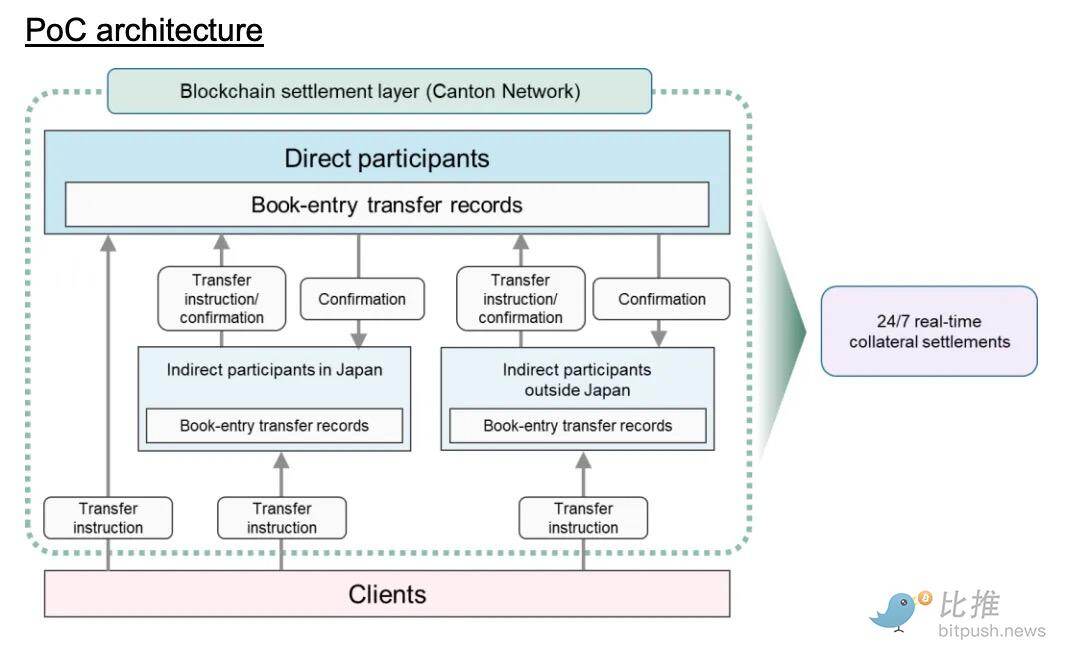
Eight months later, on April 20, 2026, Japan’s central clearing house JSCC, Mizuho Financial Group, Nomura Holdings, and Digital Asset launched a proof-of-concept (PoC) to move Japanese Government Bonds (JGBs) as collateral onto the Canton Network.
JGBs are among the most important financial instruments in Asia, with a circulation value exceeding $9 trillion. They are the most widely used single collateral asset in the region’s institutional market. When banks and hedge funds across Asia need to secure their leveraged positions, JGBs are often the first choice. Now, the entire collateral system is moving on-chain.
This could very well be the most significant blockchain news of 2026.
This article analyzes why JGBs are the most suitable assets for tokenization, why the Canton Network continues to win institutional mandates while public chains compete for retail traffic, and how “24/7” collateral settlement will fundamentally change global trading desks.
Why JGBs? Why Now?
For decades, Japan has tried to make the Yen a global reserve currency, without ever fully succeeding. Even today, the Yen accounts for only about 4-6% of global reserves, trailing behind the US Dollar, Euro, and even the British Pound.
But something unexpected happened along the way: Japanese Government Bonds became one of the fastest-growing collateral assets on the Euroclear Collateral Highway, the infrastructure for moving collateral among large global financial institutions. Foreign holdings of JGBs have climbed to approximately 11.9%, meaning about 144 trillion Yen is held by institutions outside Japan.

In institutional finance, collateral is everything. Every leveraged position, every derivatives trade, every repo requires high-quality assets as security. Backed by the world’s third-largest economy, JGBs carry virtually no default risk, making them one of the few qualifying assets globally. When a hedge fund in Singapore builds a leveraged position or a bank in London covers derivative exposure, JGBs are frequently used as collateral.
The most important infrastructure victory for криптовалютаcurrency is happening inside traditional finance. Even though Japan never “won” the currency war, JGBs have become the operational infrastructure for Asian institutional finance.
The problem is that the entire collateral system still operates as if it’s 1995. A JGB collateral transfer between two institutions must traverse a chain of custodians: starting with the Bank of Japan (BOJ), then Hofuri (Japan’s securities depository), then the custodian bank, and finally the sub-custodian bank. Each layer requires separate reconciliation and only operates during Tokyo business hours (roughly 9 AM to 3 PM JST).
A collateral transfer that should take seconds ends up taking days. During these days, the collateral is effectively “frozen.” A trading desk in New York needing to use it at 10 PM must wait for Tokyo to wake up. A study by GFMA and BCG estimated that blockchain could unlock $100 billion in trapped collateral globally; for a bank with $100 billion in daily repo volume, tokenized settlement could save $150 million to $300 million annually in operating costs alone.
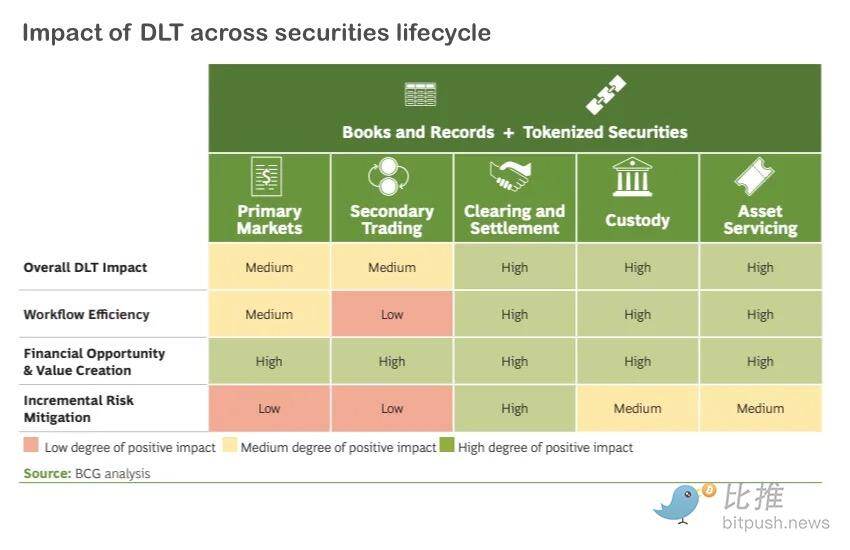
Here is something unsettling for Japan: the US has already moved.
The DTCC, which holds custody over $99 trillion in US securities and processes $3.7 quadrillion in transactions annually, partnered with Digital Asset in December 2025 to tokenize US Treasuries on the Canton Network. This means the core of US securities infrastructure is moving toward 24/7 tokenized settlement.
Broadridge is already processing $354 billion in tokenized Treasury repo transactions daily on the same network; JPMorgan’s Kinexys has processed cumulative transaction volumes exceeding $1.5 trillion through its on-chain payment rails. US Treasuries are rapidly becoming “always available, always movable” collateral assets, while JGBs remain locked within Tokyo’s business hours.
If you are a global fund manager needing to post collateral for a margin call at 2 AM, and you can choose between tokenized US Treasuries that settle instantly or JGBs that require waiting 6 hours for Tokyo to open, you would choose US Treasuries every time.
If this choice is amplified across thousands of trading desks, JGBs risk losing their status as “premium collateral.” For a country whose sovereign bonds are deeply woven into the fabric of Asian financial collateral, this is even an existential issue. The four companies involved in the JGB on-chain pilot used the word “urgent” in their press release. Given the pace of US infrastructure evolution, it’s hard to disagree.
Why Canton Keeps Winning
When Japan’s JSCC had to choose a network for JGB collateral, they chose Canton – the same chain already used by DTCC, Broadridge, and JPMorgan. The reason lies in the extremely demanding requirements of sovereign bond collateral.
Sovereign bond collateral has specific needs that most blockchains cannot meet. When Mizuho Bank transfers JGB collateral to a counterparty in London, the transaction must comply with Japan’s Book-Entry Transfer Act. The blockchain record must be legally synchronized with Hofuri’s official registry.
Each party in the transaction (from the clearing house to custodians to counterparties) can only see data they are authorized to view under Japanese and international securities laws. Furthermore, the entire process requires atomic settlement: the collateral and payment must move at the exact same instant, or neither moves.
This is an extremely complex set of constraints. Canton was chosen because its architecture is built to solve these problems. Each institution runs its own ledger, and cross-institutional transactions only synchronize the data each party is permitted to see. Smart contracts written in Digital Asset’s Daml language dictate who can see what and who must authorize each step.
Consequently, when JSCC, Mizuho, and Nomura conduct JGB collateral transfers on Canton, the clearing house sees the full picture, Mizuho sees its side, Nomura sees its side, and no one sees what they shouldn’t. Canton is now the only network globally where the three major sovereign bond collateral pools (US Treasuries, JGBs, and European sovereign bonds) can move freely across borders, in real-time, 24/7. No other network, public or private, comes close to this.
What Does “24/7” Collateral Really Change?
Most coverage of tokenized on-chain settlement stops at “it’s faster.” But speed is just the beginning; the real transformation lies in how the system behaves under stress.
Consider what happened during the COVID-19 pandemic in March 2020. Рынокs crashed, volatility soared, and initial margin requirements for equity futures jumped 100% within weeks. Funds unable to meet margin calls were forced to sell assets to raise cash.
But selling assets in a falling market pushes prices down, triggering more margin calls, which forces more selling. This feedback loop is one of the most dangerous dynamics in finance, nearly bringing the system down again during the UK LDI pension crisis in September 2022.
How 24/7 tokenized settlement changes this:
- Direct Collateral Usage: When facing a margin call, most funds currently must first sell assets for cash. With on-chain collateral, funds can directly pledge JGBs or US Treasuries to meet the requirement without converting to cash first. The “forced selling loop” weakens because fewer institutions are dumping assets into a falling market just for liquidity.
- Solving the “Delivery vs. Payment” Gap: In traditional repos, the cash lender sends money first, and receives collateral later. During this window, one party is exposed. Banks factor this “intraday exposure” into their haircuts and financing costs.
- Atomic Execution: With on-chain atomic settlement, both sides of the transaction (collateral and cash) move at the same instant. Santander tested this in December 2024, executing $50 million and €50 million intraday repos on JPMorgan’s Kinexys, which were automatically unwound three hours later. Intraday repos, which once required complex third-party setups or committed credit lines, are now becoming routine.
More significantly, during a Canton demonstration in January 2026, the London Stock Обмен Group (LSEG) introduced its digital settlement house (DiSH) into the transaction. DiSH uses tokenized commercial bank deposits as the cash leg, not stablecoins.
This is because banks won’t use USDC to settle billion-dollar transactions – USDC is a private IOU, not “money good.” DiSH tokens represent actual deposits at regulated banks and can be transferred on-chain 24/7. This solves the cash leg problem, the final piece of the puzzle for institutional adoption. Now, Japan plans to connect JGBs to this same infrastructure.
What This Means
If the JGB pilot succeeds, with US Treasuries already online and European sovereign bonds in demonstrations, it appears to me that Canton is starting to look like the next SWIFT.
This is a single network becoming the default layer for moving the world’s most important collateral across borders. Like SWIFT, once enough institutions join, exiting becomes nearly impossible. Network effects compound. Each new class of sovereign bonds added benefits existing participants and makes it harder for competitors to catch up.
I find this worth pondering. We have spent years in the crypto space debating decentralization, worrying about single points of failure, and building systems where no single entity controls the trajectory. Yet now, the historically most significant blockchain deployments are converging on a single permissioned network managed by the same institutions that run global finance.
Good or bad? It depends on what you think this is all about. If the goal is to improve capital market efficiency, reduce settlement risk, and unlock hundreds of billions in trapped collateral, then it is working. If the goal is to diminish the power of existing financial institutions, then it is doing the exact opposite – the old gatekeepers are just upgrading to better infrastructure.
I don’t think this makes the event less important. Settling government bonds in a financial system that operates on one blockchain, 7×24, cross-border, with atomic settlement, is a genuine upgrade for how global finance functions. But I do think it’s worth being honest about what kind of upgrade this is – it is an efficiency revolution: the plumbing has been rebuilt, but the plumbers are still the same people.
Эта статья взята из интернета: Japan’s bond market is fully moving on-chain
Related: A 10,000-Word Deep Dive into Hyperliquid HIP-4: Leveraging Prediction Рынокs and Options Trading to Encroach on Traditional Finance
Compiled by|Odaily; Translator|Azuma(@azuma_eth) Currently, Hyperliquid is regarded as one of the few still “investable” assets in the cryptocurrency market. The overall market is in a downtrend, while HYPE has demonstrated remarkable stability. There are many reasons for this, but one is undoubtedly Hyperliquid’s strong fundamentals, its focus on revenue generation, and its continuous use of profits to repurchase HYPE. The crypto industry has matured relatively, and some shifts are still occurring — protocols are trying to move away from pushing “crypto-first” products and are shifting towards more general fintech models where cryptocurrency is just part of the infrastructure, not a deliberately emphasized selling point. Today, whether it’s asset management institutions, native crypto users, or the broader general public, they increasingly evaluate protocols using logic similar to traditional equity valuation —…
Related articles
































 Русский
  English
  繁體中文
繁體中文  简体中文
简体中文  日本語
日本語  Tiếng Việt
  العربية
  한국어
한국어  Bahasa Indonesia
  हिन्दी
  اردو
اردو