







Genius Airdrop Details: 70% Deduction for Immediate Claim at TGE, or Lock for One Year to Receive Full Amount
Author | Asher (@Asher_ 0210)

Another “rug pull” project has emerged…
Following the previous update that allocated 21% of the total token supply for airdrops (divided into Season 1, Season 2, and Season 3, each accounting for 7%), yesterday, Genius—which received a “tens of millions of dollars” investment from YZi Labs and has CZ serving as an advisor—updated its Season 1 airdrop documentation. According to the latest content, a total of 70 million GENIUS tokens will be distributed at TGE. Early users have two claim methods:
- Choose to claim immediately at TGE: The immediate claim window is 7 days after TGE. If a user chooses to claim immediately, 70% of their tokens will be automatically burned. For example, if a user has a total claimable amount of 100 GENIUS tokens and chooses immediate claim, they will lose 70 GENIUS, ultimately receiving only 30 GENIUS. The remaining 70 GENIUS will be permanently burned.
- Choose to claim after a one-year lockup at TGE: This claim method incurs no penalty. Users do not need to perform any tasks and simply wait for the airdrop claim window to close. Afterward, the user’s token allocation will be locked in a smart contract for one year. For example, if a user has a total claimable amount of 100 GENIUS tokens and chooses to claim after a one-year lockup, they will receive 100 GENIUS after one year.
According to the latest official Telegram information, Genius explained that this airdrop distribution plan aims to provide an exit path for users who are not concerned about the project’s long-term development while rewarding those who stay and genuinely believe in the product suite.
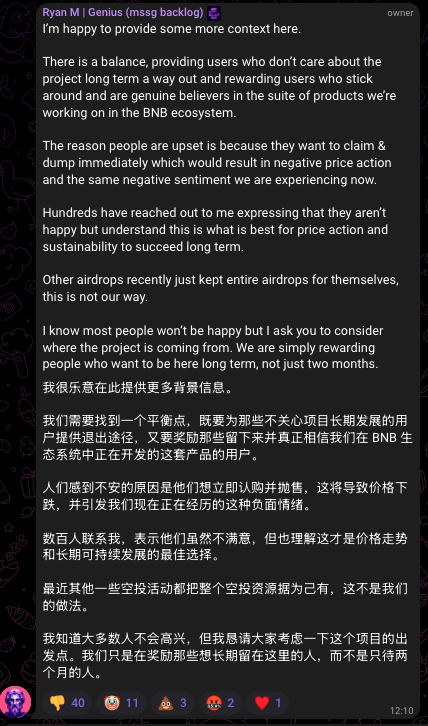
Genius’s official explanation of the airdrop rules
Even more interestingly, the official documentation’s airdrop section included a previous tweet from CZ (tweet content: “If you’ve ever been jealous of people who bought криптовалюта low and rode it through cycles, think about what they did at times like this.”)
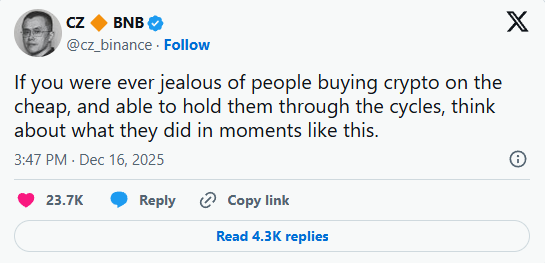
Such airdrop claim rules have ignited strong dissatisfaction within the airdrop farming community.
Genius: Backed by a “Tens of Millions of Dollars” Investment from YZi Labs and with CZ as an Advisor
Genius is a privacy-centric decentralized trading platform offering spot, perpetual contracts, and copy trading. It supports over 10 public chains including BNB Chain and Solana. Its goal is to become an on-chain alternative to Binance—bringing CEX-like speed, liquidity, and privacy experience on-chain while maintaining full self-custody and non-custodial (users hold private keys) principles.
As early as October 2024, Genius announced the completion of a $6 million seed funding round led by CMCC Global, with participation from institutions including Cadenza Ventures, AVA Labs, Arca, and Flow Traders.
Then, on January 13 of this year, Genius announced that YZi Labs had invested “tens of millions of dollars” and that CZ personally joined as an advisor.
A Textbook “Rug Pull” Process: From Maximizing Expectations to Rule Reversal
After the rules were announced, the community’s most direct feeling was “betrayal.” Community members complained that with CZ’s endorsement and a clear TGE timeline, they were willing to spend months and real money to boost trading volume. However, just before TGE, they were told they would be “cut by 70%”—“either take the small change and leave, or spend another year with the project team.”
If we break down the entire process, this resembles a “textbook-level rug pull process” involving continuous expectation adjustments and final rule changes on the eve of TGE.
Initially, a nearly indisputable narrative was presented: funding, advisors, airdrop ratio, and timeline were all laid out clearly, with smooth logic and clear expectations. Within this framework, continuously boosting volume, investing time and funds became the “rational choice” for airdrop farmers.
Subsequently, expectations began to be recalibrated. The airdrop ratio was lowered, and the distribution structure was adjusted. Such changes are not uncommon, and in the market environment at the time, they could even find some room for explanation. Many airdrop farmers chose to continue investing at this stage, essentially accepting the new expectation of “reduced but still existing returns.”
The real turning point came on the eve of TGE. After the claim rules were redesigned, the originally certain allocation turned into a multiple-choice question with constraints—either accept significant losses for liquidity or bear time costs for the full allocation. At this point, the gap between expectation and reality rapidly widened.
Cost Reassessment: Except for the Earliest Users, Recent “Volume Boosters” May Collectively Get “Rug Pulled”
According to feedback from several long-term participating “airdrop farming” users, the cost of earning GP points by boosting trading volume in recent weeks was roughly $0.025 to $0.045 per point.
However, for a project that has been live for several months and has even delayed fixing features like the roulette wheel, early users can hardly maintain high expectations for the opening price or the Season 2 airdrop. Under such expectations, most people are more likely to choose the TGE option that burns 70% and immediately claim the remaining 30%. This means the actual cost is directly amplified, translating to a real cost increase to $0.083 to $0.15 per point.
According to a compilation by user Nathan, if the total point amount is 200 million, for users who earned GP points by boosting trading volume in recent weeks, Genius’s opening FDV would need to be at least as high as $800 million to avoid getting “rug pulled.”
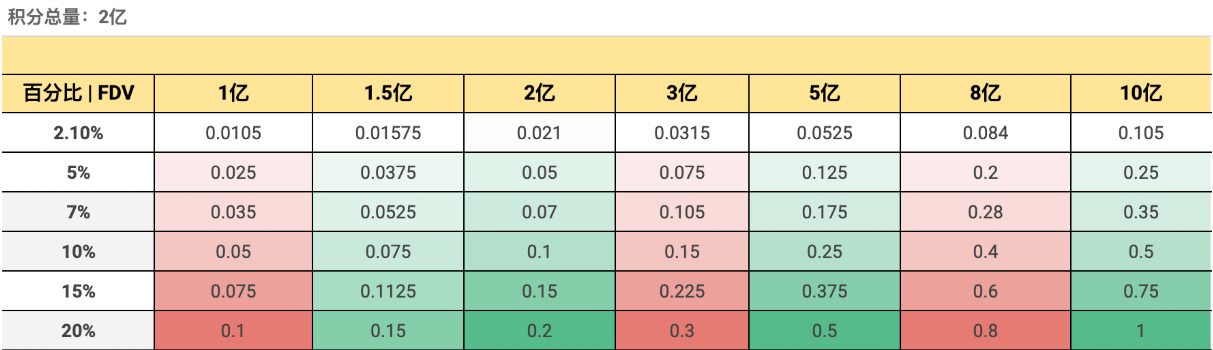
Relationship between airdrop ratio and FDV
Perhaps only the very earliest users won’t lose money.
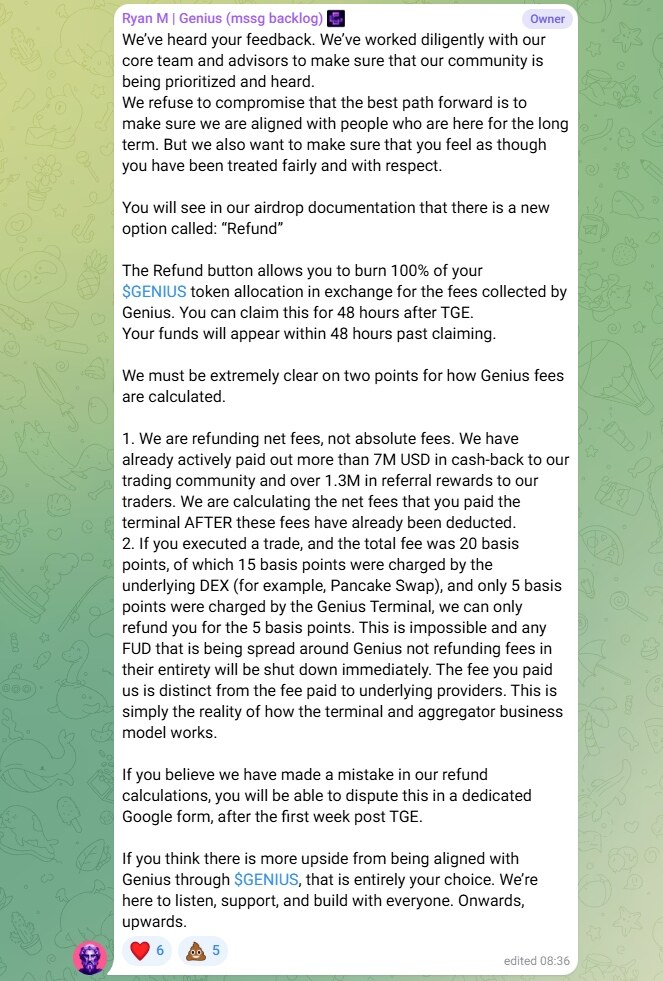
Team Response: Burning All Airdrop Токенs Can Refund All Fees Generated on Genius
Since announcing the airdrop rules, the Genius community has been filled with discontent. This morning, after listening to community feedback, the team posted in the official Telegram channel stating that an additional “refund” option will be added during the airdrop claim. Choosing a refund means burning 100% of the GENIUS token airdrop allocation in exchange for the fees collected by Genius. Users can apply for a refund within 48 hours after TGE ends, and the refund will be processed within 48 hours after the claim. Furthermore, regarding the calculation method for Genius fees, users need to understand the following two points:
- What is refunded is the net fee, not the absolute fee. Genius has already distributed over $7 million in cashback to the trading community and over $1.3 million in referral rewards to traders. The team calculates the net fee users actually paid to the trading terminal, which has already deducted the aforementioned rebates and rewards.
- If a user executes a trade with a total fee of 20 basis points, where 15 basis points are charged by the underlying decentralized exchange (e.g., PancakeSwap) and the Genius terminal only charges 5 basis points, Genius can only refund the user this 5 basis point fee. Genius cannot refund the user’s entire fee because the fee paid to Genius is different from the fee paid to the underlying provider.
Эта статья взята из интернета: Genius Airdrop Details: 70% Deduction for Immediate Claim at TGE, or Lock for One Year to Receive Full Amount
Related: Why is OpenAI Catching Up to Claude Code Instead?
Original Author: Maxwell Zeff, Wired Original Compilation: Peggy, BlockBeats Editor’s Note: In the current era of rapidly rising AI coding agents, OpenAI, which once led the generative AI wave with ChatGPT, has unexpectedly become a “chaser” in this critical race. In stark contrast, Anthropic, founded by former OpenAI members, has rapidly gained popularity in the developer community and enterprise market with Claude Code, becoming one of the key leaders in the AI programming tools field. Through interviews with OpenAI executives, engineers, and multiple developers, this article reveals the real story behind this competition: from the early splitting of the OpenAI Codex project and the shift of resources towards ChatGPT and multimodal models, to the internal team’s reintegration and accelerated launch of AI programming products, OpenAI is undergoing a transition from…
Related articles
































 Русский
  English
  繁體中文
繁體中文  简体中文
简体中文  日本語
日本語  Tiếng Việt
  العربية
  한국어
한국어  Bahasa Indonesia
  हिन्दी
  اردو
اردو