







DAT: The Evolution of Strategic Assets for Crypto Enterprises
The Development Logic of DAT
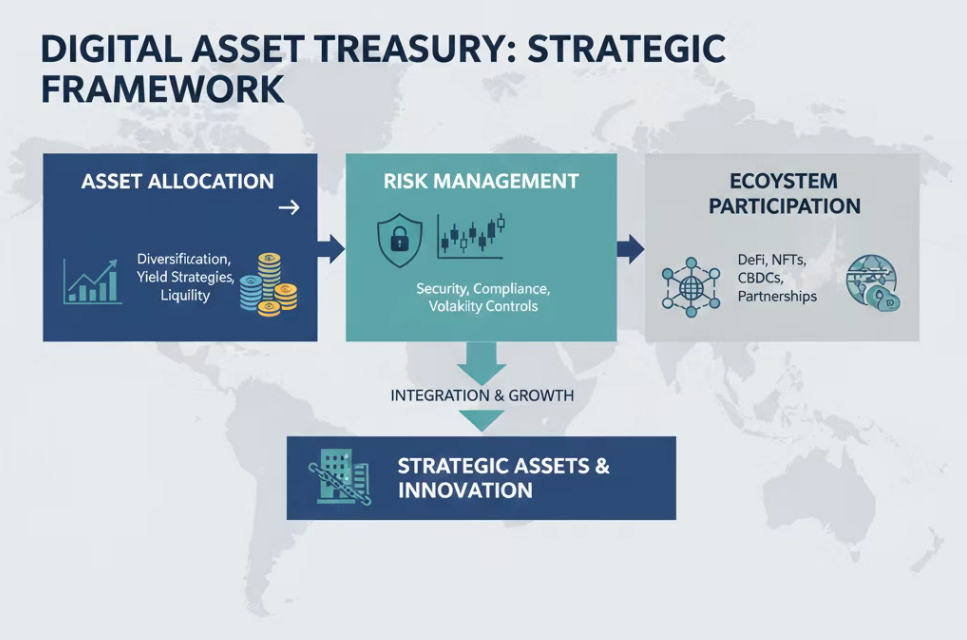
Typical DAT (Digital Assets and Technologies) companies usually raise funds through equity financing, bond issuance, or private placements, and allocate them to mainstream digital assets such as Bitcoin and Ethereum. Compared to the earlier strategy of primarily “hoarding” криптовалютаcurrencies, companies today place greater emphasis on the rationality of asset allocation, risk control systems, and strategic synergy with the blockchain ecosystem. On the one hand, digital assets provide companies with asset diversification and long-term value potential; on the other hand, companies must simultaneously establish cash flow management and risk constraint mechanisms to ensure operational sustainability. Furthermore, holding digital assets means that companies can participate in on-chain governance, staking, and lending, thereby gaining deeper participation and influence at the ecosystem level. This change indicates that DAT is gradually becoming part of a company’s strategic management system, rather than just an asset on paper.
Рынок Structure and Corporate Performance
Recent industry performance indicates that DAT (Digital Assets, Telecommunications, and Assets) companies are entering a phase of significant structural adjustment. Some companies are stabilizing market expectations and improving shareholder structures through share buybacks and asset portfolio optimization; others are gradually returning to a more robust operational path through strategic contraction or asset restructuring. Simultaneously, index providers like MSCI are re-evaluating their inclusion criteria for DAT-related companies, significantly increasing their focus on corporate information disclosure, governance structure, and operational stability. This signifies that the market is shifting away from reliance on asset size and short-term price performance, and instead assessing a company’s operational capabilities and risk management in complex environments.
It’s worth noting that some companies with Ethereum-related assets as their core holdings have demonstrated relative resilience during recent market adjustments. This doesn’t necessarily reflect the advantage of a single asset, but rather highlights the crucial role of asset diversification, business synergy, and governance capabilities in a company’s long-term performance. Overall, changes in market structure are driving the DAT industry’s transition from an “asset-driven” to a “capability-driven” model.
Corporate Behavior and Strategic Choices
By examining specific corporate behaviors, the strategic logic behind DAT can be understood more clearly.
At the asset level, companies no longer view digital assets as isolated investment targets, but rather incorporate them into their long-term capital allocation framework to support future business expansion and ecosystem development.
In terms of risk and stability, companies balance market expectations with internal stability through asset diversification, share buybacks, and operational restructuring. The significance of these operations lies not in short-term market feedback, but in providing the company with greater strategic maneuvering space.
At the ecosystem level, holding digital assets enables enterprises to participate in on-chain governance and ecosystem building, transforming financial behavior into real influence and voice. This shift from “asset management” to “ecosystem participation” is becoming an important path for DAT (Digital Asset Management) companies to build long-term competitiveness.
In summary, DAT has evolved from a simple token holding behavior into a comprehensive practice that integrates asset strategy, risk control, and ecosystem participation.
Industry Trends and Company Differentiation
Looking at a longer timeframe, the evaluation criteria for the DAT (Digital Assets, Telecommunications, and Assets) industry are undergoing a substantial change. Market focus is gradually shifting from asset size and short-term price fluctuations to a company’s operational capabilities, cash flow stability, and governance transparency. This change directly drives differentiation among companies: those with clear asset strategies, diversified asset allocations, and robust governance structures are more likely to establish an advantage in long-term competition; while companies that heavily rely on a single asset or market sentiment have significantly limited strategic flexibility and sustainability.
More importantly, some companies have begun to transform digital assets into sustainable strategic resources through a combination of business synergy, ecosystem participation, and asset management. This path does not rely on a single market stage but is built on long-term capability building, and it constitutes the core direction for the future development of the DAT industry.
in conclusion
The true value of DAT (Digital Asset Management) companies lies not in the amount of digital assets they hold, but in their ability to integrate these assets into a clear strategic framework, establish a robust operating system and governance structure, and develop sustainable participation capabilities at the ecosystem level. By observing changes in corporate behavior and industry structure, we can see that the DAT industry is moving towards a competitive phase centered on strategic capabilities and long-term execution.
Understanding DAT (Digital Assets and Technologies) essentially means understanding how digital assets have transformed from a financial instrument into a key resource within a company’s strategic framework. This transformation not only reshapes how companies manage their assets but also provides new benchmarks for investors and industry participants. In the future, companies that can achieve positive synergy between asset strategy, risk management, and ecosystem participation are more likely to establish a long-term, stable competitive advantage within the DAT framework.
Эта статья взята из интернета: DAT: The Evolution of Strategic Assets for Crypto Enterprises
Related: Game of Thrones: From Trump to CZ, why are billionaires betting on “prediction markets”?
Introduction: A Game of Probability In 2025, the prediction market experienced a truly explosive growth. Just this past third week of October, weekly trading volume surpassed $2 billion for the first time, setting a new record for the platform. The entire market was red-hot. This wasn’t a slow evolution; it was a sudden gold rush. Behind this outbreak are three powerful forces that cannot be ignored; when political leaders, Wall Street, and the crypto core all turn their attention and money to the same place, we must ask a question: what exactly do they see? The answer split into two completely different, yet equally captivating stories. Chapter 1: The Big Shots Enter, and the Rules of the Game Begin to Change Role 1: Trump’s “Truth Prediction”—Social Media Meets Financial Betting…
Related articles
































 Русский
  English
  繁體中文
繁體中文  简体中文
简体中文  日本語
日本語  Tiếng Việt
  العربية
  한국어
한국어  Bahasa Indonesia
  हिन्दी
  اردو
اردو