







AAOI rises over 10% against the trend; “New Stock God” Serenity claims it could double again
On June 4, Eastern Time, U.S. tech stocks experienced a sharp shock triggered by Broadcom’s earnings guidance, causing the first cracks in the AI valuation narrative.
Broadcom’s FY2Q results were not bad in themselves, with revenue of $22.2 billion and EPS of $2.44 both surpassing consensus estimates, and AI semiconductor revenue growing 143% year-over-year. However, its guidance for the current quarter failed to meet the market’s already elevated expectations. CEO Hock Tan also revealed during the conference call that Google, a major custom chip customer, might diversify its supply chain, and stated that chip business expansion would drag on gross margins. This combination punctured the core narrative that had supported AI trades over the past few months, triggering a sharp rotation of funds that day.
The Dow Jones Industrial Average surged 1.7% for the day, driven by traditional sectors, hitting a new all-time high. However, the Nasdaq Composite Index closed down 0.09%, and the Nasdaq 100 fell 0.5%. Within this “barbell-style” divergence, well-known AI and semiconductor stocks faced broad selling pressure: Broadcom -12.59%, Micron -7%, Marvell down 7% pre-market, AMD down over 4% pre-market.
Yet amidst this broad sell-off, AAOI charted an independent course, completely contrary to the sector’s sentiment.
Broadcom Guidance Pops the Expectation Bubble, First De-ratting for AI Sector
Broadcom became the trigger that crashed the AI trade this time, not because its performance was poor, but because its guidance failed to meet the market’s peak expectations.
Hock Tan disclosed in the earnings call that AI chip sales for this fiscal year (ending October) would reach $56 billion. While substantial, this figure fell short of market expectations. Combined with his comments on Google diversifying its supply chain, the market’s confidence in the valuation premium Broadcom had built over the past year on ASIC business began to waver. Broadcom hit an intraday low of $403, erasing approximately $300 billion in market value for the day, marking its largest single-day drop since January 2025.
Selling pressure then spread across the entire AI computing power chain. The memory sector also suffered, with Micron, considered a key supplier of HBM for AI accelerators and deeply tied to AI capital expenditure sentiment, falling about 7% in a single day. Other memory-related stocks like SanDisk and Western Digital also weakened. CrowdStrike, despite its own decent Q2 revenue guidance, was sold off indiscriminately amidst the overall cooling of AI trades.
Bridgewater Associates founder Ray Dalio joined the chorus of warnings on AI valuations that day, explicitly distinguishing “buying AI stocks” from “investing in AI technology” and warning that current valuations “might be becoming excessive.” This echoed recent consecutive warnings from JPMorgan Chase CEO Jamie Dimon and Apollo CEO Marc Rowan regarding AI capital expenditure and high valuations.
The direction of capital rotation is also a significant signal. Funds flowed into traditional economy stocks represented by the Dow Jones Industrial Average, rather than exiting risk assets entirely. This indicates the market is not engaging in systemic risk aversion but rather a structural reduction within the AI sector itself.
AAOI’s Independent Rally: Up Over 10% in a Day, Hitting Near-Term Highs Intraday
In this environment, AAOI recorded a single-day gain of 11.76%, climbing from around $171 to an intraday high of $209.64, closing at $202.89, creating a sharp contrast with the plunge of Broadcom and Micron.
AAOI has experienced several rounds of violent fluctuations recently. It hit an all-time high of $233.67 on May 13, fell 9% on May 29, rebounded 17.18%-18.81% on June 1, and staged another 11.76% independent rally on June 4. Over the past 30 days alone, there have been more than four trading days with intraday swings exceeding 10%. This volatility has become the norm within AAOI’s current valuation structure. Its trading volume on May 11 was 214% of its three-month average.
The medium-term catalysts driving AAOI’s strength are relatively clear. On May 8, the day after the company reported Q1 results, Rosenblatt raised its price target for AAOI from $140 to $220 in one go, reiterated a “Buy” rating, and named it a “Top Pick.” Around the same time, Raymond James raised its target from $72.50 to $160, while B. Riley raised its target to $129 but maintained a Neutral rating. Rosenblatt’s core logic includes the start of revenue contributions from 800G optical modules for Amazon; qualification with Oracle potentially opening a second revenue stream; and broad-based demand pull across the 100G/400G/800G and emerging 1.6T product generations.
The supporting data from the company’s fundamentals is also concrete. AAOI has disclosed cumulative orders for 800G and 1.6T optical modules exceeding $324 million. In April 2026, it received a $20.9 million grant from the Texas Semiconductor Innovation Fund to expand its factory in Sugar Land, Texas, to 210,000 square feet. It also announced an additional 388,000 square feet of capacity in Pearland, targeting a monthly production capacity of 700,000 units of 800G and 1.6T optical modules by 2027. Management memandus for optical module business revenue to reach an annualized run rate of $1.4 billion by Q3 2027.
However, AAOI’s fundamentals are not without blemishes. Its Q1 2026 results actually missed expectations, with a GAAP net loss of $14.3 million and revenue of $151.1 million, both slightly below consensus estimates. Its Q2 guidance places adjusted EPS between -$0.03 and +$0.03, near the breakeven point. When maintaining its Neutral rating, B. Riley noted that AAOI’s 800G volume production would be delayed to the second half of the year and highlighted execution risks tied to over-reliance on customer forecasts. Additionally, AAOI executives collectively sold approximately $12.6 million worth of stock in mid-May. While their remaining holdings remain substantial, the timing of the sales coincides with the stock’s high price level.
In short, AAOI is currently caught in a tension between a very strong narrative, relatively weak Q1 earnings, and significant valuation premiums. This is the fundamental reason behind its ability to generate high single-day price volatility.
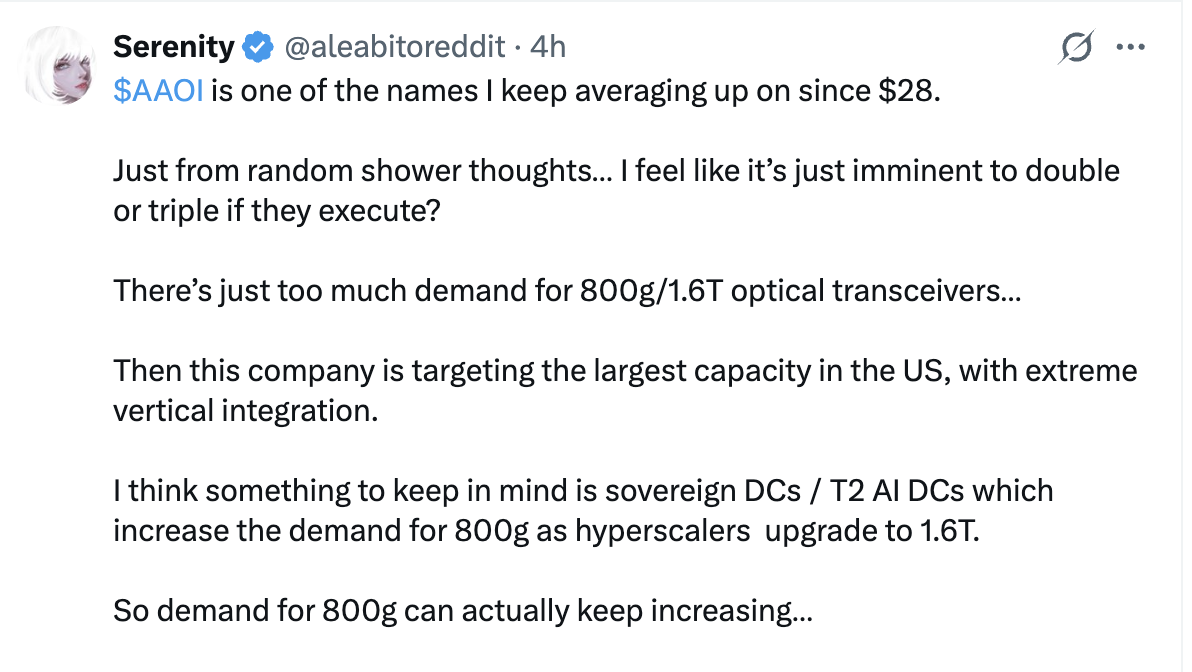
It’s worth noting that AAOI also has a potential additional driver. Serenity, known as the “new stock guru” in Chinese kripto circles, has posted multiple times expressing a bullish view on AAOI, stating it is his favorite optical communication exposure in the U.S. stock market. He started building his position from $28 and believes it could be the “next SanDisk.”
The Logic Behind the Reversal Rally: ‘Differentiated Pricing’ Within the AI Sector
AAOI’s contrarian strength on June 4 should not be interpreted as a counterexample to concerns about AI valuations, but rather as an early signal that the market is starting to implement “differentiated pricing” within the AI sector.
One of Serenity’s public judgments in April was that optical communication-related assets might show greater resilience than large-cap tech stocks: “Even if the S&P 500 falls another 20%, optical communications companies could still outperform.” This logic is rooted in supply chain scarcity. InP substrates, laser light sources, and 800G optical module production capacity are in a state of structural tightness in the short to medium term, with pricing power residing on the supply side rather than the demand side.
The sell-off triggered by Broadcom’s guidance was essentially a correction of the “custom ASIC + large customer concentration” narrative, not a correction of total AI infrastructure demand. From this perspective, optical communications plays, which are strongly linked to downstream computing power deployment, do not directly overlap narratively with Broadcom’s core issues (customer concentration, Google’s potential supply chain diversification).
However, risks also exist. AAOI’s current stock price and corresponding valuation already incorporate extremely high execution expectations. The market assumes it will achieve a $1.4 billion annualized optical module revenue run rate by Q3 2027 and maintain high gross margins. If Q2 or Q3 earnings reports fail to validate the 800G volume production schedule, or if customer concentration risks (Amazon, Microsoft) show any volatility, the valuation structure could experience sharp reversals. The actual Q1 earnings report was already weak, a crack currently masked by order growth and expansion narratives, but not completely eliminated.
For observers in the Chinese market, the notable aspect of AAOI’s contrarian rally is not the gain itself, but the directional choice of capital divergence within the market. When the overarching AI narrative begins to show its first crack, capital’s willingness to increase positions in AAOI at the moment of Broadcom’s decline suggests a specific judgment: Broadcom’s problem does not equal the problem for all AI capital expenditure. Optical communications is still recognized as a “physical bottleneck” narrative. Whether this judgment holds will ultimately depend on the actual earnings delivery over the next few quarters.
Artikel ini bersumber dari internet: AAOI rises over 10% against the trend; “New Stock God” Serenity claims it could double again
Related: IPO also seeking to beat OpenAI to market, Anthropic aims to seize AI ‘pricing power’
Anthropic filed first, pushing the competition with OpenAI from models, revenue, and valuation to the pricing test of the public market. Anthropic announced on Monday that it has confidentially submitted an application for a U.S. IPO, moving ahead of its competitor OpenAI in the listing process. In a statement, Anthropic said the filing “gives us the right to choose to go public once the SEC completes its review” and emphasized that “the proposed initial public offering will be subject to market conditions and other factors.” This is not yet a formal public offering. According to a Reuters report, Anthropic’s listing could potentially occur as early as this fall, but it did not disclose the offering size or terms. The significance of a confidential submission is that the company can advance…
相关文章
































 Bahasa Indonesia
  English
  繁體中文
繁體中文  简体中文
简体中文  日本語
日本語  Tiếng Việt
  العربية
  한국어
한국어  हिन्दी
  اردو
اردو  Русский