





Original Source: Wall Street News
Elon Musk’s three-year ambition for a super app has finally transitioned from concept to product.
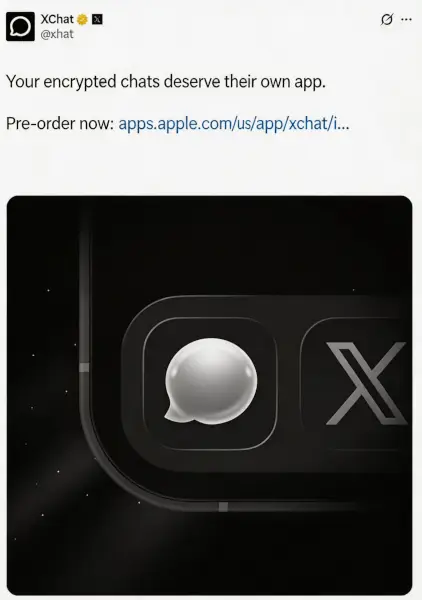
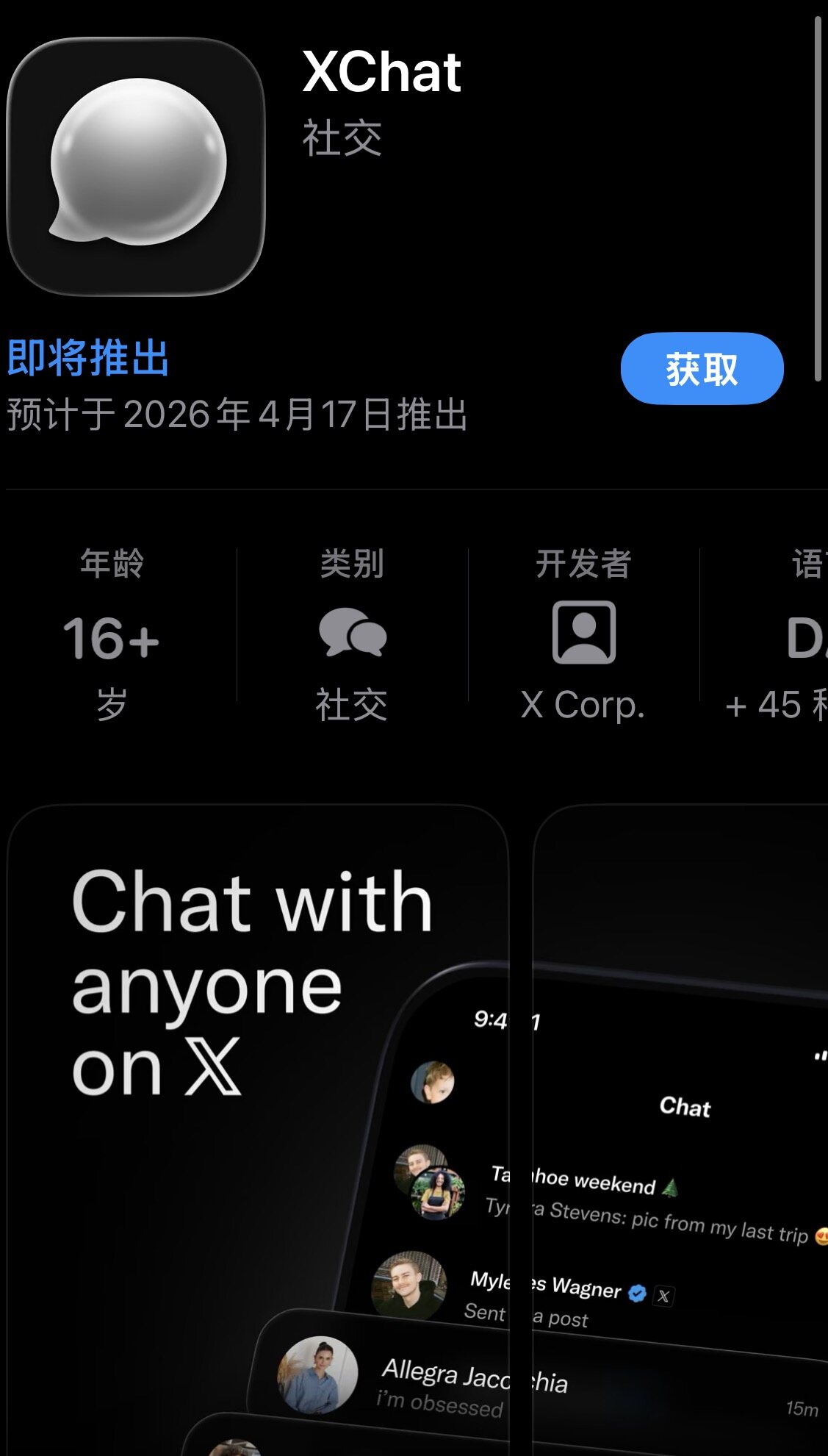
On April 11th, Musk’s X platform officially announced that the standalone encrypted communication application XChat will launch on the Apple App Store on April 17th, available for download to global users.
This application adopts an end-to-end encryption architecture, deeply integrates the Grok AI large language model, and does not require phone number registration—users can log in directly by binding their X account. It is widely seen by the outside world as a key step in Musk’s plan to build a “Western version of WeChat.”
Notably, XChat supports Simplified Chinese, and users in Mainland China can also reserve downloads via direct links on the App Store. The app requires devices to be upgraded to iOS/iPadOS 26.0 or above, with an Android version expected to follow.
Four-Year Obsession: From a Tweet to a Product
Musk’s public obsession with the “super app” model can be traced back to his $44 billion acquisition of Twitter in 2022. He has expressed high praise for the WeChat model on multiple public occasions—Chinese users can fulfill all their daily needs for socializing, payments, shopping, and travel booking within a single app, while Western users are forced to constantly switch between over a dozen fragmented applications.
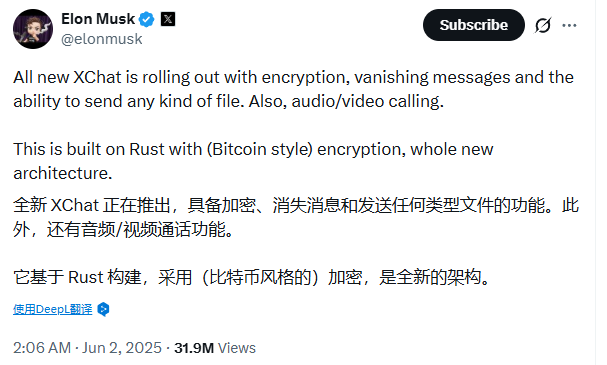
In June of last year, Musk announced the XChat development plan on the X platform, explicitly mentioning core features such as encryption, self-destructing messages, arbitrary format file transfer, and audio/video calls. He also disclosed that the app is built using the Rust programming language and employs a “Bitcoin-style encryption” architecture.
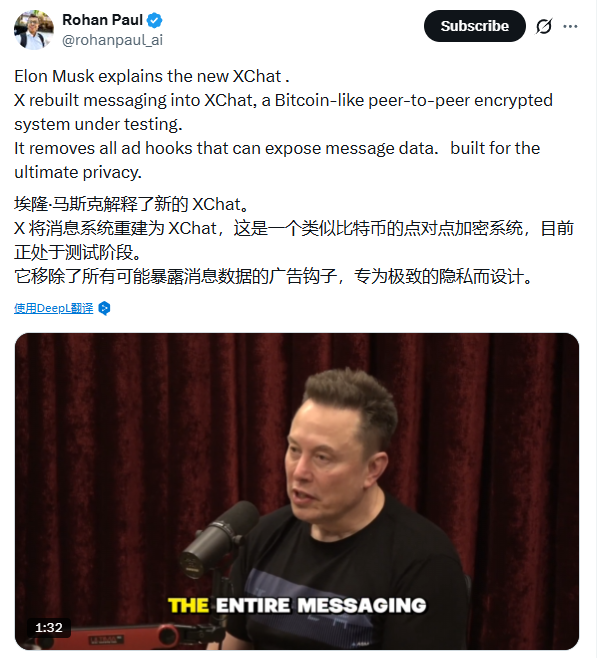
In a previous podcast, he further criticized mainstream communication tools like WhatsApp for having advertising “hooks,” arguing that having enough information to target ads essentially means having enough information to surveil users.
Technical Foundation: Can the Encryption Architecture Deliver on Privacy Promises?
The core technical selling point of XChat lies in the design logic of its encryption system. The app is developed in Rust—a programming language renowned for memory safety. Tech giants like Microsoft and Google have been migrating parts of their core system code to Rust to reduce the risk of security incidents caused by memory vulnerabilities.
At the encryption architecture level, Musk’s description of “Bitcoin-style encryption” points to an end-to-end asymmetric encryption system. Under this architecture, message encryption keys are stored only locally on the devices of the communicating parties, and the server cannot decipher any chat content. This means that even if X company’s servers are attacked or compelled to provide user data to external agencies, all they could hand over would be irrecoverable encrypted gibberish.
The company also promises no ads and no user data tracking. XChat also features privacy functions like self-destructing messages, two-way message recall, screenshot prevention, and screenshot alerts, surpassing the granularity of privacy protection features found in most mainstream communication apps.
Feature Matrix: A Communication Hub Attempting to Integrate Everything
In terms of feature coverage, XChat offers one-on-one chats and large group chats supporting up to 481 people. It supports text, images, and arbitrary format file transfers. Premium users can send files up to 4GB in size per transfer and enjoy high-definition audio and video calls.
Integration with the X platform ecosystem is another key design: users can directly drag and drop tweets or videos from X into chat dialog boxes, minimizing the friction of content sharing. This reveals Musk’s logic for building a “super app moat”—when social content, communication history, and media consumption all converge within the same ecosystem, user migration costs will significantly increase.
Furthermore, XChat deeply integrates the Grok large language model from xAI. Users can directly invoke Grok within the chat interface to process files, organize documents, plan trips, and answer questions. The chat box thus evolves from a simple text input tool into a private AI assistant with contextual understanding capabilities.
However, this is also the functional node where external privacy concerns about XChat are most concentrated—the boundaries of AI involvement in private conversations and the handling of related data currently lack sufficient public disclosure.
Competitive Landscape: Finding Space Between Three Giants
XChat is entering a fiercely competitive field. Signal has built near-religious levels of trust among privacy-focused communication users through its open-source, non-profit, and no-commercial-pressure positioning. WhatsApp boasts over 2 billion monthly active users, creating a network effect barrier that is extremely difficult to breach. Telegram highly overlaps with XChat in terms of feature richness and has already amassed a massive community user base.
XChat is currently betting on two differentiation paths: one is the deep integration of Grok AI, and the other is the synergistic effect of the X platform ecosystem. Whether the former can truly change user communication habits depends on the actual capability boundaries of Grok and users’ acceptance of AI participating in private conversations. The latter heavily relies on the user base size and activity level of the X platform itself—which is precisely the most persistently debated variable since Musk took over Twitter.
Musk’s longer-term blueprint is to gradually layer payment and service ecosystems on top of communication functions, ultimately realizing his envisioned Western version of the “Everything App.” However, the current form of XChat remains quite distant from this goal, resembling more of a combination product akin to a “cleaner Telegram plus Grok AI.” Whether it can maintain application fluidity while continuously expanding features, avoiding the trap of becoming a “bloated super app,” will be a key test for XChat’s ability to retain users in the long run.
Artikel ini bersumber dari internet: “Musk’s Version of WeChat” Is Really Here
Related: BitMart Partner Program Fully Upgraded, Co-building the Web3 Community Ecosystem
Competition in the cryptocurrency industry is entering a phase of higher intensity. The differences between platforms are no longer just about the products or activities themselves, but are increasingly reflected in how resources are allocated, how partnerships are established, and whether there is a capacity for sustained amplification. The relationship between platforms and their partners is also being redefined. The model previously dominated by short-term cooperation is being replaced by more long-term, structured collaborative approaches. The synergy efficiency around content, traffic, and users has become the new core variable. Recently, BitMart has systematically upgraded its BitMart Partner ecosystem. Compared to the previous approach focused primarily on single-point incentive cooperation, this adjustment places greater emphasis on restructuring the overall framework, including redesigning long-term cooperation, resource investment mechanisms, and partner growth paths.…
相关文章































 Bahasa Indonesia
  English
  繁體中文
繁體中文  简体中文
简体中文  日本語
日本語  Tiếng Việt
  العربية
  한국어
한국어  हिन्दी
  اردو
اردو  Русский