







Walsh to Shrink the Balance Sheet? BofA: It Might Just Be “All Bark, No Bite”
Original Source: Wall Street News
बाज़ार fears that new Fed Chair Kevin Warsh will aggressively shrink the balance sheet may be greatly overestimating what he can actually do.
Warsh was recently confirmed by the Senate as Fed Chair. Given his long-standing criticism of the Fed’s massive balance sheet, the market broadly expects him to rapidly push for significant quantitative tightening. However, in their latest research report released on May 18, BofA interest rate strategists Mark Cabana and Katie Craig were blunt: Whether in terms of scale or composition, Warsh’s ability to substantially alter the balance sheet is extremely limited, and the direct impact on the market is expected to be close to zero.
BofA’s core judgment is this: the Fed completed quantitative tightening normalization in Q4 2025. To further shrink the balance sheet, it would need to reduce one of its three major liabilities: currency, the Treasury General Account (TGA), or reserves. The only one Warsh can practically manipulate is reserves, and even then, the path is narrow and the pace slow.
On the asset side, the MBS reinvestment plan is already in place and fully priced in by the market. The effect of compressing the weighted average maturity (WAM) of Treasury holdings is neutralized by market mechanisms, trending towards zero. Neither constitutes a tightening of financial conditions, nor do they trigger signs of rate cuts.
The report also highlights a scenario not yet in mainstream focus: if the Standing Repo Facility (SRP) rate for banks is set equal to the Interest on Reserve Balances (IOR) rate, combined with reducing disclosure requirements to diminish the “stigma” effect, it could more effectively compress banks’ demand for reserves. This would create genuine operational space for balance sheet reduction. BofA believes this approach could have a more significant impact than traditional market expectations of Warsh’s tightening path.
The Scale Problem: Of Three Major Liabilities, Only Reserves are Mutable
After completing quantitative tightening normalization, the Fed’s balance sheet totaled approximately $6.78 trillion, driven by the liability side. The three core liabilities are: reserves (approx. $3.12 trillion, 46%), currency (approx. $2.46 trillion, 36%), and the TGA (approx. $807 billion, 12%).
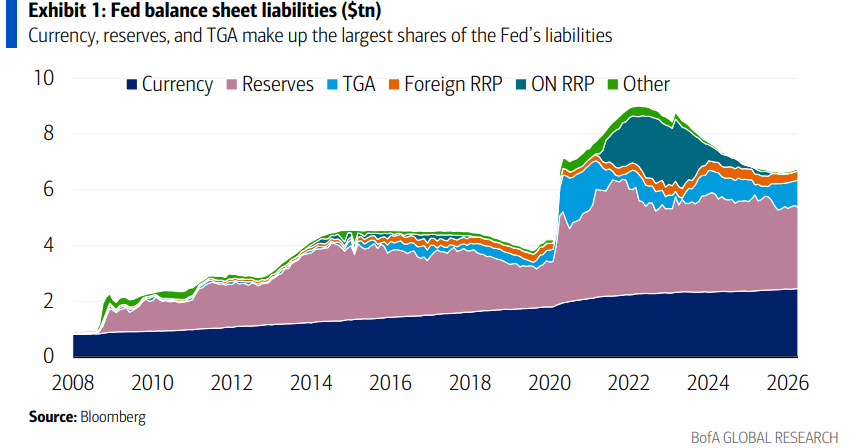
Currency is considered an “exogenous” liability by central banks, beyond the reach of policy tools. BofA notes that theoretically, it could be compressed by eliminating large denomination notes, but “this will not happen in the US.”
Regarding the TGA, the Treasury has clearly stated it has no intention of reducing it. BofA expects the TGA to rise to $900 billion by the end of Q2 2025 and further to $950 billion by the end of Q3 2025.
BofA believes marginal adjustments to the TGA through repo investments are possible but have minimal impact; adjustments via the Treasury Tax and Loan (TT&L) account are “highly unlikely.”
Reserves are the most realistic option for Warsh to shrink the balance sheet, but each path has its constraints.
A “bank-unfriendly” approach—such as setting reserve caps or tiered interest rates—would compress bank liquidity, weaken market-making and lending appetite, and consequently drag on the economy. BofA thinks Warsh is unlikely to adopt this.
A “bank-friendly” path involves relaxing regulations, allowing banks to pre-position collateral at the discount window to expand their High-Quality Liquid Assets (HQLA), thereby reducing their demand for reserves.
BofA estimates this path could ultimately lead to a $200 billion to $500 billion reduction in reserves. However, the process is slow and, because it doesn’t tighten financial conditions, wouldn’t justify rate cuts.
Composition Adjustment: Impact of WAM Compression is Neutralized to Zero
On the asset composition front, Warsh’s operational space is also constrained by mechanisms.
The Fed currently holds about $1.98 trillion in MBS. It is gradually reducing this by allowing maturing and prepaying MBS to roll off and reinvesting the proceeds into Treasury bills at a pace of $10 billion to $20 billion per month.
BofA considers the likelihood of selling MBS extremely low (barring a direct buyback by Fannie Mae or Freddie Mac, which is seen as a low-probability event). The current practice is already fully priced in by the market and does not constitute a new disruption.
Shortening the weighted average maturity (WAM) of Treasury holdings is another focal point.
Warsh might shift the reinvestment of maturing Treasury coupon proceeds from the current method of allocating proportionally across all maturities to concentrating them in shorter-dated securities (e.g., 2- to 3-year Treasuries) to accelerate WAM compression. However, the Fed’s reinvestments use an “add-on” auction format – meaning they participate in auctions to directly increase the supply of short-term Treasuries, rather than replacing longer-dated ones.
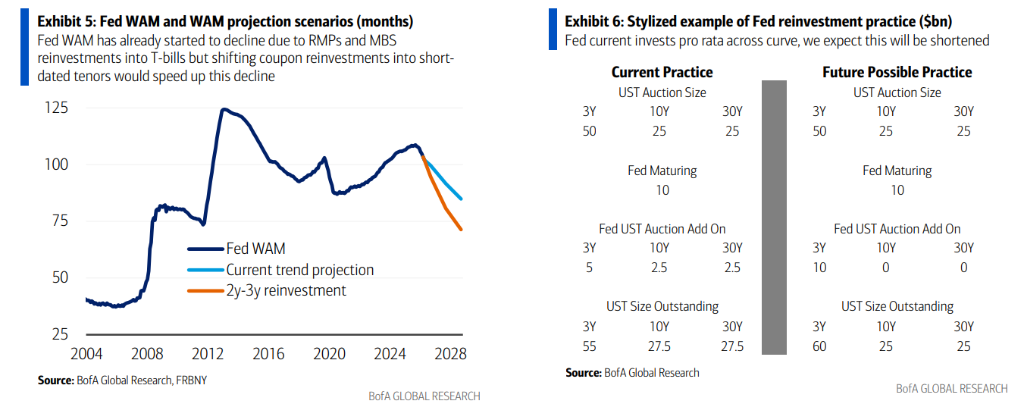
This raises a key question: Will the Treasury offset the Fed’s WAM shortening by adjusting its debt issuance structure? BofA’s answer is no. If this assessment holds true, the actual impact of Fed WAM compression on the overall Treasury market and financial conditions would be zero. Consequently, there would be no logic for Warsh to push for rate cuts on this basis.
Ample Reserves: Warsh Has Neither the Will Nor the Ability to Change
In BofA’s view, the crucial question regarding Warsh is: Will he support an “ample” or a “scarce” reserve regime? BofA’s answer is “ample,” with high certainty.
The advantage of an ample reserves regime is its ease of operation, ensuring sufficient funding in the banking system, curbing money market volatility, and supporting relatively accommodative financial conditions. The cost is simply a slightly larger balance sheet. In contrast, while a scarce regime could further shrink the balance sheet size, it brings tangible risks like increased money market volatility and liquidity pressures.
BofA provides two supporting points. First, President Trump places far greater importance on accommodative financial conditions than on the size of the Fed’s balance sheet, and Warsh is expected to remain open to his policy preferences.
Second, the Fed formally adopted the ample reserves regime in 2019, and the current leadership is unanimously in favor, with some officials holding quite strong views. BofA cites Fed Governor Waller’s remarks in a speech from February 2026: “You don’t want banks looking for money under the sofa cushions every night… That’s incredibly inefficient, and incredibly stupid.” BofA specifically highlighted the last word in its report.
BofA believes Warsh not only subjectively favors the ample regime but will also be objectively constrained by the consensus within the Fed.
The SRP=IOR Mechanism: A Potential True Game-Changer
BofA’s report proposes a mechanism reform that goes beyond the traditional framework, drawing from a previous statement by Dallas Fed President Lorie Logan: setting the bank Standing Repo Facility (SRP) rate equal to the Interest on Reserve Balances (IOR) rate.
The specific design would allow banks to pledge Treasuries or agency debt to the Fed in exchange for cash at a rate equal to their deposit rate, available around the clock. The mechanism would operate similarly to the discount window but be open 24/7 with no discrete operating times.
Because the rate is competitive and carries no premium, banks would be more willing to use it, reducing their need to hold precautionary reserve buffers. This would create operational space for the Fed to shrink its balance sheet. The Bank of England currently uses a similar mechanism.
To further amplify the effect, BofA suggests reforming the disclosure system, specifically by eliminating the weekly report that currently discloses the distribution of reserves by region. Market participants use this report to track institutions potentially facing liquidity pressure. Eliminating it could effectively reduce the “stigma” effect associated with using the SRP tool, making banks more willing to use it when needed rather than hoarding excess reserves.
The report also notes that the bank SRP and dealer SRP should be differentiated: the dealer SRP rate should be about 5 to 10 basis points higher than the bank SRP to ensure banks are incentivized to lend funds in the repo market while preserving room for free market pricing.
BofA concludes that the “bank SRP = IOR” mechanism, combined with report system reforms, could substantially reduce bank reserve demand, thereby providing a truly feasible path for Warsh to compress the balance sheet. This approach is not yet part of mainstream market discussion, but BofA expects it will eventually attract widespread attention—with an impact potentially far exceeding the market’s current conventional estimates of Warsh’s ability to shrink the balance sheet.
यह लेख इंटरनेट से लिया गया है: Walsh to Shrink the Balance Sheet? BofA: It Might Just Be “All Bark, No Bite”
Powell is likely to hold what could be his final formal news conference as Fed Chair on Wednesday local time (early Thursday Beijing time) — potentially marking the end of an era of regular question-and-answer sessions with the press as the central bank’s top official. Investors and economic observers closely watch these press conferences. Supporters of having the Fed Chair regularly appear before the media argue that it allows the central bank to shape the narrative around its interest rate decisions and helps the market digest its policies. However, some critics, including Kevin Warsh, Trump’s nominee to succeed Powell as Fed Chair, believe Fed officials communicate too much. Warsh, who is likely to be confirmed before the Fed’s next policy meeting in mid-June, has hinted he might completely stop holding…
相关文章
































 हिन्दी
  English
  繁體中文
繁體中文  简体中文
简体中文  日本語
日本語  Tiếng Việt
  العربية
  한국어
한국어  Bahasa Indonesia
  اردو
اردو  Русский